
Skip to content
The Encyclopedia of Horology

Clock · Mantel clock

Regency-style ebonized and polychrome mantel clock

Partially verified

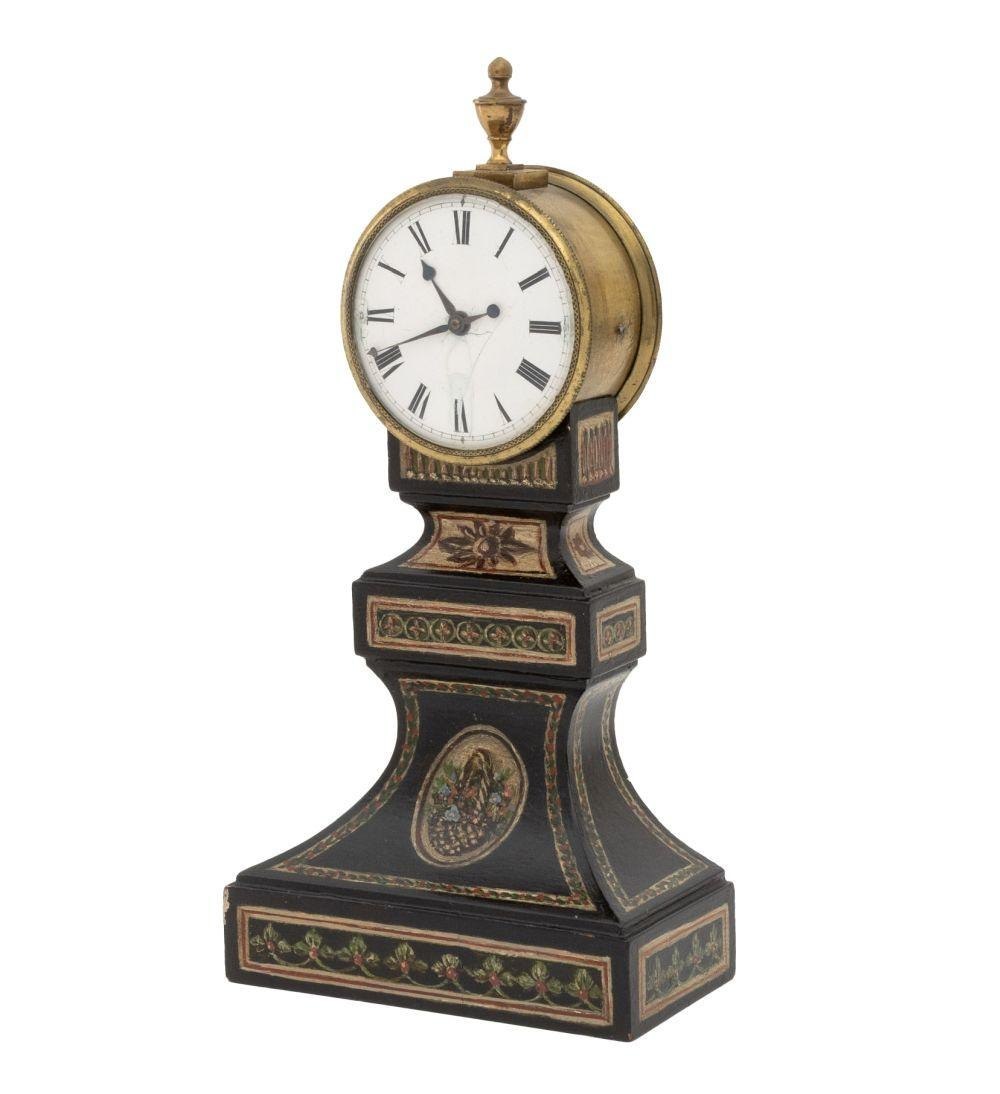
This Regency-era mantel clock is constructed with an ebonized finish featuring intricate polychrome painted floral and decorative motifs. The piece is designed in the manner of Thomas Weeks, a prominent clockmaker and merchant active in early 19th-century London. The clock features a prominent brass casing housing a porcelain clock face, which is adorned with black Roman numerals. The entire assembly sits upon an architectural pedestal base decorated with painted floral garlands and a central oval medallion. The physical dimensions of the timepiece are 9.75 inches in height, 5 inches in width, and 2.5 inches in depth. The internal clock mechanism and the underside of the unit are marked with the numeral "1859". While the porcelain clock face shows signs of prior repair and the ebonized finish exhibits minor paint loss, the clock remains a distinct example of period decorative horology.

Full view of the Regency-style mantel clock, featuring an ebonized base with polychrome floral decoration and a brass-cased dial.
Full view of the Regency-style mantel clock, featuring an ebonized base with polychrome floral decoration and a brass-cased dial. — Auctions at Showplace. Rights pending — permission not yet requested. Original source

Catalogue identity

Source
orbiscollectibles.com
Category
Clock · Mantel clock
Maker / attribution
Thomas Weeks (attributed)
Reference
Not recorded
Catalogue / lot identifier
Source URL identifies the listing
Source-reported date
early 19th century
Source-reported place
England
Source-reported serial
1859

Source-reported attribution and specifications are not independent authentication. A listing does not establish present ownership, current display, availability or permission to reproduce.

Object description

Construction and Design

The clock is built upon an architectural pedestal base, which is finished in ebonized wood. The surface is ornamented with intricate polychrome painted floral motifs and decorative garlands. A central oval medallion serves as a focal point on the front of the pedestal base.

Mounted atop the pedestal is a prominent, circular brass casing. This casing contains a porcelain clock face marked with black Roman numerals, conforming to the Regency aesthetic. The overall form is completed by a decorative finial positioned at the very top of the brass assembly.

Evidence for this section
  • “constructed with an ebonized finish featuring intricate polychrome painted floral and decorative motifs”
  • “architectural pedestal base decorated with painted floral garlands and a central oval medallion”
  • “prominent brass casing housing a porcelain clock face, which is adorned with black Roman numerals”

Attribution and Markings

The clock is attributed to the manner of Thomas Weeks, a clockmaker and merchant known for his operations in London during the early 19th century.

Internal components, specifically the clock mechanism and the underside of the unit, bear the numeric marking '1859'. This identifier is consistently applied to the observed parts of the device, although its specific role in the maker's cataloguing system is not defined.

Evidence for this section
  • “designed in the manner of Thomas Weeks, a prominent clockmaker and merchant active in early 19th-century London”
  • “The internal clock mechanism and the underside of the unit are marked with the numeral "1859”

Condition Report

The condition of the timepiece presents specific signs of its age and usage. The porcelain face exhibits indications of past restoration, as noted in the auction description.

Furthermore, the exterior ebonized finish displays localized areas of paint loss. These observations suggest historical wear consistent with a piece from the early 19th century, while the mechanism remains an integral part of the assembly.

Evidence for this section
  • “porcelain clock face shows signs of prior repair”
  • “ebonized finish exhibits minor paint loss”

Open research questions

  • What is the specific nature of the '1859' mark, and does it correspond to any known production numbering for Weeks or his workshop?
  • Are there similar extant examples by Thomas Weeks that confirm the attribution of this specific architectural base design?

Source evidence

Recorded claims and source quotations for Regency-style ebonized and polychrome mantel clock
FieldSource-reported valueSource quotation
MakerThomas Weeks“designed in the manner of Thomas Weeks”
Dimensions9.75 inches x 5 inches x 2.5 inches“9.75 inches in height, 5 inches in width, and 2.5 inches in depth.”
Marks1859“internal clock mechanism and the underside of the unit are marked with the numeral "1859".”
DecorationsFloral garlands and oval medallion“decorated with painted floral garlands and a central oval medallion.”
ConditionRepaired dial and paint loss“porcelain clock face shows signs of prior repair and the ebonized finish exhibits minor paint loss”

Visible details

  • Porcelain dial with hairline fractures visible
  • Polychrome painted floral motifs on ebonized wood base
  • Central oval medallion on pedestal
  • Brass casing with top finial

Research qualifications

  • The attribution to Thomas Weeks is qualified as 'in the manner of'
  • The exact significance of the numeral '1859' is not specified as a serial or date

Photograph identity and source facts were screened before import; rights clearance remains pending.

Terms in this record

Glossary explanations for terms named in this object’s record.