
Skip to content
The Encyclopedia of Horology

Clock · Watchman's recording clock

Recording Clock - W. Eppner

Partially verified

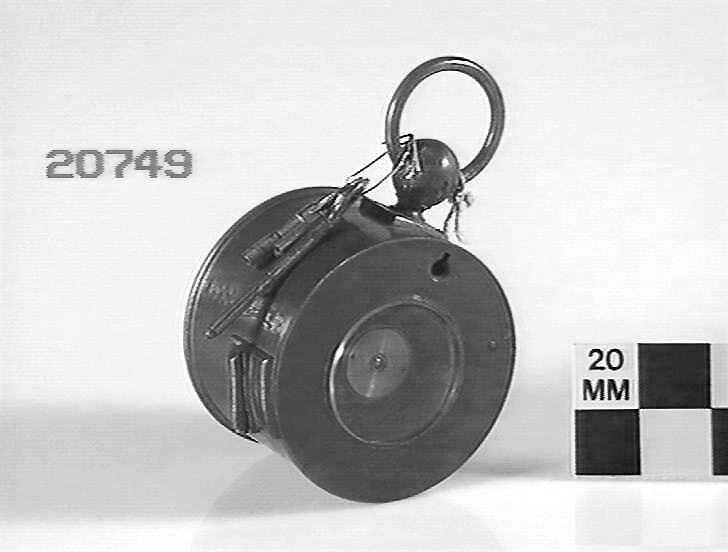
This portable recording clock, measuring 5.5 cm in height and 8 cm in outside diameter, was produced in the late 19th century by Wilhelm Eppner of Chaux-de-Fonds, Switzerland. The device is a spring-wound mechanism designed to monitor a watchman's rounds. The operator carried the clock to specific locations where keys were chained, using them to record the time of each inspection on the internal mechanism. The instrument is housed in a brass cylinder featuring a circular glass aperture, with a dial displaying Arabic numerals. The object includes three keys: two are handmade, while the third is cast and attributed to a later date. The dial bears the inscription 'Eppner Revete S.G.D.G.', and the external case is stamped 'Lutz & Schulz, Buenos Ayres', indicating distribution in Argentina. The clock was acquired by Museums Victoria through a loan and subsequent bequest from Mr. John Askew in 1938.

The W. Eppner recording clock showing the brass cylindrical housing, suspension ring, and key aperture.
The W. Eppner recording clock showing the brass cylindrical housing, suspension ring, and key aperture. — Museums Victoria. Rights pending — permission not yet requested. Original source

Catalogue identity

Source
collections.museumsvictoria.com.au
Category
Clock · Watchman's recording clock
Maker / attribution
Wilhelm Eppner
Reference
Not recorded
Catalogue / lot identifier
ST 20749
Source-reported date
circa 1890
Source-reported place
Switzerland

Source-reported attribution and specifications are not independent authentication. A listing does not establish present ownership, current display, availability or permission to reproduce.

Object description

Construction and Design

The recording clock consists of a cylindrical brass casing designed for portability. The device features a circular glass aperture that provides a view of the internal dial. The dial itself is calibrated with Arabic numerals to facilitate the reading of time during the watchman's inspection rounds.

Its physical dimensions are 5.5 cm in height and 8 cm in outside diameter. The object is fitted with a suspension ring, allowing for ease of carry during professional use.

Evidence for this section
  • “Consists of a brass cylinder with circular glass aperture.”
  • “Dial has arabic numerals.”
  • “Spring wound.”
  • “5.5 cm (Height), 8 cm (Outside Diameter)”

Signatures and Distribution

The object displays two primary inscriptions that identify its manufacturing and distribution history. The dial is marked with 'Eppner Revete S.G.D.G.', a reference to the maker, Wilhelm Eppner of Chaux-de-Fonds, Switzerland, and the patent status of the design. The acronym S.G.D.G. indicates a French patent designation.

The external brass case is stamped with the name 'Lutz & Schulz, Buenos Ayres'. This confirms that the instrument was handled by the distributor Lutz & Schulz, located in Argentina,

Evidence for this section
  • “Dial marked 'Eppner Revete S.G.D.G.'”
  • “Outside case is stamped 'Lutz & Schulz, Buenos Ayres'”
  • “Association: type: Maker, name: Wilhelm Eppner, date: circa 1890, locality: Chaux de Fonds, country: Switzerland”

Function and Components

The clock was specifically utilized as a recording device for security personnel. The watchman carried the clock to designated sites where keys were chained; the act of inserting the key into the clock served to record the specific time of that inspection. The set includes three keys associated with the clock's operation.

Regarding the keys, two are documented as handmade items, while the third key is noted as a cast, later addition. The clock was formally acquired by the museum via a bequest from John Askew in 1938.

Evidence for this section
  • “The watchman carried the clock to places where the key was chained, and the key used to record the time of inspection on the clock.”
  • “Clock has 3 keys. 3 are handmade and the third is cast and of a later date.”
  • “Loan & Subsequent Bequest from Mr John Askew, 25 Nov 1938”

Open research questions

  • What is the specific nature of the S.G.D.G. patent referenced on the dial?
  • What was the extent of the business relationship between W. Eppner and Lutz & Schulz?

Source evidence

Recorded claims and source quotations for Recording Clock - W. Eppner
FieldSource-reported valueSource quotation
MakerWilhelm Eppner“Maker, name: Wilhelm Eppner”
OriginChaux de Fonds, Switzerland“locality: Chaux de Fonds, country: Switzerland”
Dimensions5.5 cm height, 8 cm diameter“5.5 cm (Height), 8 cm (Outside Diameter)”
Dial InscriptionEppner Revete S.G.D.G.“Dial marked 'Eppner Revete S.G.D.G.'”
Case InscriptionLutz & Schulz, Buenos Ayres“Outside case is stamped 'Lutz & Schulz, Buenos Ayres'”
ProvenanceJohn Askew bequest 1938“Loan & Subsequent Bequest from Mr John Askew, 25 Nov 1938”

Visible details

  • Cylindrical brass case construction
  • Circular glass display aperture
  • Arabic numerals on the dial
  • Integrated suspension ring at the top

Research qualifications

  • The third key is identified as a later cast replacement
  • Distributor association with Buenos Aires is specific to the stamping on the case

Photograph identity and source facts were screened before import; rights clearance remains pending.

Consulted source

Recording Clock - W. Eppner, Switzerland, Late 19th Century

Reviewed 2026-10-26 · Record 949005a048

Terms in this record

Glossary explanations for terms named in this object’s record.