
Skip to content
The Encyclopedia of Horology

Tool · French quadrant

Quadrans Vetus (Old Quadrant)

Partially verified

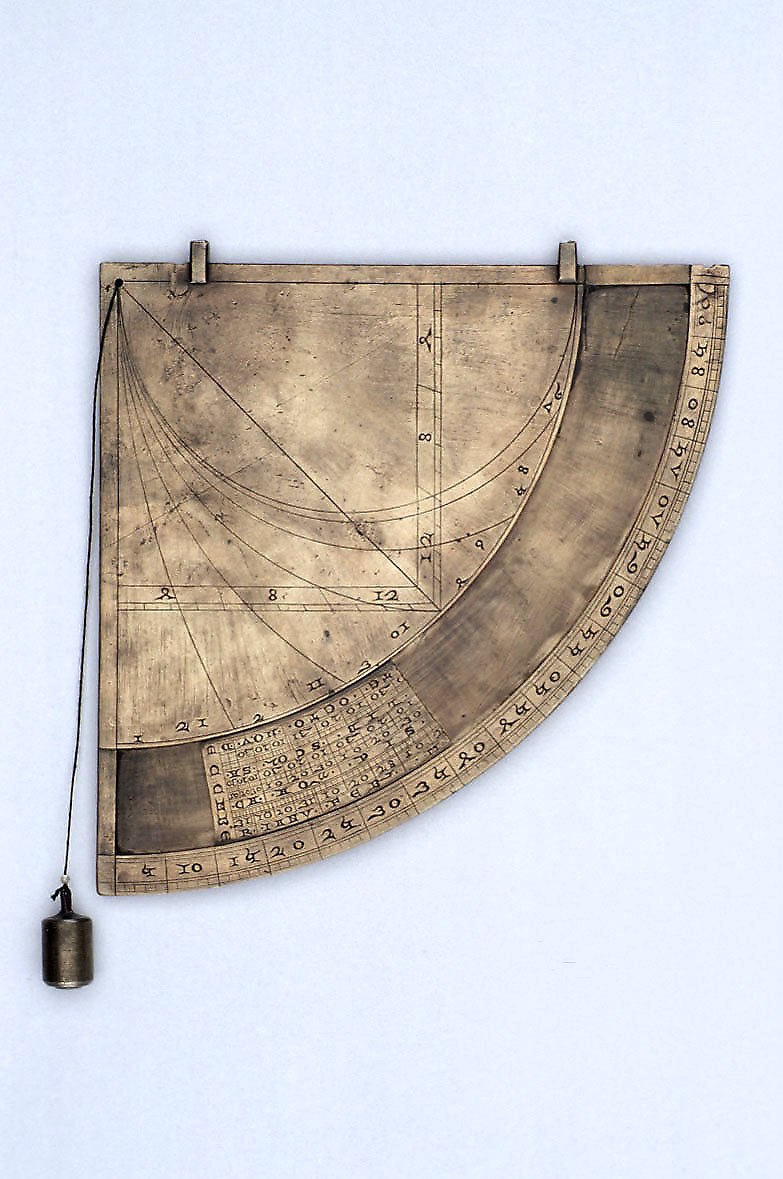
This brass instrument is an example of a rare quadrans vetus, or old quadrant, originating from France and dating to circa 1300. It measures 158 mm in radius and features a design that allows for adjustment to any latitude through a sliding, curved plate that moves within a slot above the degree arc. The instrument displays complex astronomical scales, including unequal hour lines, a shadow square, a calendar scale, and a zodiac scale. The reverse side accommodates a lunar volvelle, which was recently reunited with the quadrant after previously being separated. All inscriptions are executed in Gothic lettering. The device includes a plumb bob with a pearl bead and a ring for suspension. This quadrant, which was once part of the Lewis Evans collection, is currently held by the Museum of the History of Science in Oxford, inventory number 52020.

The obverse of the brass quadrant showing the shadow square, unequal hour lines, and the adjustable sliding plate.
The obverse of the brass quadrant showing the shadow square, unequal hour lines, and the adjustable sliding plate. — Museum of the History of Science, Oxford. Rights pending — permission not yet requested. Original source

Catalogue identity

Source
www.mhs.ox.ac.uk
Category
Tool · French quadrant
Maker / attribution
Not established
Reference
Not recorded
Catalogue / lot identifier
52020
Source-reported date
circa 1300
Source-reported place
France

Source-reported attribution and specifications are not independent authentication. A listing does not establish present ownership, current display, availability or permission to reproduce.

Object description

Physical Configuration

The instrument is a brass quadrant with a radius of 158 mm. It includes a ring for suspension at the apex. On the primary side, a shadow square is present, marked from 0 to 12. Superimposed over this are unequal hour lines numbered 1 to 6 and 7 to 12, the latter engraved in mirror script. A sliding, curved plate is positioned within a slot above the degree arc, which is calibrated from 0 to 90 degrees.

A plumb bob is attached to the instrument, featuring a small pearl bead. The reverse side of the object is designed to hold a lunar volvelle. Centrally, the volvelle is decorated with an eight-leaf floral motif. This side also contains circular engravings representing a calendar scale and a zodiac scale, both of which are divided to correspond to the days of the year.

Evidence for this section
  • “Brass; 158 mm in radius”
  • “On one side of the instrument is a shadow square marked [0] to 12”
  • “The limb of the plate is engraved with a scale of degrees from [0] to 90”
  • “The lunar volvelle has a decoration of an eight-leaf flower in the centre.”

Function and Adjustment

The instrument is categorized as a quadrans vetus. The sliding plate is engineered to move within a slot, allowing the user to adjust the instrument for different latitudes. The sliding plate is engraved with various temporal and astrological data, including the names and days of the months and the names of the zodiacal signs.

The lunar volvelle provides tracking for the lunar month, with days numbered 1 to 29.5. The calendar scale is divided into months of 30 or 31 days, and the zodiac scale is divided accordingly, with markings every 10 units.

Evidence for this section
  • “The presence of the sliding, curved plate moving in a slot above the degree arc makes the instrument adjustable for use in any latitude”
  • “A sliding curved plate, only half of which remains, is engraved with the names and days of the months and the names of the zodiacal signs.”

History and Provenance

The quadrant was formerly part of the Lewis Evans collection, now housed within the Museum of the History of Science in Oxford. The instrument had historically been separated from its lunar volvelle, but the two components have been recently reunited.

The instrument remains unsigned. Its construction and the style of its inscriptions are attributed to France, with a date of origin around 1300.

Evidence for this section
  • “The volvelle on the back had become separated from the quadrant itself, which was preserved in the Lewis Evans collection”
  • “The two pieces were only recently reunited.”
  • “Unsigned”

Open research questions

  • What is the specific method by which the sliding plate adjusts the instrument for variable latitudes?
  • Does the mirror script used on the hour lines serve a specific optical function when using the plumb bob?

Source evidence

Recorded claims and source quotations for Quadrans Vetus (Old Quadrant)
FieldSource-reported valueSource quotation
Inventory Number52020“Inventory number: 52020”
MaterialBrass“Brass; 158 mm in radius”
Radius158 mm“158 mm in radius”
ScriptGothic“All the inscriptions are in Gothic lettering.”
OriginFrench“circa 1300; French”
TypeQuadrans vetus“This instrument is an example of the very rare quadrans vetus , or old quadrant .”

Visible details

  • Plumb bob suspended from the upper corner with a bead
  • Gothic lettering engraved throughout the scales
  • Shadow square marked 0 to 12 visible on the primary face
  • Sliding plate mechanism visible in the arched slot

Research qualifications

  • The sliding curved plate is only half-preserved
  • The lunar volvelle on the reverse side is partially missing

Photograph identity and source facts were screened before import; rights clearance remains pending.

Consulted source

Quadrant

Reviewed 2026-10-26 · Record a4bca2bd5d

Terms in this record

Glossary explanations for terms named in this object’s record.