
Skip to content
The Encyclopedia of Horology

Tool · English polyhedral dial

Polyhedral Dial

Partially verified

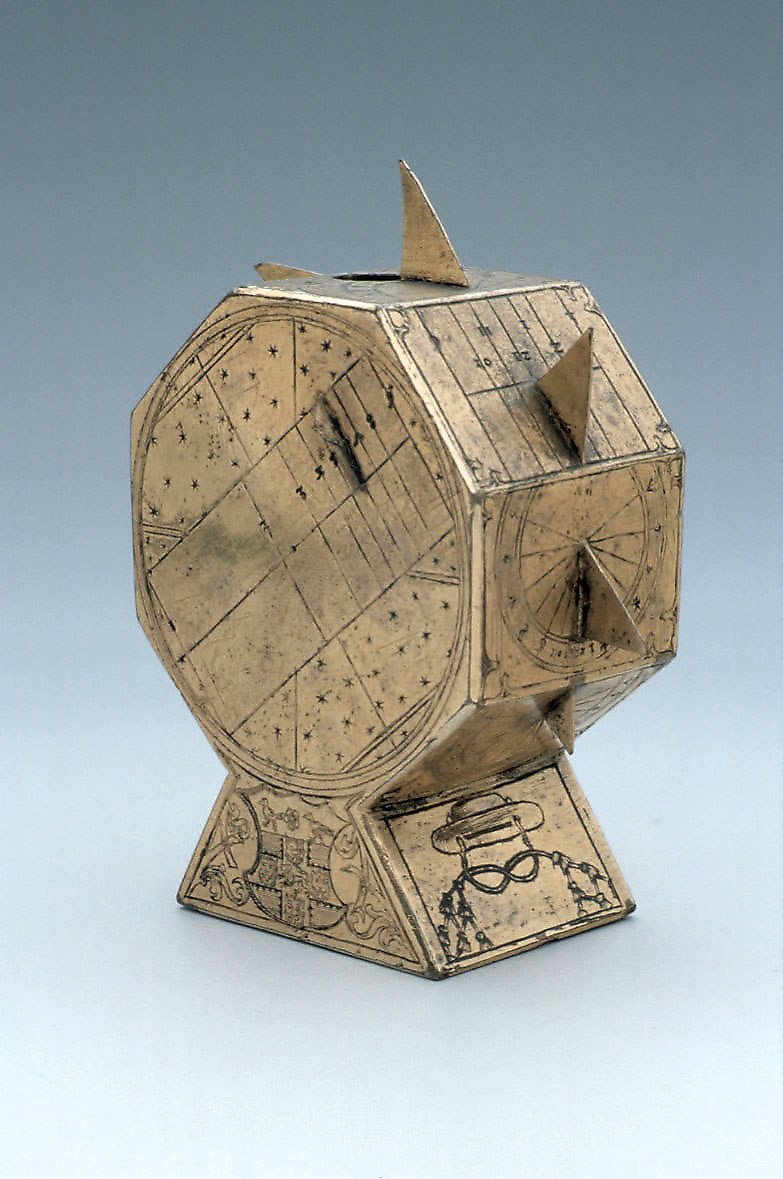
This polyhedral sundial, standing 100 mm tall and constructed from gilt brass, is a complex timekeeping instrument designed with nine distinct dial faces. Based on an octagonal geometry, it incorporates an array of horizontal, polar, equinoctial, and vertical dials, all configured for a latitude of 52 degrees. The top surface features a horizontal dial and a recess intended for a compass, though the magnetic needle and cover are missing. The structure is supported by a four-sided base adorned with armorial engravings associated with Cardinal Wolsey, including the arms of York Minster and a cardinal's hat. While unsigned, the instrument is attributed to the German mathematician Nicolaus Kratzer, who served as astronomer to Henry VIII and was associated with Corpus Christi College, Oxford. The object is held in the collection of the Museum of the History of Science, Oxford.

A polyhedral gilt brass sundial featuring multiple faces and heraldic engravings on the base, attributed to Nicolaus Kratzer, circa 1525.
A polyhedral gilt brass sundial featuring multiple faces and heraldic engravings on the base, attributed to Nicolaus Kratzer, circa 1525. — Museum of the History of Science, Oxford. Rights pending — permission not yet requested. Original source

Catalogue identity

Source
www.mhs.ox.ac.uk
Category
Tool · English polyhedral dial
Maker / attribution
Attributed to Nicolaus Kratzer
Reference
Not recorded
Catalogue / lot identifier
54054
Source-reported date
circa 1525
Source-reported place
England

Source-reported attribution and specifications are not independent authentication. A listing does not establish present ownership, current display, availability or permission to reproduce.

Object description

Geometry and Dial Configuration

The instrument derives its complex form from an octagonal solid, which serves as a platform for nine individual sundials. The faces are oriented to allow for timekeeping on multiple planes as they receive sunlight. The top surface hosts a horizontal dial labeled for hours 6 to 12 to 6. Integrated into this section is a central circular recess, originally designed to accommodate a magnetic compass for orientation.

The remaining faces are dedicated to specific astronomical representations. These include polar dials set at right angles to the equatorial plane, as well as superior and inferior equinoctial dials positioned parallel to the equatorial plane. Vertical north and south dials are situated on the rectangular sides, while the two large octagonal faces feature elaborate projections of the celestial sphere, detailing the horizon, tropics, and various circles, finished with dotted star markings.

Evidence for this section
  • “accommodates nine sundials”
  • “On the top face is a horizontal dial for hours 6 to12 to 6”
  • “Each octagonal face has a projection of the celestial sphere with the horizon, pole, equator, tropics, arctic and antarctic circles marked.”

Material and Armorial Decoration

The instrument is fabricated from gilt brass and stands at a height of 100 mm. The base is structured as a four-sided pedestal that provides both physical stability and a medium for heraldic display. The engravings on the base serve to identify the patron for whom the instrument was manufactured.

The base features the coat of arms belonging to Cardinal Wolsey and the arms of York Minster. Furthermore, two sides of the base are decorated with engravings of a cardinal's hat. These features provide a direct link to the instrument's original ownership and the high-ranking status of the patron in early 16th-century England.

Evidence for this section
  • “Gilt brass”
  • “the four-sided base has Wolsey's arms, the arms of York Minster, and (on two sides) a cardinal's hat.”

Attribution and Historical Context

Although the object bears no signature, historical scholarship attributes its creation to the German mathematician Nicolaus Kratzer. Kratzer moved to England around 1518, where he eventually took the position of astronomer to Henry VIII. His academic standing was further solidified through his role at Corpus Christi College, Oxford, and his lectureship founded by Cardinal Wolsey.

The reliance on complex polyhedral geometry illustrates the advanced level of instrument design practiced by Kratzer during his time in England in the early 16th century.

Evidence for this section
  • “it was probably made by the German mathematician Nicolaus Kratzer”
  • “Each dial is arranged for 52 degrees north”

Open research questions

  • What is the specific composition of the brass alloy used in this instrument?
  • Are there extant records confirming the commissioning of this dial by Cardinal Wolsey?

Source evidence

Recorded claims and source quotations for Polyhedral Dial
FieldSource-reported valueSource quotation
MaterialGilt brass“Gilt brass”
Height100 mm“100 mm in height”
ProvenanceCardinal Wolsey“This instrument was made for Wolsey”
Latitude52 degrees north“Each dial is arranged for 52 degrees north”
Number of Dials9“In this case the shape is based on an octagon and accommodates nine sundials”

Visible details

  • Engraved cardinal's hat on the base
  • Projection of the celestial sphere marked with star patterns on octagonal faces
  • Triangular gnomons fixed to several faces
  • Gilt brass construction

Research qualifications

  • Magnetic needle and glazed compass cover are absent
  • Attribution to Nicolaus Kratzer is based on scholarly opinion rather than a signature

Photograph identity and source facts were screened before import; rights clearance remains pending.

Consulted source

Polyhedral Dial

Reviewed 2026-10-26 · Record 7644b885d5

Terms in this record

Glossary explanations for terms named in this object’s record.