
Skip to content
The Encyclopedia of Horology

Tool · Pocket compass sundial

Pocket Compass Sundial by Peter & John Dollond

Partially verified

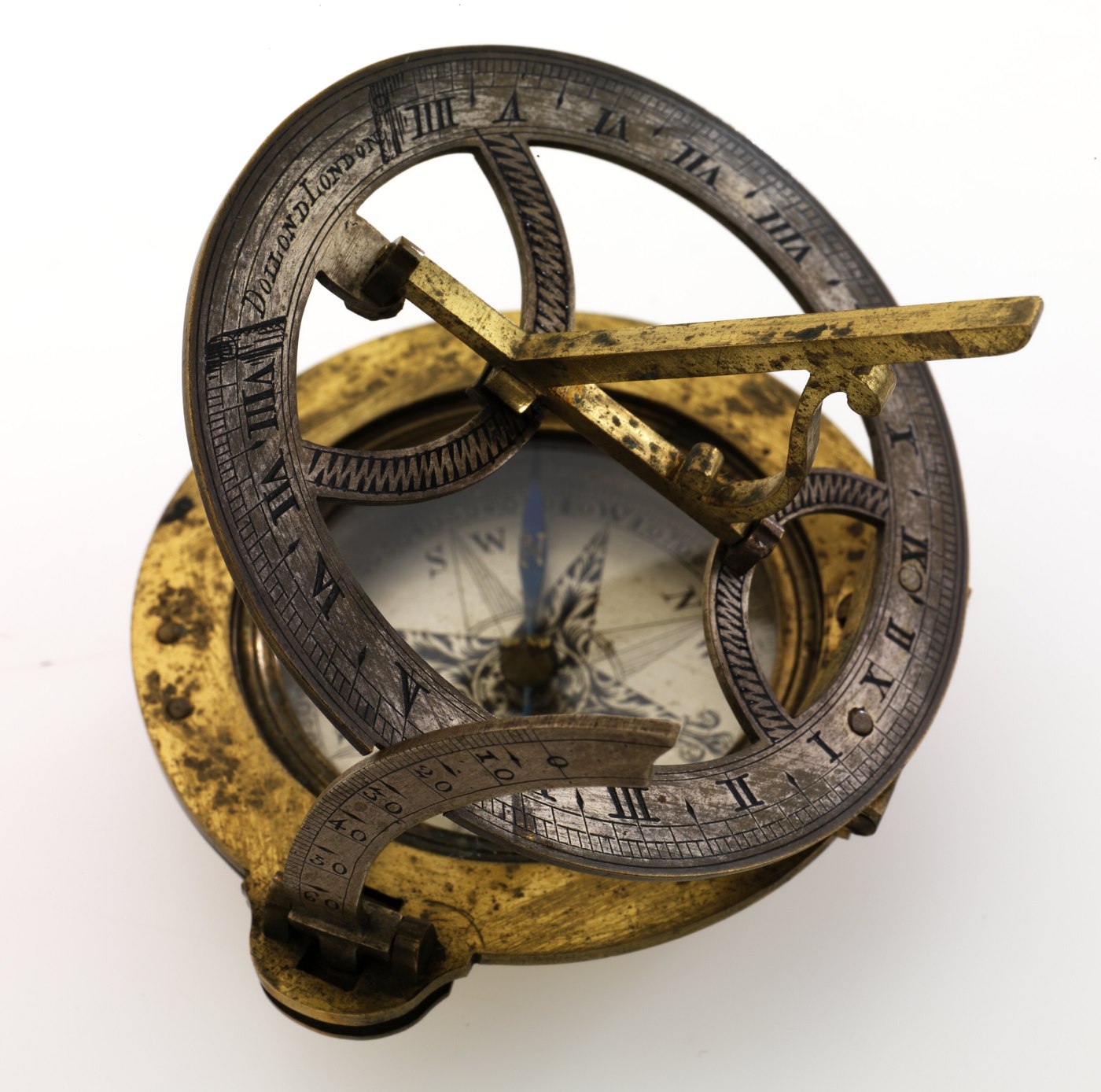
This pocket compass sundial is constructed from brass and steel, featuring a glass lid and a blue-toned compass dial. Manufactured in London by Peter and John Dollond, the instrument includes a hinged, moveable arm to function as a sundial. The object measures approximately 65 mm in width and 21 mm in height. It is associated with the maritime explorer George Bass, who reportedly utilized the device during a whaleboat expedition from Sydney to Westernport Bay between December 1797 and February 1798. Following the expedition, the instrument returned to England in 1800, where it entered the possession of Elizabeth Waterhouse, Bass's wife. The compass remained within the Waterhouse family until it was purchased at auction in 1998 by Dr. William F. Wilson. It was later donated to Museums Victoria in 2011 by the Wilson-Anastasios, Wilson, and Dubar families.

A view of the pocket compass sundial showing the hinged gnomon and the Dollond London signature on the dial ring.
A view of the pocket compass sundial showing the hinged gnomon and the Dollond London signature on the dial ring. — Museums Victoria. Rights pending — permission not yet requested. Original source

Catalogue identity

Source
collections.museumsvictoria.com.au
Category
Tool · Pocket compass sundial
Maker / attribution
Peter Dollond
Reference
Not recorded
Catalogue / lot identifier
HT 29959
Source-reported date
circa 1790
Source-reported place
England

Source-reported attribution and specifications are not independent authentication. A listing does not establish present ownership, current display, availability or permission to reproduce.

Object description

Construction and Design

The pocket compass sundial is designed as a compact, portable instrument. The main body consists of a brass case containing a compass with a blue-finished needle and a detailed dial. The lid is fitted with a glass cover to protect the sensitive magnetic needle.

A moveable arm is hinged to the top of the compass, functioning as the gnomon for the sundial component. An adjustable arc allows the user to set the instrument based on coordinates. The circumference of the sundial ring is clearly engraved with the manufacturer’s mark, 'Dollond London', and standard hour markings.

Evidence for this section
  • “The sundial made of brass, is moveable with a moveable arm that is hinged to the top of the compass.”
  • “The compass is made of both brass and steel and has a glass lid and blue coloured dial.”

Historical Context and Provenance

The instrument is associated with George Bass, a notable figure in early Australian maritime exploration. It was reportedly used during his 1797-1798 expedition in an unnamed whaleboat, which significantly contributed to the mapping of the Victorian coastline and the confirmation of the strait between Tasmania and the Australian mainland.

Following the expedition, the compass was taken back to England by Bass in 1800. It was subsequently held by Elizabeth Waterhouse, whom Bass married that same year. The item was passed through the Waterhouse family for generations before being sold at auction in 1998 to Dr. William F. Wilson.

Evidence for this section
  • “Pocket compass sundial used by George Bass on the whaleboat expedition that explored the coast of Victoria as far as Westernport Bay, 1797-98.”
  • “The pocket compass returned to England with George Bass in 1800. It then came into the possession of Elizabeth Waterhouse”

Donation and Status

The object is registered as HT 29959 within the Museums Victoria collection. It was acquired via the Cultural Gifts Program on November 22, 2011, as a donation from Dr. Meaghan Wilson-Anastasios, Ms. Victoria Wilson, and Mr. Adrian Dubar.

The donation was made to honor the memory of William F. Wilson. According to the museum’s records, the object is considered to hold national significance regarding the early maritime history of the Victorian coastline and Tasmania.

Evidence for this section
  • “Registration number: HT 29959”
  • “This compass is a unique item of national significance to the early maritime exploration of Australia”

Open research questions

  • Can the specific model or production records for Dollond compass sundials from the 1790s confirm an exact manufacturing date?
  • Does the note mentioned as being in the possession of Elizabeth Waterhouse still exist in an archival collection?

Source evidence

Recorded claims and source quotations for Pocket Compass Sundial by Peter & John Dollond
FieldSource-reported valueSource quotation
ManufacturerPeter & John Dollond“Manufacturer, name: Peter & John Dollond”
Datecirca 1790“circa 1790”
Registration numberHT 29959“Registration number: HT 29959”
Primary materialsBrass, steel, glass“The sundial made of brass, is moveable with a moveable arm that is hinged to the top of the compass. The compass is made of both brass and steel and has a glass lid and blue coloured dial.”
Dimensions65 mm (Width), 21 mm (Height)“dimensions: 65 mm (Width), 21 mm (Height), comments: Measurement From Conservation.”
Associated userGeorge Bass“Association: type: User, name: George Bass”
Acquisition date22 Nov 2011“Acquisition: Cultural Gifts Donation from Dr Meaghan Wilson-Anastasios, Ms Victoria Wilson, Mr Adrian Dubar, 22 Nov 2011”

Visible details

  • The sundial ring is engraved with the maker's name 'Dollond London'.
  • The compass dial features a central floral-style compass rose and a blue-finished magnetic needle.
  • The sundial assembly utilizes a hinged arm and a calibrated arc for adjustment.

Research qualifications

  • The provenance of the object prior to the 1797-98 whaleboat expedition is unknown.
  • The source states that its arrival in New South Wales in 1795 is assumed rather than confirmed.

Photograph identity and source facts were screened before import; rights clearance remains pending.

Consulted source

Pocket Compass Sundial - George Bass, circa 1790

Reviewed 2026-10-26 · Record 590442e9c5

Terms in this record

Glossary explanations for terms named in this object’s record.