
Skip to content
The Encyclopedia of Horology

Clock · Digital clock

Plato Clock

Partially verified

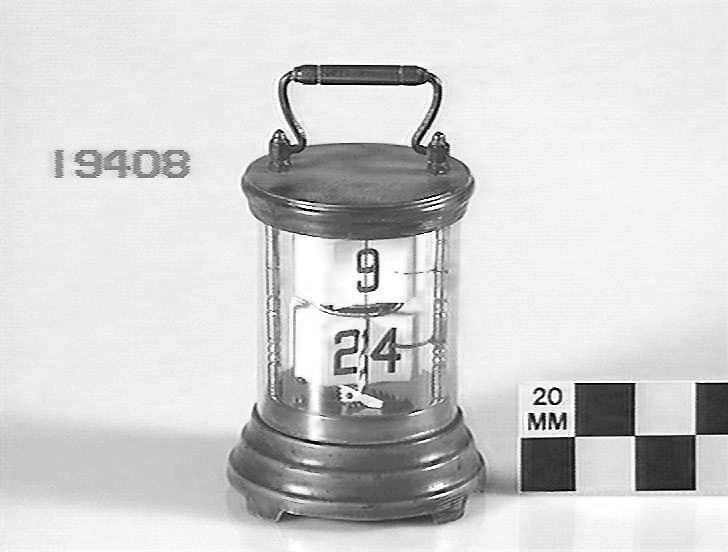
This digital clock, identified as a 'Plato Clock', dates to approximately 1910. It is housed in a cylindrical glass case with a brass base and lid, and is fitted with a handle for portability. The clock features a mechanical system contained within the base that drives two sets of cards to display the time by flipping over at specified intervals for hours and minutes respectively. The spring-wound movement is revealed through the transparent casing. The object carries an inscription on the base detailing various patent dates from 1902 and 1903. Additionally, the top of the clock is marked with an inscription indicating it was provided by J.G. White & Co Ltd, London. It was acquired by the museum through a loan and subsequent bequest from Mr John Askew in 1928, with its origin and association linked to the London locality.

A front view of the Plato Clock, showing the digital card display, brass casing, and carrying handle.
A front view of the Plato Clock, showing the digital card display, brass casing, and carrying handle. — Museums Victoria. Rights pending — permission not yet requested. Original source

Catalogue identity

Source
collections.museumsvictoria.com.au
Category
Clock · Digital clock
Maker / attribution
Not established
Reference
Not recorded
Catalogue / lot identifier
ST 19408
Source-reported date
circa 1910
Source-reported place
England

Source-reported attribution and specifications are not independent authentication. A listing does not establish present ownership, current display, availability or permission to reproduce.

Object description

Case and Design

The object is a digital desk clock constructed with a clear cylindrical glass body. This allows for full visibility of the internal mechanism, which consists of stacked cards that rotate to update the time. The base and top lid are manufactured from brass, providing a metallic frame for the glass housing. A matching brass handle is attached to the top lid, allowing the clock to be moved.

The overall height of the clock is 13 centimetres, with an outside diameter of 9 centimetres. The design relies on the mechanical movement housed within the base to cycle through hours and minutes by flipping individual cards as the time progresses.

Evidence for this section
  • “Cylindrical glass case with brass base and lid.”
  • “Mechanism in base causes two sets of cards to flick over at the appropriate intervals: hours and minutes respectively.”
  • “13 cm (Height), 9 cm (Outside Diameter)”

Signatures and Markings

The clock includes specific inscriptions that clarify its identity and origin. The base is engraved with a series of patent dates, beginning with December 16, 1902, and followed by three dates in 1903. These markings relate to the original patents established by Eugene L. Fitch.

The top of the lid features an inscription that reads: 'Compliments of J.G. White & Co Ltd, London E.C.' This suggests the clock was used as a promotional item associated with the London-based company.

Evidence for this section
  • “Base is marked 'The Plato Clock patented Dec 16 1902 Apr 28 1903 Apr 7 1903 July 7 1903'.”
  • “Top of clock marked 'Compliments of J.G. White & Co Ltd, London E.C.'”

History and Provenance

The Plato Clock patent was filed by Eugene L. Fitch in 1903, with production following shortly after. Historical documentation notes that these clocks were featured at the 1904 St Louis World's Fair and were manufactured by the Ansonia Clock Co in the United States and by Junghans in Europe.

This specific example reached the collection through a loan and subsequent bequest from Mr. John Askew in April 1928. It is catalogued as part of the science and measurement collection.

Evidence for this section
  • “The Plato Clock was patented by Eugene L. Fitch in New York City in 1903, and production commenced in 1904.”
  • “Production was by the Ansonia Clock Co in the United States and Junghans in Europe.”
  • “Acquisition: Loan & Subsequent Bequest from Mr John Askew, Apr 1928”

Open research questions

  • Is it possible to determine if this specific unit was produced by Junghans or another European manufacturer based on the branding?
  • Were J.G. White & Co Ltd known for distributing promotional horological items during this period?

Source evidence

Recorded claims and source quotations for Plato Clock
FieldSource-reported valueSource quotation
Registration numberST 19408“Registration number: ST 19408”
Dimensions13 cm height, 9 cm outside diameter“13 cm (Height), 9 cm (Outside Diameter)”
Mechanism typeSpring wound“Physical description: Spring wound.”
Patent markingDec 16 1902, Apr 28 1903, Apr 7 1903, July 7 1903“Base is marked 'The Plato Clock patented Dec 16 1902 Apr 28 1903 Apr 7 1903 July 7 1903'.”
ProvenanceLoan and bequest from Mr John Askew, April 1928“Acquisition: Loan & Subsequent Bequest from Mr John Askew, Apr 1928”
Associated companyJ.G. White & Co Ltd, London“Top of clock marked 'Compliments of J.G. White & Co Ltd, London E.C.'”

Visible details

  • Cylindrical glass enclosure containing two rotating card-based display stacks
  • Brass base and top lid with a central carrying handle
  • Patent information engraved on the base periphery
  • Promotional text engraved on the upper surface of the lid

Research qualifications

  • The specific manufacturer is not explicitly identified for this individual unit
  • The exact production location is not confirmed, only the association with London

Photograph identity and source facts were screened before import; rights clearance remains pending.

Consulted source

Digital Clock - 'Plato Clock', England, circa 1910

Reviewed 2026-10-26 · Record 26b7991589

Terms in this record

Glossary explanations for terms named in this object’s record.