
Skip to content
The Encyclopedia of Horology

Clock · Planetarium clock

Planetarium clock by François Ducommun

Partially verified

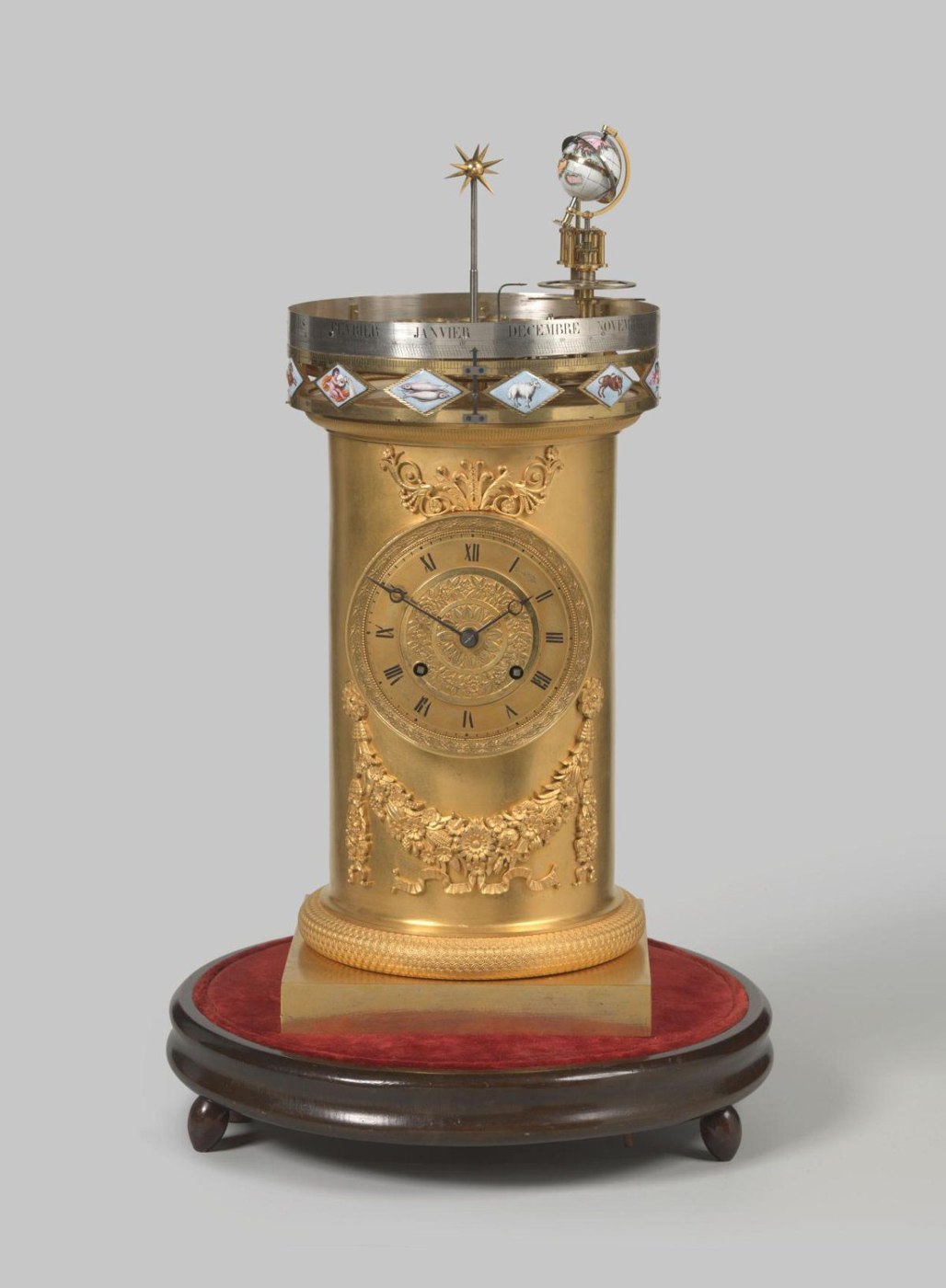
This planetarium clock, dating to approximately 1820, is attributed to the clockmaker François Ducommun of La Chaux-de-Fonds, Switzerland. The clock is constructed from gilded copper with enamel paint detailing and is designed in the shape of a tower mounted upon a square base, supported by a wooden plinth. The central tower features an integrated dial displaying time with black steel hands. Above the dial, the upper section is decorated with zodiac signs depicted on lozenge-shaped enamel plaques. Further astronomical features include a silver-toned circular band engraved with month names and degree graduations, alongside a planetarium mechanism featuring a globe painted in enamel. The object includes a glass dome and rests on a circular wooden stand. It entered the collection of the Rijksmuseum as part of a 1910 bequest from the estate of Madame S.G.A. de Perrot-Hatwan.

The planetarium clock by F. Ducommun, showing the central dial, the upper zodiacal plaques, the graduated silver ring, and the mounted globe under a glass dome.
The planetarium clock by F. Ducommun, showing the central dial, the upper zodiacal plaques, the graduated silver ring, and the mounted globe under a glass dome. — Rijksmuseum. Rights pending — permission not yet requested. Original source

Catalogue identity

Source
www.rijksmuseum.nl
Category
Clock · Planetarium clock
Maker / attribution
F. Ducommun
Reference
Not recorded
Catalogue / lot identifier
BK-NM-12209
Source-reported date
ca. 1820
Source-reported place
Switzerland

Source-reported attribution and specifications are not independent authentication. A listing does not establish present ownership, current display, availability or permission to reproduce.

Object description

Construction and Design

The timepiece is fashioned as a miniature tower situated on a square base. Its primary structure consists of gilded copper, which is further embellished with decorative enamel work. The tower serves as a support for the complex astronomical features positioned at its summit. Below these mechanical displays, the main body of the tower houses the primary timekeeping dial, flanked by gilded copper festoon ornaments that provide the structure with a cohesive aesthetic.

The upper decorative band features zodiacal signs applied to lozenge-shaped enamel plaques. Above this sits a silver-colored ring containing month inscriptions and a graduation scale for astronomical observation. The mechanism is surmounted by an enamel-painted globe, indicative of the intended planetarium functionality. The assembly, including its wooden base and glass dome, stands 42 cm in height, with the base measuring 17 cm in width.

Evidence for this section
  • “Verguld koperen planetariumklok in de vorm van een toren op een vierkant grondvlak”
  • “Aan de bovenkant de tekens van de dierenriem met emailverf op ruitvormige plaques geschilderd”
  • “Daarboven een zilveren cirkelband met graadverdeling en de maanden van het jaar”

Horological Features

The time is displayed on a circular dial located at the center of the tower. The dial features black painted numerals and is accompanied by black steel hands, which contrast with the gilded background. The dial surface is further enhanced with intricate engraved detailing.

Beyond the primary time display, the object integrates a planetarium mechanism. This device combines the tower structure with an enamel globe. The alignment of the zodiac plaques and the degree-graduated silver band suggests a design meant to demonstrate orbital positions or celestial cycles.

Evidence for this section
  • “In het midden van de toren bevindt zich de wijzerplaat met zwart geschilderde cijfers en zwarte stalen wijzers”

Attribution and Provenance

The clock is attributed to the clockmaker François Ducommun based in La Chaux-de-Fonds, Switzerland. The manufacture is dated to circa 1820. This information aligns with the cataloging provided by the museum, which classifies the object as a mechanical clock.

The object became part of the public domain via a legacy donation. It was bequeathed to the Rijksmuseum by Madame S.G.A. de Perrot-Hatwan of Amsterdam in 1910, where it has been cataloged under the object number BK-NM-12209.

Evidence for this section
  • “La Chaux-de-Fonds (Zwitserland), ca. 1820, door François Ducommun”
  • “Legaat van mevrouw S.G.A. de Perrot-Hatwan, Amsterdam”
  • “legaat 1910”

Open research questions

  • What specific gear train arrangement connects the main clock movement to the planetarium display?
  • Does the planetarium mechanism accurately replicate specific planetary motions or represent general celestial cycles?
  • Are there hidden signatures or marks on the movement interior to confirm Ducommun's involvement beyond the attribution?

Source evidence

Recorded claims and source quotations for Planetarium clock by François Ducommun
FieldSource-reported valueSource quotation
MakerF. Ducommun“uurwerkmaker: F. Ducommun, La Chaux-de-Fonds”
Dateca. 1820“ca. 1820”
MaterialGilded copper, enamel paint“Verguld koper, beschilderd in email”
Height42 cm“met stolp: hoogte 42 cm”
Base Width17 cm“houten voetstuk: breedte 17 cm”
ProvenanceLegacy of S.G.A. de Perrot-Hatwan, 1910“Legaat van mevrouw S.G.A. de Perrot-Hatwan, Amsterdam”
Object IDBK-NM-12209“Objectnummer BK-NM-12209”

Visible details

  • Integrated planetarium mechanism with an enamel-painted globe
  • Gilded copper tower casing with ornamental swags
  • Zodiac signs on diamond-shaped enamel plaques at the top
  • Silver-toned ring showing month names and graduation

Research qualifications

  • Specific mechanical operation of the planetarium is not documented
  • Provenance is limited to a 1910 bequest history

Photograph identity and source facts were screened before import; rights clearance remains pending.

Terms in this record

Glossary explanations for terms named in this object’s record.