
Skip to content
The Encyclopedia of Horology

Clock · Oil lamp clock

Pewter oil lamp clock

Partially verified

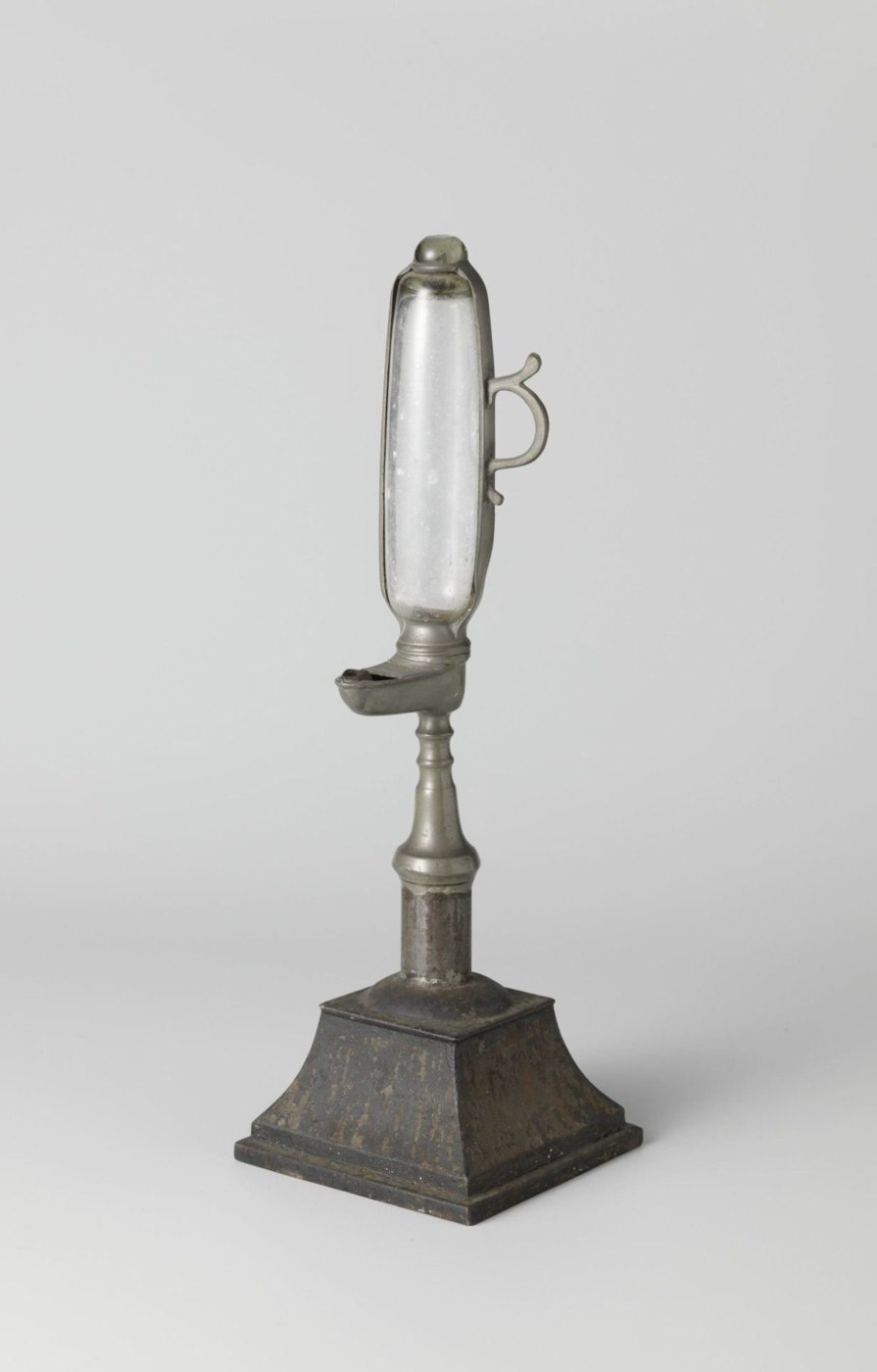
This object is an oil lamp designed to function as a clock, measuring 35.5 cm in height. It consists of a square, inverted conical iron base featuring remnants of black and red paint. A cylindrical shaft rises from the center of this base to support the primary structure, which is fashioned from pewter. The main body begins with a conical shaft embellished with two subtle nodes, extending upward to a spout and a glass oil reservoir. An external pewter frame encloses the glass lamp and incorporates a handle on one side. The opposite side of the frame is decorated with a scale of Roman numerals, indicating its use as a timekeeping device based on the consumption of oil over time. The object was donated to the collection in 1898 by J.A. Frederiks of The Hague and is attributed to an anonymous maker active in Western Europe between 1700 and 1800.

Pewter oil lamp clock shown in full, displaying the iron base, conical pewter shaft, glass reservoir, and the Roman numeral scale on the metal frame.
Pewter oil lamp clock shown in full, displaying the iron base, conical pewter shaft, glass reservoir, and the Roman numeral scale on the metal frame. — Rijksmuseum. Rights pending — permission not yet requested. Original source

Catalogue identity

Source
www.rijksmuseum.nl
Category
Clock · Oil lamp clock
Maker / attribution
Not established
Reference
BK-NM-11327
Catalogue / lot identifier
BK-NM-11327
Source-reported date
1700 - 1800
Source-reported place
Western Europe

Source-reported attribution and specifications are not independent authentication. A listing does not establish present ownership, current display, availability or permission to reproduce.

Object description

Construction and Design

The lamp is constructed from a combination of iron, pewter, and glass. The iron base provides a stable square footing, while the upper components are crafted from pewter. A central cylindrical shaft connects the base to the main body of the lamp, which is composed of a conical section punctuated by two nodes.

The primary lighting element is a glass reservoir mounted within a pewter frame. This frame serves two purposes: supporting the lamp components and providing a functional interface for the user. A handle is attached to one side of the metal frame, facilitating movement of the device.

Evidence for this section
  • “De ijzeren voet is vierkantig, omgekeerd conisch”
  • “Midden op de voet loopt een cylindrische schacht omhoog”
  • “Het omringende tinnen frame heeft aan een zijde een handvat”

Horological Function

The object is designed to measure time by monitoring the oil level within the glass lamp. As the oil is consumed through the spout, the diminishing volume corresponds to the passage of time. The measurement scale is displayed on the exterior pewter frame.

The time scale is marked using Roman numerals placed on the side of the frame opposite the handle. By observing the position of the oil level relative to these markings, the time could be tracked.

Evidence for this section
  • “Olielamp van tin, die gebruikt kan worden als klok”
  • “De andere zijde is gedecoreerd met Romeinse cijfers”

Provenance and Documentation

The object was acquired by the museum through a donation from J.A. Frederiks in 1898. It is held within the collection under the identification number BK-NM-11327.

The attribution to an anonymous maker in Western Europe reflects the lack of specific historical records regarding the manufacture of this piece, which is dated to the 18th century.

Evidence for this section
  • “Schenking van J.A. Frederiks, Den Haag”
  • “vervaardiger: anoniem, West-Europa”

Open research questions

  • How was the oil level calibrated to match the intervals of the Roman numerals?
  • Are there remains of the original wick mechanism inside the spout?

Source evidence

Recorded claims and source quotations for Pewter oil lamp clock
FieldSource-reported valueSource quotation
Object numberBK-NM-11327“Objectnummer BK-NM-11327”
DimensionsHeight 35.5 cm, base 11.7 cm by 11.7 cm“hoogte 35,5 cm, voet: breedte 11,7 cm x breedte 11,7 cm”
MakerAnonymous“vervaardiger: anoniem”
Dating1700-1800“1700 - 1800”

Visible details

  • The base is iron and shows visual traces of red and black paint.
  • The Roman numerals are located on the metal frame surrounding the glass reservoir.
  • The design features two decorative nodes on the conical pewter shaft.
  • There is a single handle attached to the side of the lamp's frame.

Research qualifications

  • The mechanism's operational accuracy and original method of time indication are not detailed in the source.
  • The origin is broadly attributed to Western Europe without a specific workshop or geographic center.
  • The exact year of manufacture remains uncertain within the provided 1700-1800 range.

Photograph identity and source facts were screened before import; rights clearance remains pending.

Consulted source

Pewter oil lamp, serving as a clock

Reviewed 2026-11-02 · Record d7aee1096a

Terms in this record

Glossary explanations for terms named in this object’s record.