
Skip to content
The Encyclopedia of Horology

Tool · Dairat al-Muaddil

Ottoman Dairat al-Mu'addil

Partially verified

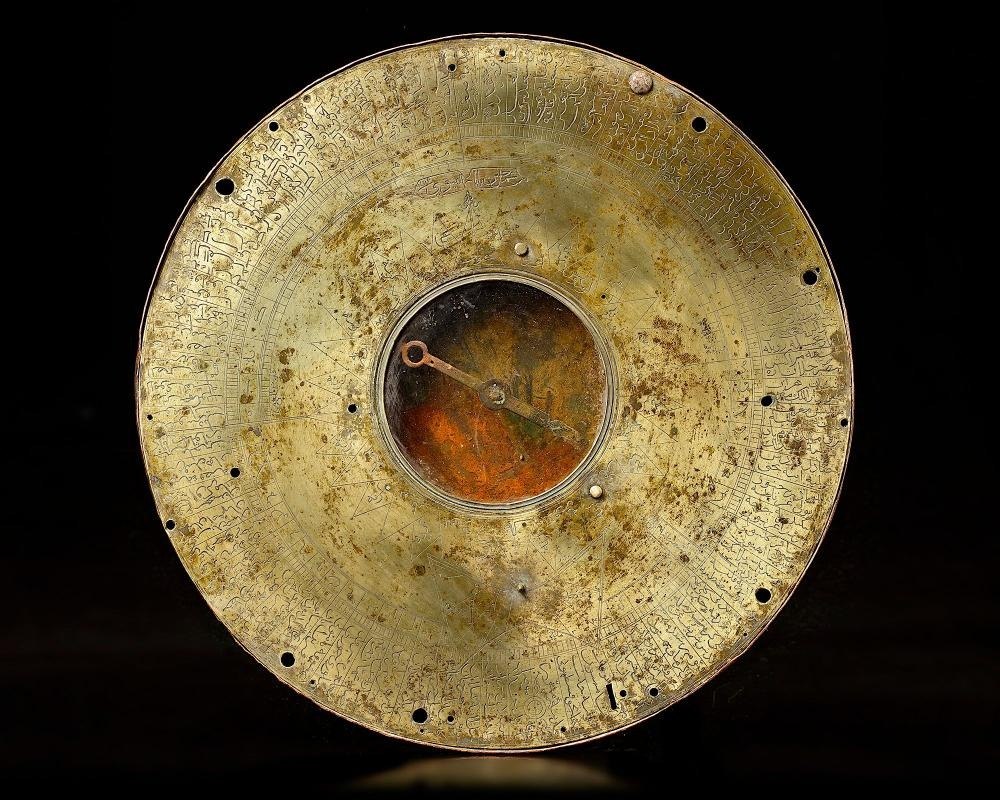
The object is a circular brass dairat al-mu’addil (equatorial circle), a navigational and religious instrument designed to combine a sundial with a qibla indicator. Measuring 24 cm in diameter, the instrument features a central magnetic compass surrounded by an engraved wind-rose. The outer circumference is engraved with a list of various localities and their corresponding Qiblas. A small sundial with an integral gnomon is positioned below the south point of the central compass area. The brass plate shows evidence of missing components, including four leveling screws and a hinged, graduated semi-circular arc originally intended to be positioned along the east-west line for inclination adjustment relative to the horizontal plane. The instrument is attributed to the Ottoman period, dated by the source to 1757/1758 AD.

The obverse of the brass dairat al-mu’addil showing the central compass, the engraved wind-rose, and the outer scale of geographic localities.
The obverse of the brass dairat al-mu’addil showing the central compass, the engraved wind-rose, and the outer scale of geographic localities. — Oriental Art Auctions / Invaluable. Rights pending — permission not yet requested. Original source

Catalogue identity

Source
orbiscollectibles.com
Category
Tool · Dairat al-Muaddil
Maker / attribution
Not established
Reference
Not recorded
Catalogue / lot identifier
200798083
Source-reported date
1757/1758 AD
Source-reported place
Ottoman Empire

Source-reported attribution and specifications are not independent authentication. A listing does not establish present ownership, current display, availability or permission to reproduce.

Object description

Construction and Layout

The instrument is constructed from a circular brass plate measuring 24 cm in diameter. The central portion of the plate is recessed to house a magnetic compass. Encircling this central feature is a wind-rose, which contains the four main cardinal points labeled in Ottoman Turkish as shimal, junub, sharq, and garb. Interspersed between these cardinal points are inscriptions denoting intermediary winds and rhumb lines, referred to as orta and kerte respectively.

The outermost section of the brass plate contains a densely engraved ring of text that lists various localities alongside their respective Qiblas. Positioned near the southern edge of the instrument is a dedicated small sundial, complete with its original gnomon, allowing for the determination of time alongside the primary directional functions of the device.

Evidence for this section
  • “The main disk of the instrument consists of a circular brass plate.”
  • “The center of a disk features a magnetic compass. Around the magnetic compass is a wind-rose with the typical four quarters of the compass”
  • “The instrument also features a small sundial below the south point of the instrument equipped with a small gnomon.”

Mechanical Features and Losses

The instrument exhibits signs of partial loss regarding its mechanical components. There are several clear holes along the circumference and plate structure where original hardware would have been mounted. Specifically, the source notes the absence of four leveling screws, which would have been necessary to ensure the plate remained horizontal during use.

Additionally, the instrument is missing a graduated semi-circular arc. This element was originally intended to be hinged along the east-west axis. Once in place, it would have allowed the operator to incline the instrument at a specific angle relative to the horizontal plane, using a scale in the plane of the meridian to ensure precision.

Evidence for this section
  • “The various holes on the instrument are due to the missing parts such as four leveling screws and a graduated semi-circular arc”
  • “This arc can be inclined at any desired angle to the horizontal plane by means of the graduated scale in the plane of the meridian.”

Historical Context and Attribution

The dairat al-mu’addil, translated as the equatorial circle, was originally developed by the 15th-century astronomer ‘Abd al-Aziz ibn Muhammad al-Wafa’i al-Miqati, who served at the al-Mu’ayyad mosque in Cairo.

The current specimen is attributed to the mid-18th century, specifically the 1757/1758 period, though independent verification of the type and dating is advised by the source.

Evidence for this section
  • “The dairat al-mu’addil (Eng. equatorial circle) is an instrument with combines a sundial with a qibla indicator.”
  • “It was invented by the 15th century astronomer and timekeeper at the al-Mu’ayyad mosque in Cairo, ‘Abd al-Aziz ibn Muhammad al-Wafa’i al-Miqati.”
  • “It was later also described by other scholars, including the Turkish admiral Seydi Ali Reis, making the instrument very popular in Ottoman circles.”

Open research questions

  • What specific localities are recorded in the outer circumferential inscriptions?
  • Can the missing arc components be reconstructed based on similar surviving 18th-century Ottoman examples?

Source evidence

Recorded claims and source quotations for Ottoman Dairat al-Mu'addil
FieldSource-reported valueSource quotation
MaterialBrass“circular brass plate”
Date1757/1758 AD“1757/1758 AD”
Cardinal directionsShimal, junub, sharq, garb“shimal (north), junub (south), sharq (west), garb (east)”
Object ID200798083“200798083”
Missing partsFour leveling screws and a graduated semi-circular arc“missing parts such as four leveling screws and a graduated semi-circular arc”

Visible details

  • Central magnetic compass assembly
  • Engraved wind-rose with Ottoman Turkish lettering
  • Outer circular scale featuring place names
  • Visible holes at the perimeter for missing leveling hardware

Research qualifications

  • Independent confirmation of type attribution remains research required
  • Missing components preclude full functional assessment of the arc and leveling system

Photograph identity and source facts were screened before import; rights clearance remains pending.

Consulted source

AN OTTOMAN DAIRAT AL-MUADDIL

Reviewed 2026-11-02 · Record 5f7cffead8

Terms in this record

Glossary explanations for terms named in this object’s record.