
Skip to content
The Encyclopedia of Horology

Tool · Central European nocturnal

Nocturnal by Hans Dorn

Partially verified

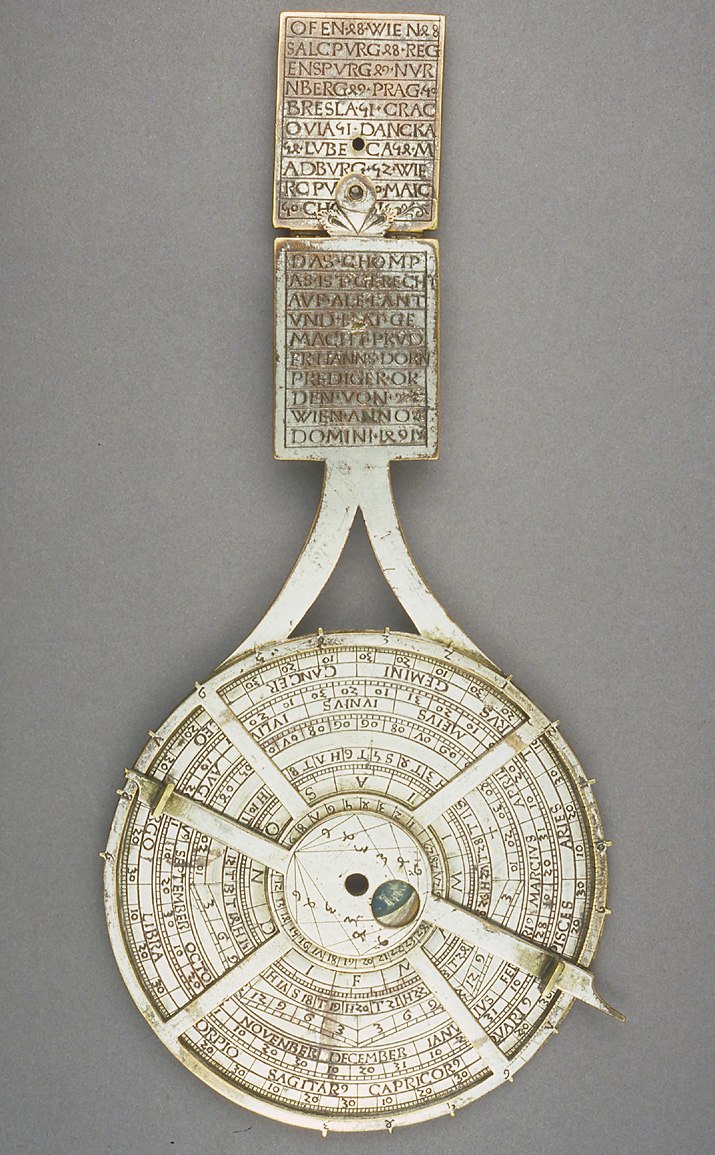
This 1491 nocturnal, crafted from silvered brass by the Dominican monk Hans Dorn in Vienna, is an early multi-functional scientific instrument. Measuring 121 mm in diameter, the object integrates a circular disc with an extension tapering into a V-shaped handle, which supports an attached box. The front of the primary disc is engraved for latitude 47°, featuring a celestial equator, unequal hour lines, and astrological houses. A rotating ecliptic circle and ruler facilitate astrological calculations and hour conversions. The reverse side serves as a nocturnal with various circular scales, including calendrical and lunar mansion indices, alongside a lunar phase aperture containing crushed azurite. Housed within the box is an equatorial dial and a compass, the latter noted for an 8°E magnetic deviation. The instrument's surface is extensively engraved with a list of European cities and their respective latitudes, concluding with a signature identifying the maker and the year of production.

Front view of the nocturnal showing the ecliptic circle, ruler, and city list on the handle extension.
Front view of the nocturnal showing the ecliptic circle, ruler, and city list on the handle extension. — © British Museum, London. Rights pending — permission not yet requested. Original source

Catalogue identity

Source
www.mhs.ox.ac.uk
Category
Tool · Central European nocturnal
Maker / attribution
Hans Dorn
Reference
MLA 1894,6-15.1
Catalogue / lot identifier
MLA 1894,6-15.1
Source-reported date
1491
Source-reported place
Austria

Source-reported attribution and specifications are not independent authentication. A listing does not establish present ownership, current display, availability or permission to reproduce.

Object description

Construction and Design

The nocturnal is constructed from silvered brass and maintains a circular format with a tapering handle. The front face is calibrated for latitude 47° and includes detailed engravings for unequal hours and astrological houses. An ecliptic circle rotates over the main plate, which is further operated by a rotating ruler. The instrument allows for complex astronomical calculations, including the conversion between equal and unequal hours, and is specifically designed for use as a nocturnal.

The reverse side of the primary disc contains a sequence of circular scales that integrate calendrical and astronomical data. These include zodiac markers, lunar mansion indicators, and shadow scales. A secondary rotating disc features two arms resembling an alidade, designed with sighting vanes. A circular aperture on this disc allows for the visual representation of lunar phases, achieved using crushed azurite. The central hole of the instrument acts as a sighting aperture for nocturnal observations.

Evidence for this section
  • “The instrument consists of a circular disc with an extension on one side which tapers into a v-shaped handle to which a box is fixed.”
  • “This side of the instrument can be used for converting equal into unequal hours and for astrological purposes.”
  • “This disc has a circular aperture which reveals the phases of the moon on the plate below in blue made from crushed azurite.”

Box and Integrated Components

Attached to the handle is a box containing supplementary timekeeping components. An equatorial dial, formed as a foliate scroll, is housed inside and can be adjusted for latitude using a foldable arm. A latitude scale is engraved into the interior of the box floor to facilitate this setting.

The box also contains an inset compass. Although the glass is a replacement and the needle is missing, the instrument is associated with a magnetic deviation of approximately 8°E. The outer lid features a hole, enabling visibility of the compass dial while the box is closed.

Evidence for this section
  • “The box contains an equatorial dial in the form of a foliate scroll, numbered 3 to 12 to 9, which can be set to the appropriate latitude by means of a foldable arm and a latitude scale on the inside of the bottom of the box.”
  • “The inset compass has a deviation of circa 8?E, the needle is missing and the glass is a replacement.”
  • “A hole in the lid of the box allows the compass to be seen while the box is closed.”

Signatures and Geographical Markings

The instrument is marked with a comprehensive list of cities across its exterior and interior surfaces, each accompanied by its latitude. This list serves as a reference for the user across various locations in Europe, including cities such as Vienna, Nuremberg, and Prague.

The maker's signature is engraved on the outside of the box bottom. It explicitly attributes the construction to Brother Hans Dorn of the Dominican order in Vienna, dated to 1491. This text also comments on the utility of the compass integration.

Evidence for this section
  • “The outside and inside of the lid and the inside of the bottom of the box are engraved with the names and latitudes of cities”
  • “The text on the outside of the bottom explains the range of the compass and gives the signature as follows: 'DAS CHOMPAS IST GERECHT AVF ALE LANT VND HAT GEMACHT PRVDER HANNS DORN PREDIGER ORDEN VON WIEN ANNO DOMINI 1491'.”

Open research questions

  • What is the historical significance of the crushed azurite used for the lunar aperture in late 15th-century instrumentation?
  • Are there remaining functional remnants of the original pin gnomon that could assist in a digital reconstruction of the equatorial dial's operation?

Source evidence

Recorded claims and source quotations for Nocturnal by Hans Dorn
FieldSource-reported valueSource quotation
MakerHans Dorn“Signed by Hans Dorn”
Date1491“Dated 1491”
Dimensions121 mm diameter“121 mm in diameter”
MaterialSilvered brass“Silvered brass”
SignaturePrvder Hanns Dorn Prediger Orden von Wien“DAS CHOMPAS IST GERECHT AVF ALE LANT VND HAT GEMACHT PRVDER HANNS DORN PREDIGER ORDEN VON WIEN ANNO DOMINI 1491”
Inventory NumberMLA 1894,6-15.1“Registration no. MLA 1894,6-15.1”
Compass deviation8 degrees east“The inset compass has a deviation of circa 8?E”

Visible details

  • Engraved list of cities and latitudes on box exterior
  • Rotating ecliptic circle with Latin zodiac names
  • Lunar phase aperture with crushed azurite inlay
  • Missing pin gnomon and compass needle

Research qualifications

  • The compass needle is missing and the glass is a replacement
  • Pin gnomon for the equatorial dial is missing

Photograph identity and source facts were screened before import; rights clearance remains pending.

Consulted source

Nocturnal

Reviewed 2026-10-26 · Record 7e14f00302

Terms in this record

Glossary explanations for terms named in this object’s record.