
Skip to content
The Encyclopedia of Horology

Tool · Italian nocturnal and quadrant

Nocturnal and Quadrant by Lorenzo della Volpaia

Partially verified

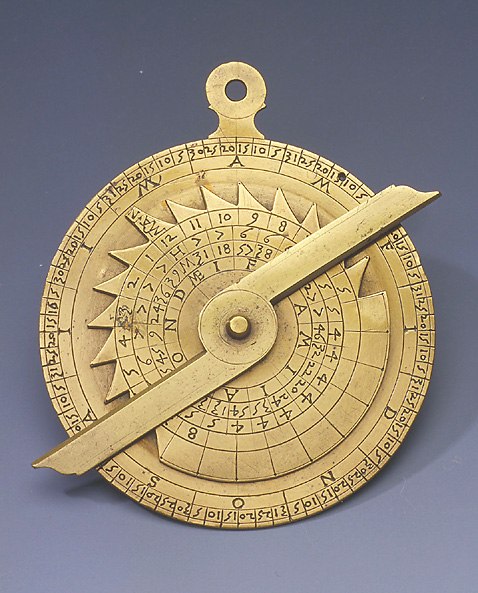
This brass nocturnal and quadrant, measuring 77 mm in diameter, was created by Lorenzo della Volpaia in 1511 in Florence. The instrument consists of three superimposed discs engraved with various markings designed to calculate time at night by orienting the discs based on the current day and month. One side features a circular disc with a calendar scale and a notched volvelle disc with fifteen teeth, incorporating several concentric scales for reading hours, minutes, and months. The second face contains an Italian hours diagram for a latitude of 43 degrees, flanked by two halves of a calendar scale and a 90-degree scale. The instrument includes a central rule that is not original, which obstructs the sighting hole and prevents use. The piece originates from the legacy of the scientist Vincenzo Viviani and is currently held by the Istituto e Museo di Storia della Scienza in Florence.

The obverse side of the nocturnal, showing the notched volvelle, hour and calendar scales, and the non-original central rule.
The obverse side of the nocturnal, showing the notched volvelle, hour and calendar scales, and the non-original central rule. — Istituto e Museo di Storia della Scienza, Firenze. Rights pending — permission not yet requested. Original source

Catalogue identity

Source
www.mhs.ox.ac.uk
Category
Tool · Italian nocturnal and quadrant
Maker / attribution
Lorenzo della Volpaia
Reference
Not recorded
Catalogue / lot identifier
1305
Source-reported date
1511
Source-reported place
Florence

Source-reported attribution and specifications are not independent authentication. A listing does not establish present ownership, current display, availability or permission to reproduce.

Object description

Construction and Design

The nocturnal is constructed from brass and measures 77 mm in diameter. It comprises three superimposed discs, each engraved with specific astronomical and calendrical markings. The instrument is designed for nocturnal time calculation through the manipulation of these discs based on date observations.

On the primary face, a circular disc features a calendar scale read anti-clockwise. Within this, a volvelle disc is fitted, featuring an edge notched with 15 teeth. Concentric to these teeth are four distinct scales, including hour, minute, and month indicators, as well as a scale corresponding to the arc of the teeth.

Evidence for this section
  • “It is made up of three superimposed discs”
  • “The nocturnal is composed of a circular disc divided around the circumference with a calendar scale read anti-clockwise to 5 days.”
  • “Within this is a volvelle disc with a portion of its edge notched with 15 teeth.”

The Quadrant Face

The reverse side of the instrument functions as a quadrant. The centre contains an hour diagram for an Italian hours dial, covering the range of 9 to 23. This diagram is calibrated for a latitude of 43 degrees, which corresponds to the region of Tuscany. Flanking the diagram are the two segments of a calendar scale.

Below the hour diagram, the instrument features a scale of 90 degrees, which reads to single-degree increments. Additional features include a scale of three rings above the hour diagram, comprising a month scale, zodiac symbols, and a series of letters A through H representing numerical values.

Evidence for this section
  • “The second face of the instrument carries at the centre the hour diagram for an Italian hours dial (9 to 23) for latitude 43?”
  • “Beneath the diagram is a scale of 90? reading to one degree.”
  • “Above the hour diagram is a scale of three rings the middle one of which is a scale of months”

Condition and Provenance

The instrument is documented as having a rule mounted at the centre, which the source identifies as not being original to the piece. This modern or replaced rule obstructs the sighting hole, rendering the nocturnal unusable in its current state.

Regarding its history, the nocturnal forms part of the collection at the Istituto e Museo di Storia della Scienza in Florence. It is noted to have come from the legacy of the scientist Vincenzo Viviani.

Evidence for this section
  • “A rule mounted at the centre is not original and makes the instrument unusable by blocking the sighting hole.”
  • “This instrument originates from the legacy of the scientist Vincenzo Viviani.”

Open research questions

  • What specific material and style characteristics identify the work of the Della Volpaia family in the early 16th century?
  • When and why was the non-original central rule added to the instrument?

Source evidence

Recorded claims and source quotations for Nocturnal and Quadrant by Lorenzo della Volpaia
FieldSource-reported valueSource quotation
MakerLorenzo della Volpaia“Signed by Lorenzo della Volpaia”
Date1511“Dated 1511”
MaterialBrass“Brass; 77 mm in diameter”
LocationFlorence“Dated 1511; Florence”
Inventory Number1305“Inventory number: 1305”
ProvenanceVincenzo Viviani“This instrument originates from the legacy of the scientist Vincenzo Viviani.”
Latitude43 degrees“calibrated for a latitude of 43?, corresponding roughly to Tuscany.”

Visible details

  • Circular brass body with integrated suspension loop at the top
  • Notched volvelle disc with fifteen teeth mounted centrally
  • Engraved hour and calendar scales visible on the main circular surface
  • Non-original central rule spanning across the dial face

Research qualifications

  • The central rule is documented as a non-original addition
  • The central rule currently prevents the instrument from being functional due to blockage of the sighting hole

Photograph identity and source facts were screened before import; rights clearance remains pending.

Consulted source

Nocturnal And Quadrant

Reviewed 2026-10-26 · Record 739c249863

Terms in this record

Glossary explanations for terms named in this object’s record.

Other italian nocturnal and quadrant records