
Skip to content
The Encyclopedia of Horology

Clock · Mantel clock

Mantel clock in the shape of an oval basket

Partially verified

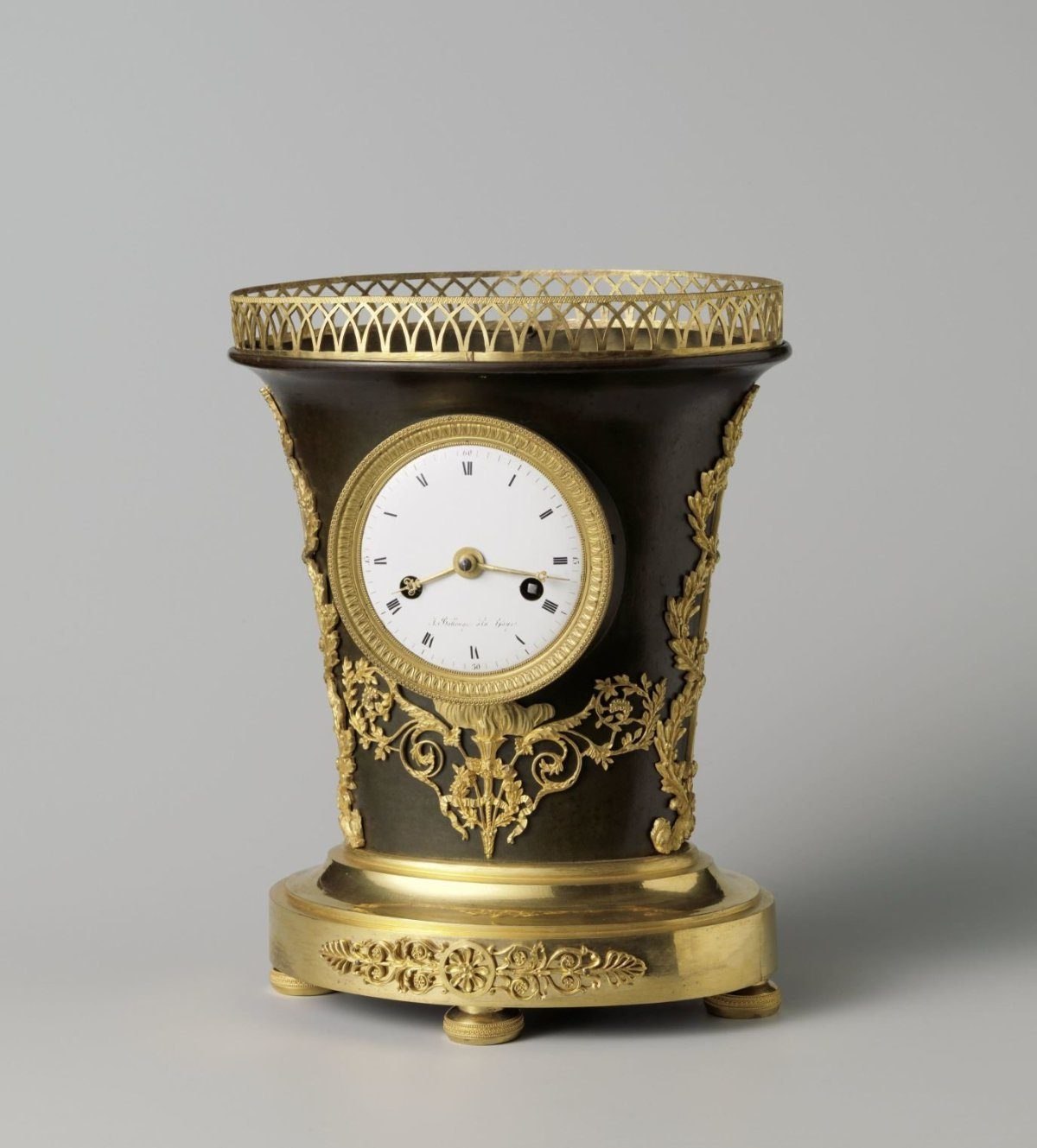
This mantel clock, created by Jacques Bollengier in The Hague between approximately 1800 and 1825, is constructed in the form of an oval basket. The body features a combination of partially gilded and patinated bronze. The clock rests upon a profiled plinth supported by feet decorated with pearl and pendulum-like borders. The upper rim of the basket displays a lattice-work design of pointed arches. The enameled dial is set into the dark patinated central section, which is further embellished with gilt bronze mounts including acanthus leaves, thyrsus staves, olive branches, rosettes, and palmettes. Beneath the dial, the decorative program includes a torch depicted with ribbons, a flower wreath, and leafy tendrils adorned with berries. The overall dimensions of the clock are 28.5 cm in height, 22.5 cm in width, and 15.5 cm in depth, representing an example of early 19th-century mechanical timekeeping.

Front view of the mantel clock in the form of an oval basket.
Front view of the mantel clock in the form of an oval basket. — Rijksmuseum. Rights pending — permission not yet requested. Original source

Catalogue identity

Source
www.rijksmuseum.nl
Category
Clock · Mantel clock
Maker / attribution
Jacques Bollengier
Reference
Not recorded
Catalogue / lot identifier
BK-1977-109
Source-reported date
ca. 1800 - ca. 1825
Source-reported place
Netherlands

Source-reported attribution and specifications are not independent authentication. A listing does not establish present ownership, current display, availability or permission to reproduce.

Object description

Design and Materials

The mantel clock takes the form of an oval basket, utilizing a contrast between materials and textures. The central body consists of a dark patinated metal, providing a visual anchor for the lighter, gilded bronze decorative elements. These mounts are applied across the exterior, encompassing botanical motifs such as acanthus leaves, olive branches, and floral wreaths.

The base serves as a foundation, featuring a profiled design enhanced with pearl and rhythmic border decorations. At the pinnacle, the basket rim is finished with a lattice-work fence of pointed arches, which completes the structural form of the object. The overall composition balances these geometric and organic elements to create the clock's basket profile.

Evidence for this section
  • “Pendule van deels verguld, deels gepatineerd brons, in de vorm van een ovale mand”
  • “Rond de uitbuigende bovenrand loopt een hekwerk van puntbogen.”
  • “De verdere versiering bestaat uit acanthusbladeren, thyrsusstaffen, olijftakken, rozetten en palmetten.”

Dial and Signature

The clock face is an enameled dial set directly into the dark patinated bronze section of the basket. The dial displays the signature of the maker, documented as 'J. Bollenge à la Haye'. This signature confirms the clock's association with the maker Jacques Bollengier, who was active in The Hague.

The area immediately below the dial is adorned with additional decorative metalwork. This includes a motif of a burning torch accompanied by a ribbon, further contributing to the ornamentation surrounding the timekeeping element.

Evidence for this section
  • “De geëmailleerde wijzerplaat op het donker gepatineerde middengedeelte toont bloemblaadjes en kralenranden.”
  • “Hieronder een brandende fakkel met lint, bloemkrans en bladranken met bessen.”
  • “signatuur, wijzerplaat: ‘J. Bollenge à la Haye’”

Acquisition and History

The clock is held within the collection of the Rijksmuseum and was acquired in 1977. Its provenance is linked to the legacy of Mrs. V.R. van Poelgeest-Spatkowa from Amsterdam, who bequeathed the object to the institution. It is currently cataloged under the object number BK-1977-109.

The records indicate that the object is considered to be in the public domain. The Rijksmuseum provides a specific persistent URL for reference and identification purposes, ensuring that the clock remains documented for future scholarly access and research.

Evidence for this section
  • “Legaat van mevrouw V.R. van Poelgeest-Spatkowa, Amsterdam”
  • “legaat 1977”
  • “Objectnummer BK-1977-109”

Open research questions

  • Are there any internal movement components that further verify the maker's signature?
  • Does the specific decorative motif of the burning torch and ribbons correlate with other works by Jacques Bollengier from this period?

Source evidence

Recorded claims and source quotations for Mantel clock in the shape of an oval basket
FieldSource-reported valueSource quotation
MakerJacques Bollengier“uurwerkmaker: Jacques Bollengier, Den Haag”
Dateca. 1800 - ca. 1825“ca. 1800 - ca. 1825”
LocationThe Hague“Den Haag”
Height28.5 cm“hoogte 28,5 cm”
Width22.5 cm“breedte 22,5 cm”
Depth15.5 cm“diepte 15,5 cm”
SignatureJ. Bollenge à la Haye“signatuur, wijzerplaat: ‘J. Bollenge à la Haye’”

Visible details

  • The clock dial is signed 'J. Bollenge à la Haye'.
  • The upper edge of the basket features a fine metal lattice gallery.
  • The base and applied ornamentation are rendered in gilt bronze.
  • The main body of the clock is formed of dark patinated metal.

Research qualifications

  • The exact date of manufacture is estimated within a 25-year range.
  • The source mentions 'pendulum-like borders' on the feet, which may refer to a specific ornamental motif rather than a mechanical component.

Photograph identity and source facts were screened before import; rights clearance remains pending.

Consulted source

Mantel clock in the shape of an oval basket

Reviewed 2026-11-02 · Record 107cf3c6a0

Terms in this record

Glossary explanations for terms named in this object’s record.