
Skip to content
The Encyclopedia of Horology

Pocket watch · Lyre-shaped watch

Lyre-shaped Watch

Partially verified

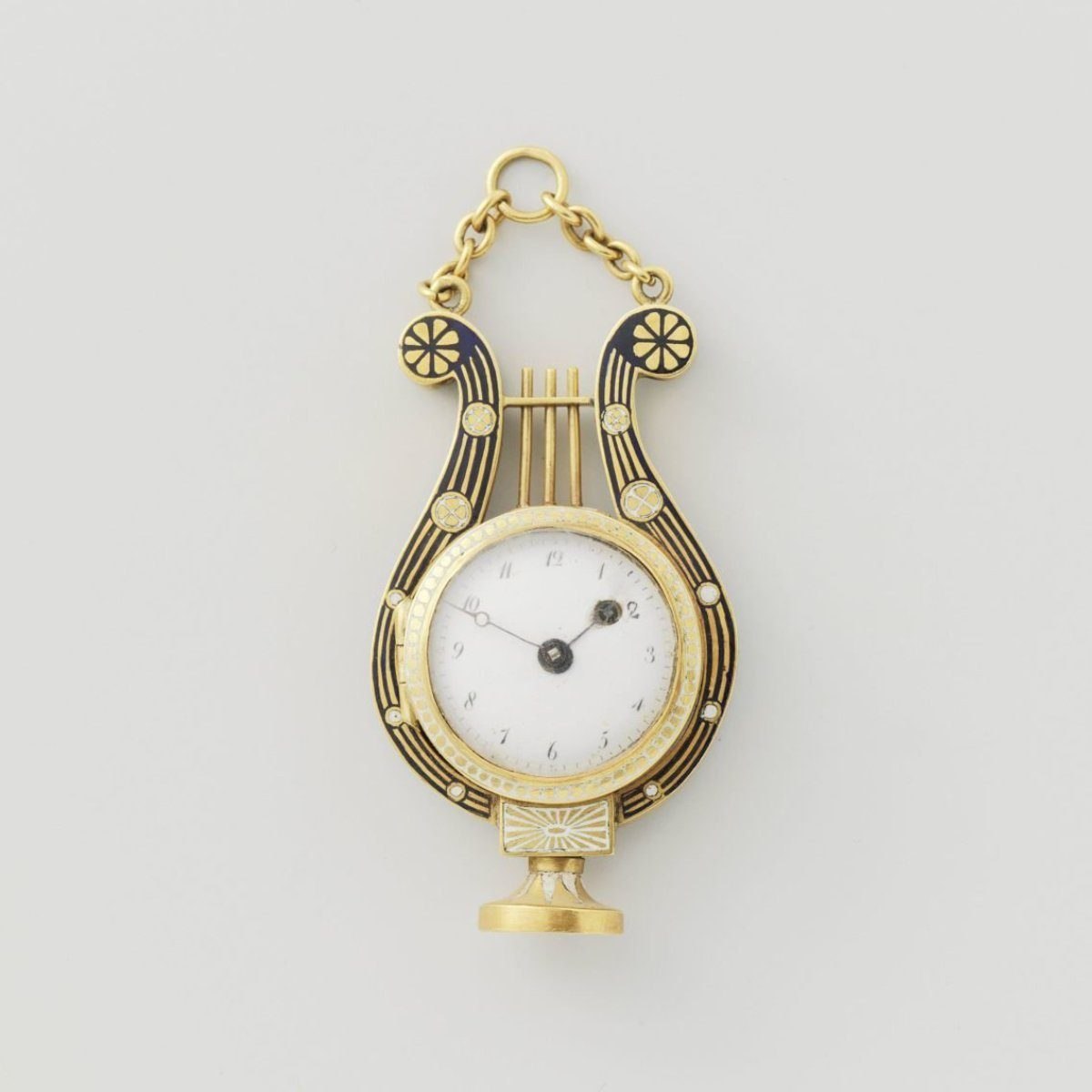
This lyre-shaped watch, identified as object BK-15049, is attributed to the Paris-based firm Breguet & Fils and dates from circa 1820 to 1830. The piece is constructed from gold, enamel, carnelian, and glass. The exterior takes the form of a musical lyre, decorated with gold lines and rosettes. At the base of this form sits a cachet featuring a depiction of an amor. The dial is integrated into the center of the lyre-shaped body, and the entire assembly is designed to be suspended, indicated by the chain link at the top. The watch entered the Rijksmuseum collection in 1937 as part of the Maurits Elzas bequest, having previously been part of the collection of J.G. de Groot Jamin.

Front view of the lyre-shaped watch showing the dial, enamel decoration, and suspension loop.
Front view of the lyre-shaped watch showing the dial, enamel decoration, and suspension loop. — Rijksmuseum. Rights pending — permission not yet requested. Original source

Catalogue identity

Source
www.rijksmuseum.nl
Category
Pocket watch · Lyre-shaped watch
Maker / attribution
Breguet & Fils
Reference
Not recorded
Catalogue / lot identifier
BK-15049
Source-reported date
ca. 1820 - ca. 1830
Source-reported place
France

Source-reported attribution and specifications are not independent authentication. A listing does not establish present ownership, current display, availability or permission to reproduce.

Object description

Design and Materiality

The watch is fashioned in the distinct shape of a lyre. The framework of the instrument is embellished with gold lines and rosette motifs, integrated with enamel detailing. The central dial is enclosed within this frame, which is topped with a suspension loop.

The bottom section of the lyre form terminates in a functional cachet, which features a figure of an amor. The materials utilized in the construction include gold, enamel, carnelian, and glass, combining horological utility with decorative arts.

Evidence for this section
  • “Horloge van goud en email in de vorm van een harp. Versierd met gouden lijnen en rozetten. De voet van de harp is een cachet met een amor.”
  • “Fysieke kenmerken goud, carneool, email en glas”

Attribution and Origin

The horological components of the object are attributed to the Parisian firm Breguet & Fils. The timing for the production of this watch is placed between approximately 1820 and 1830.

The identity of the goldsmith responsible for the decorative lyre-shaped housing remains anonymous. However, the documentation notes that the metalwork is possibly of Swiss origin.

Evidence for this section
  • “uurwerkmaker: Breguet & Fils, Parijs”
  • “edelsmid: anoniem, Zwitserland (mogelijk)”

Provenance and Collection

This object was formerly part of the collection of J.G. de Groot Jamin. It was auctioned in Amsterdam in December 1922, where it was acquired by Maurits Elzas.

Following the death of Maurits Elzas, the watch was bequeathed to the Rijksmuseum in 1937 as part of a larger collection of 107 watches.

Evidence for this section
  • “bequeathed with 106 other watches, as part of the 'Maurits Elzas Collection', to the museum, 1937”

Open research questions

  • What is the specific nature of the carnelian component referenced in the physical description?
  • Does the watch movement contain specific serial numbers that could confirm the Breguet & Fils attribution?

Source evidence

Recorded claims and source quotations for Lyre-shaped Watch
FieldSource-reported valueSource quotation
MakerBreguet & Fils“uurwerkmaker: Breguet & Fils, Parijs”
Dateca. 1820 - ca. 1830“ca. 1820 - ca. 1830”
MaterialsGold, carnelian, enamel, and glass“goud, carneool, email en glas”
GoldsmithAnonymous, potentially Switzerland“edelsmid: anoniem, Zwitserland (mogelijk)”
Object IDBK-15049“Objectnummer BK-15049”
ProvenanceAcquired via the Maurits Elzas bequest in 1937“legaat 1937”

Visible details

  • The watch case takes the literal form of a musical lyre.
  • The dial features black Arabic numerals for the hours.
  • The base of the watch frame serves as a cachet or seal.
  • The frame includes geometric enamel work and applied gold rosette motifs.

Research qualifications

  • The source attributes the goldsmith work to Switzerland only as a possibility.
  • The precise functional mechanism inside the case is not detailed in the source.

Photograph identity and source facts were screened before import; rights clearance remains pending.

Consulted source

Lyre-shaped Watch

Reviewed 2026-11-02 · Record 9ad1487540

Terms in this record

Glossary explanations for terms named in this object’s record.