
Skip to content
The Encyclopedia of Horology

Clock · Mantel clock

Louis XVI Style Marble and Ormolu Mantel Clock

Partially verified

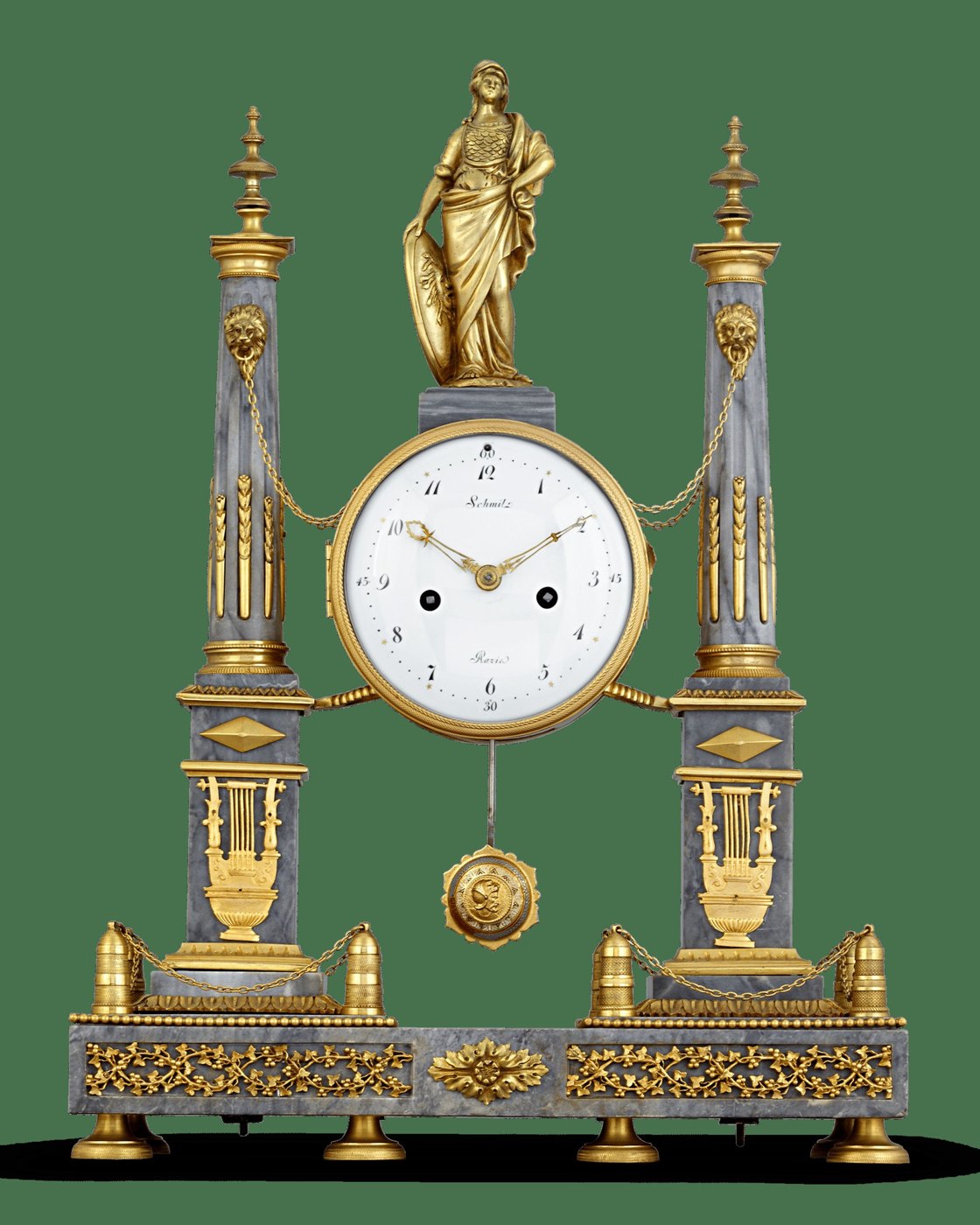
This neoclassical mantel clock is constructed from grey veined marble and ormolu (gilt-bronze). The clock features a central circular dial with Arabic numerals, signed "Schmit" and "Paris," set between two marble columns decorated with gilt-bronze mounts. The top of the clock case is surmounted by a gilt figure of Athena, who holds a shield bearing a depiction of Medusa. The clock stands on a rectangular marble base, adorned with additional gilt-bronze foliage and geometric motifs. Pendulum decoration includes a central classical profile framed by multi-colored details. The movement is visible from the rear, which shows the brass bell and mechanical components. The maker, Jean-Nicolas Schmit, attained the status of master clockmaker (maître-horloger) in August 1781.

Front view of the Louis XVI style marble and ormolu mantel clock by Jean-Nicolas Schmit.
Front view of the Louis XVI style marble and ormolu mantel clock by Jean-Nicolas Schmit. — M.S. Rau. Rights pending — permission not yet requested. Original source

Catalogue identity

Source
zamanito.com
Category
Clock · Mantel clock
Maker / attribution
Jean-Nicolas Schmit
Reference
Not recorded
Catalogue / lot identifier
Source URL identifies the listing
Source-reported date
late 18th century
Source-reported place
France

Source-reported attribution and specifications are not independent authentication. A listing does not establish present ownership, current display, availability or permission to reproduce.

Object description

Case and Design

The clock is designed in the neoclassical style, utilizing grey-veined marble as the primary structural material. It is anchored by a rectangular base and two flanking columns, which are embellished with gilt-bronze mounts. These decorative elements include lyre forms on the pedestal bases and lion-head masks integrated into the upper portions of the columns.

A central circular dial, finished in white with Arabic numerals, is suspended between the columns. The composition is finished at the summit with a gilt-bronze figure of the goddess Athena, who is depicted wearing classical attire and holding a shield decorated with the head of Medusa.

Evidence for this section
  • “ساختار کلی ساعت بر پایه‌ای از سنگ مرمر خاکستری-رگه‌دار استوار است”
  • “در بالاترین بخش اثر، مجسمه‌ای زرین از الهه آتنا قرار دارد”
  • “تزئینات زنجیری آویزان، سرهای شیر و نقش ساز چنگ روی پایه‌ها بازتاب‌دهنده زبان بصری سبک نئوکلاسیک اواخر قرن هجدهم فرانسه هستند.”

Movement and Dial

The dial of the clock features Arabic numerals and is inscribed with the signature of Jean-Nicolas Schmit along with the city of origin, Paris. The time is indicated by gilt hands. Access for winding is provided through two ports located on the dial face.

The rear of the clock exposes the mechanical movement, featuring a brass bell, which serves as part of the striking mechanism. A pendulum, visible through the space between the columns, incorporates a classical portrait encircled by colorful details in red, blue, and white.

Evidence for this section
  • “صفحه ساعت با زمینه سفید و ارقام عربی طراحی شده و نام سازنده به همراه نام پاریس روی آن نقش بسته است”
  • “آونگ آویزان در بخش میانی دارای نقوش مدور با جزئیات آبی، سرخ و سفید است”
  • “پشت ساعت نیز ساختار موتور مکانیکی و کاسه زنگ برنجی را به نمایش می‌گذارد.”

Maker and History

Records indicate he was formally admitted as a master clockmaker (maître-horloger) in August 1781.

The auction description provides the physical measurements of the clock, listing the width at 15 7/8 inches, the depth at 6 1/8 inches, and the height at 21 3/8 inches. The report notes that there is no documentation regarding the item's maintenance or mechanical condition.

Evidence for this section
  • “ژان-نیکولا اشمیت از برجسته‌ترین استادان ساعت‌ساز پاریس در دوران خود به شمار می‌رفت که در اوت سال ۱۷۸۱ میلادی به عنوان استاد ساعت‌ساز (maître-horologer) برگزیده شد.”
  • “ابعاد این اثر برابر با ۱۵ و ۷/۸ اینچ پهنا، ۶ و ۱/۸ اینچ عمق و ۲۱ و ۳/۸ اینچ ارتفاع گزارش شده است.”

Open research questions

  • Are there known surviving records of Jean-Nicolas Schmit's workshop identifying this specific clock model?
  • Can the provenance of this specific clock be traced to a historical collection prior to the dealer listing?

Source evidence

Recorded claims and source quotations for Louis XVI Style Marble and Ormolu Mantel Clock
FieldSource-reported valueSource quotation
MakerJean-Nicolas Schmit“ژان-نیکولا اشمیت”
DateLate 18th century“اواخر قرن هجدهم میلادی”
Height21 3/8 inches“۲۱ و ۳/۸ اینچ”
Width15 7/8 inches“۱۵ و ۷/۸ اینچ”
Depth6 1/8 inches“۶ و ۱/۸ اینچ”
MaterialsMarble and ormolu“مرمر و برنز طلاکوب (اورمولو)”
Master status dateAugust 1781“اوت سال ۱۷۸۱ میلادی”

Visible details

  • Arabic numerals on a white dial
  • Gilt-bronze lyre-shaped motifs on column pedestals
  • Pendulum features a central portrait with blue, red, and white detailing
  • Visible brass bell on the rear of the movement

Research qualifications

  • The source notes that details regarding service history or mechanical function are not provided.
  • The source clarifies that attribution and historical information are based on dealer descriptions and lack independent expert verification.

Photograph identity and source facts were screened before import; rights clearance remains pending.

Terms in this record

Glossary explanations for terms named in this object’s record.