
Skip to content
The Encyclopedia of Horology

Tool · French equinoctial dial

Ivory Equinoctial Dial

Partially verified

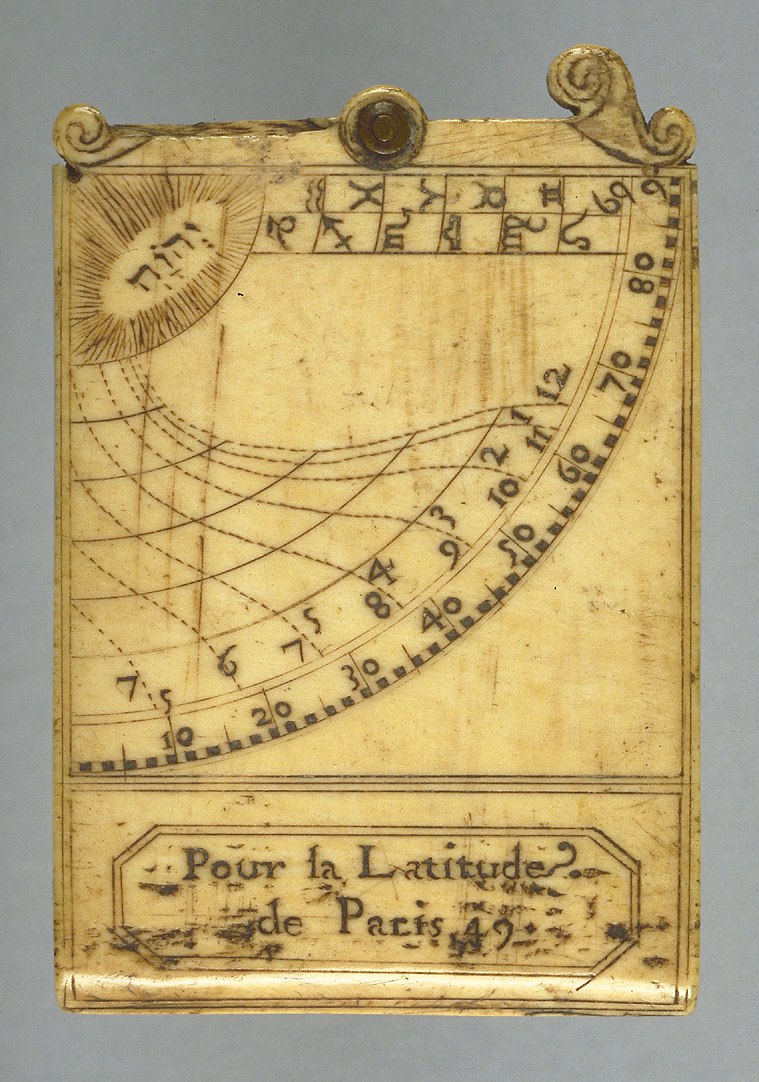
This unsigned ivory equinoctial dial is attributed to late 16th-century France. Constructed from a single leaf measuring 53 x 73 x 6 mm, the instrument integrates multiple timekeeping functions. The obverse face features an horary quadrant with a limb graduated in degrees, a scale for zodiacal signs, and common hour lines numbered from 5 to 12 to 7. The apex contains the Hebrew tetragram for 'God', and the lower section bears the inscription 'Pour la Latitude de Paris 49'. The reverse contains a Regiomontanus-type dial featuring zodiacal symbols, a scale of latitudes, and hours numbered from 1 to 12. The rims feature a shadow scale with varying numerical divisions. The instrument includes two terminal scrolls at the top, pierced to function as sights, though one is damaged. The original arm for the plumb bob is currently missing from the device.

The horary quadrant face of the equinoctial dial, showing the Hebrew tetragram and the Paris latitude inscription.
The horary quadrant face of the equinoctial dial, showing the Hebrew tetragram and the Paris latitude inscription. — British Museum, London. Rights pending — permission not yet requested. Original source

Catalogue identity

Source
www.mhs.ox.ac.uk
Category
Tool · French equinoctial dial
Maker / attribution
Not established
Reference
Not recorded
Catalogue / lot identifier
MLA 1895, 3-19.2
Source-reported date
Late 16th century ?
Source-reported place
France

Source-reported attribution and specifications are not independent authentication. A listing does not establish present ownership, current display, availability or permission to reproduce.

Object description

Construction and Design

The dial is formed from a single piece of ivory, measuring 53 mm in width, 73 mm in height, and 6 mm in thickness. The device features two terminal scrolls at the top edge, which are pierced to serve as sights; the source notes that one of these components is broken. The overall architecture is designed as a multi-functional timekeeper, incorporating both a Regiomontanus-type dial and an horary quadrant.

The instrument incorporates a shadow scale distributed across three of its rims, marked with specific subdivisions and numbers. The primary face displays an horary quadrant with a scale of degrees and zodiacal signs, while the reverse side contains the Regiomontanus-type arrangement. The missing plumb bob arm suggests the instrument is incomplete.

Evidence for this section
  • “Ivory; 53 x 73 x 6 mm”
  • “The two terminal scrolls at the top of the leaf are pierced to form sights (one of them is broken).”
  • “The arm for the plumb bob is missing.”

Inscriptions and Markings

The instrument features several inscriptions and numerical markings. On the obverse, within the apex of the horary quadrant, is the Hebrew tetragram representing 'God'. The bottom section of this face includes the inscription 'Pour la Latitude de Paris 49', denoting the intended geographic utility of the dial.

The Regiomontanus dial includes numerical scales for latitudes ranging from 5 to 60. Some of the numerical engravings on the rims are described as having potential discrepancies, with the source noting specific instances of apparent errors in the original sequence, such as '44 (recte 40?)' and '02 (recte 20?)'.

Evidence for this section
  • “In the apex of the horary quadrant , on the obverse of the ivory leaf, it has the Hebrew tetragram meaning 'God'.”
  • “On the bottom part of the leaf is the inscription 'Pour la Latitude de Paris 49'.”
  • “The shorter side of the leaf is numbered twice; one division is from 100, 80, 60, 44 (recte 40?), 02 (recte 20?) and below”

Documentation and History

The instrument is currently held by the British Museum in London, identified under registration number MLA 1895, 3-19.2. It was acquired by the museum in 1895. The dial is documented in the publication 'A Catalogue of European Scientific Instruments in the Department of Medieval and Later Antiquities of the British Museum' by F. A. B. Ward, published in 1981.

The date of manufacture is placed in the late 16th century, though this attribution is presented with uncertainty. The production origin is identified as French, based on the provided catalogue information.

Evidence for this section
  • “The instrument was purchased in 1895”
  • “described in F. A. B. Ward, A Catalogue of European Scientific Instruments in the Department of Medieval and Later Antiquities of the British Museum (London, 1981), p. 57, no.152.”
  • “Late 16th century ?; French”

Open research questions

  • What was the exact purpose of the varied numerical values identified as potentially erroneous by the researchers?
  • Is there evidence of other similar ivory equinoctial dials from the same French workshop to compare stylistic elements?

Source evidence

Recorded claims and source quotations for Ivory Equinoctial Dial
FieldSource-reported valueSource quotation
Inventory numberMLA 1895, 3-19.2“MLA 1895, 3-19.2”
Dimensions53 x 73 x 6 mm“53 x 73 x 6 mm”
Inscribed LatitudeParis, 49 degrees“Pour la Latitude de Paris 49”
ProvenancePurchased in 1895“The instrument was purchased in 1895”
OriginFrench“French”

Visible details

  • The dial is constructed from ivory.
  • One of the terminal scroll sights is broken.
  • The plumb bob arm is absent.
  • The device includes a Hebrew inscription in the apex of the horary quadrant.

Research qualifications

  • The dating remains uncertain, indicated by a question mark in the documentation.
  • Numerical markings on the instrument's side display potential errors, with source notations 'recte 40?' and 'recte 20?' suggesting inaccuracies in the original engraving.

Photograph identity and source facts were screened before import; rights clearance remains pending.

Consulted source

Equinoctial Dial

Reviewed 2026-10-26 · Record 9e6026435a

Terms in this record

Glossary explanations for terms named in this object’s record.