
Skip to content
The Encyclopedia of Horology

Tool · Iberian diptych dial

Ivory and silver diptych sundial

Partially verified

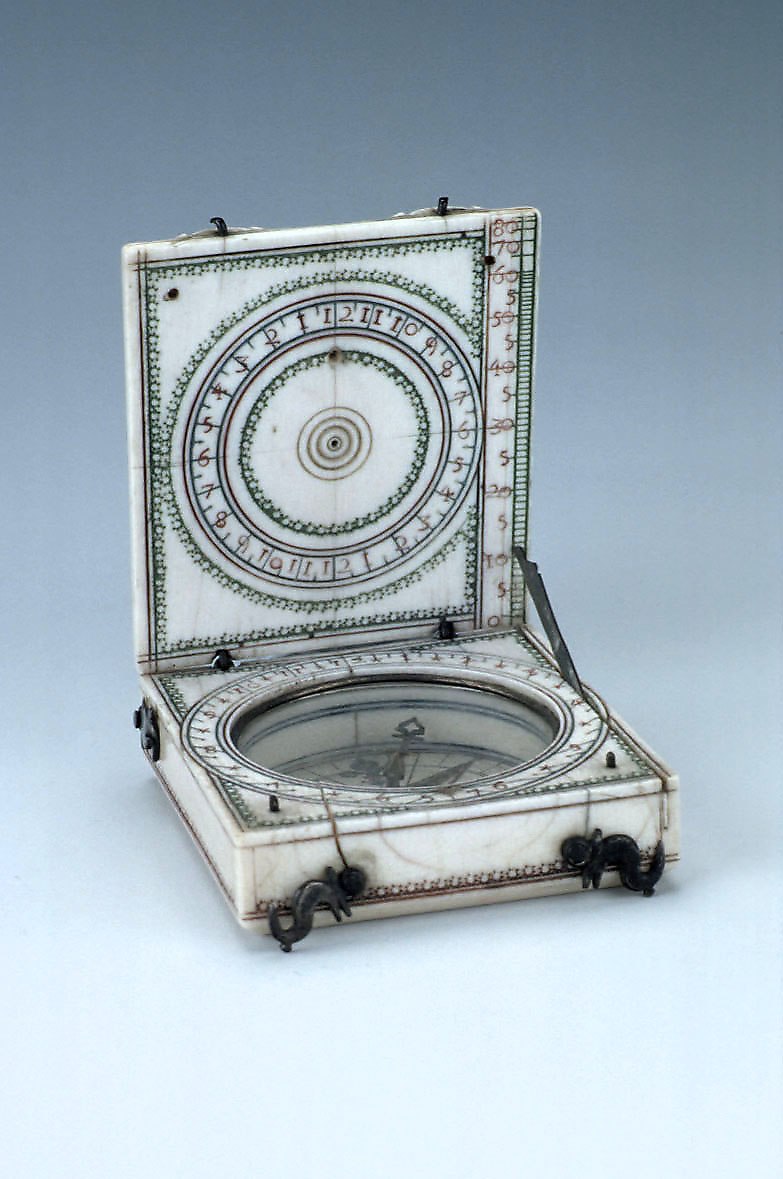
This unsigned ivory and silver diptych dial, catalogued by the Museum of the History of Science, Oxford (inventory number 83993), dates to circa 1600. The object measures 64 x 68 x 22 mm and is constructed from ivory leaves with silver components. It features complex, multi-functional timekeeping surfaces. The outer side of the upper leaf originally featured a pin gnomon dial, though the pin is now missing. The inner side of the upper leaf contains a latitude scale, while the lower leaf houses a compass bowl and a horizontal string gnomon dial for common hours. The instrument is decorated with geometrical border designs and incorporates a painted compass card. The dial is attributed to Spanish manufacture based on stylistic indicators, specifically the painting techniques applied to the compass card. It includes specific provisions for adjustment and storage, including a latitude adjustment arm and a dedicated compartment for the missing gnomon pin.

An ivory and silver diptych sundial, featuring internal latitude scales, a compass, and a string gnomon.
An ivory and silver diptych sundial, featuring internal latitude scales, a compass, and a string gnomon. — Museum of the History of Science, Oxford. Rights pending — permission not yet requested. Original source

Catalogue identity

Source
www.mhs.ox.ac.uk
Category
Tool · Iberian diptych dial
Maker / attribution
Not established
Reference
Not recorded
Catalogue / lot identifier
83993
Source-reported date
circa 1600 ?
Source-reported place
Spain

Source-reported attribution and specifications are not independent authentication. A listing does not establish present ownership, current display, availability or permission to reproduce.

Object description

Case and Exterior Features

The diptych dial is constructed from ivory, with its structure comprising an upper and lower leaf. The overall dimensions of the object are 64 x 68 x 22 mm. The exterior surfaces of the leaves are ornamented with simple geometrical decoration along the borders.

The upper leaf exterior originally featured a pin gnomon dial for common hours, marked 1 to 12 twice. This surface is decorated with green, red, and blue colors, with concentric circles appearing at the center. However, the pin itself is missing from the assembly. A storage compartment for the missing pin is located on the left edge of the lower leaf.

Evidence for this section
  • “This dial has simple geometrical decoration on the borders of its ivory leaves”
  • “The outer side of the upper leaf has a pin gnomon dial (pin missing)”
  • “on the left edge of the leaf is the compartment for stowing the pin.”

Dial Functions and Internal Mechanisms

The internal face of the upper leaf contains a latitude scale, marked on the right side in red. This scale ranges from 0 to 80 degrees, divided into 1-degree increments, with numerical markers at 5-degree intervals. The internal face of the lower leaf features a horizontal string gnomon dial for common hours, with markings reading 5 to 12 to 7.

A compass bowl is integrated into the lower leaf, containing a paper compass card. This card is silvered and painted in red, blue, and silver, with a fleur-de-lis representing north. An arm for adjusting the instrument to the latitude is mounted on the right side of the leaf.

Evidence for this section
  • “The inner side of the upper leaf has the same pattern and an unequal scale for latitudes on the right, marked in red from 0? to 80?”
  • “The inner side of the lower leaf has a compass bowl with paper compass card”
  • “The arm for adjusting the latitude is on the right side”

Attribution and Origin

The object is currently unsigned, providing no explicit information regarding its maker. The attribution to Spanish manufacture is derived from the stylistic treatment of the compass card.

The estimated date of the dial is circa 1600. The museum documentation references scholarly work regarding the broader context of ivory sundials during the 16th and 17th centuries to assist in classification.

Evidence for this section
  • “Unsigned”
  • “Painted compass card s were typical of Spanish and Italian dials , hence the attribution of this example.”
  • “circa 1600 ?”

Open research questions

  • What is the specific mechanical purpose of the concentric circle decoration on the upper leaf?
  • Could further analysis of the silver hinges and clasps provide a more precise origin than the stylistic attribution of the compass card?

Source evidence

Recorded claims and source quotations for Ivory and silver diptych sundial
FieldSource-reported valueSource quotation
Inventory number83993“Inventory number 83993”
Datecirca 1600 ?“circa 1600 ?”
Dimensions64 x 68 x 22 mm“64 x 68 x 22 mm”
MaterialsIvory and silver“Ivory and silver”
OriginSpanish“Spanish”
ConditionPin missing from upper leaf gnomon“The outer side of the upper leaf has a pin gnomon dial (pin missing)”

Visible details

  • Geometrical decoration borders the ivory leaves.
  • The compass card is painted in red, blue, and silver with a fleur-de-lis indicating north.
  • A latitude adjustment arm is positioned on the right side of the lower leaf.
  • The pin gnomon on the upper leaf is missing.

Research qualifications

  • The dating is prefaced with a question mark, indicating uncertainty.
  • The attribution to Spanish origin is based on stylistic associations rather than a maker's signature or explicit provenance.
  • The pin for the gnomon dial on the outer upper leaf is missing.

Photograph identity and source facts were screened before import; rights clearance remains pending.

Consulted source

Diptych Dial

Reviewed 2026-10-26 · Record fe6a6069ac

Terms in this record

Glossary explanations for terms named in this object’s record.