
Skip to content
The Encyclopedia of Horology

Tool · Armillary sundial

Iron Armillary Sundial

Partially verified

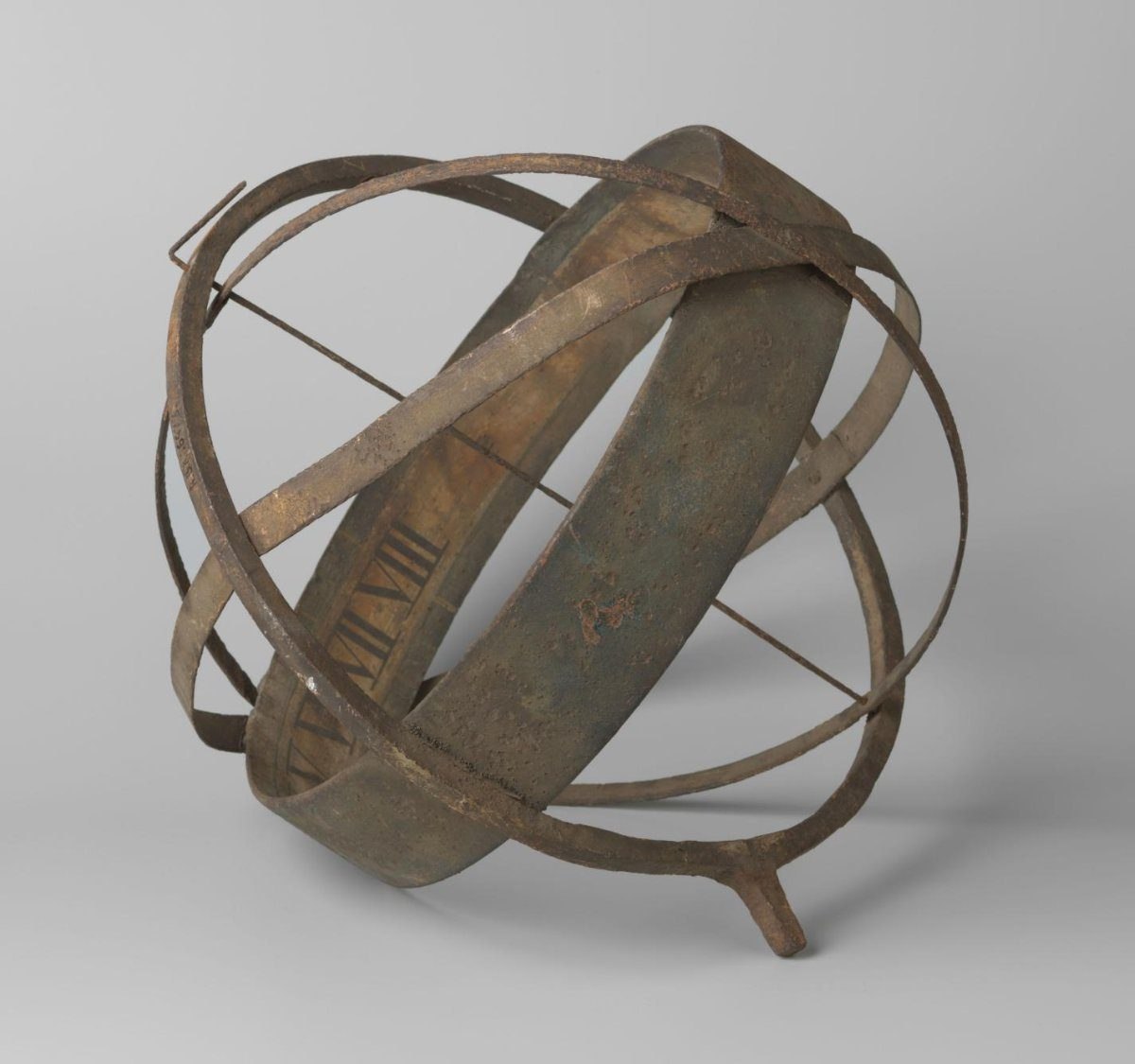
This armillary sundial, catalogued under inventory number BK-16973, is constructed of iron. It is designed as a celestial sphere consisting of several metal rings. The object features a graduated band with Roman numerals visible on its inner surface. It is dated by the Rijksmuseum to the period between circa 1699 and circa 1749. The provenance of this piece is well-documented, tracing its history through the collection of Dr. Fritz Mannheimer in Amsterdam and Paris, subsequent movement during the 1930s and 1940s, and its eventual acquisition by the Rijksmuseum.

An iron armillary sundial featuring a series of concentric metal rings with Roman numerals on the interior band.
An iron armillary sundial featuring a series of concentric metal rings with Roman numerals on the interior band. — Rijksmuseum. Rights pending — permission not yet requested. Original source

Catalogue identity

Source
www.rijksmuseum.nl
Category
Tool · Armillary sundial
Maker / attribution
Not established
Reference
Not recorded
Catalogue / lot identifier
BK-16973
Source-reported date
ca. 1699 - ca. 1749
Source-reported place
Not established

Source-reported attribution and specifications are not independent authentication. A listing does not establish present ownership, current display, availability or permission to reproduce.

Object description

Construction and Design

The sundial is constructed primarily from iron, forming an armillary sphere structure. This design uses a series of concentric metal rings intended to represent celestial coordinates. The primary band, which serves as the dial, contains Roman numeral hour markings on its interior face. The overall composition includes a structural framework designed to support the orientation of the rings relative to the sun.

Historical documentation notes that the iron assembly was once topped by a lead dragon figurine. The absence of the original stone pedestal, which would have supported the metal sphere, indicates that the object is currently in an incomplete state. The physical appearance shows age-related surface wear consistent with iron materials exposed over time.

Evidence for this section
  • “Een ijzeren zonnewijzer bekroond door een loden draak (BK-16973-1).”
  • “Het stenen voetstuk ontbreekt.”

Provenance and History

The object was part of the collection of Dr. Fritz Mannheimer, held in Amsterdam and Paris prior to 1933. In 1934, it served as security for a loan from the Mendelssohn & Co. Bank to Artistic & General Securities Ltd., though it remained in Mannheimer's possession until his death. Following his estate's financial developments in 1939, the object was acquired by the Dienststelle Mühlmann in 1940 for the planned Führermuseum in Linz.

Following the end of the Second World War, the object was identified as war-related recuperation and processed by the SNK in 1945. It was subsequently moved to museum storage and became part of the Rijksmuseum collection through a transfer in 1960. This timeline illustrates the movement of the object through private, financial, and institutional hands during the mid-20th century.

Evidence for this section
  • “collection Dr Fritz Mannheimer (1890-1939), Amsterdam and Paris, before 1933”
  • “war recuperation, SNK, 1945”

Documentation and Attribution

The Rijksmuseum identifies this object as an iron sundial. The institution assigns a broad dating range of approximately 1699 to 1749 to the work. The cataloguing includes reference to the now-missing lead component and stone base as essential aspects of the object's original historical design.

These records are archived with references to the original photographic documentation of the Mannheimer house and the post-war administrative records concerning recovered cultural property.

Evidence for this section
  • “ca. 1699 - ca. 1749”
  • “Deze herkomstzin is geformuleerd met een speciale focus op de periode 1933-45”

Open research questions

  • What is the specific geographical or workshop origin of the ironwork?
  • Are there similar armillary sundials of this era with the same lead dragon motif that can confirm the original aesthetic configuration?

Source evidence

Recorded claims and source quotations for Iron Armillary Sundial
FieldSource-reported valueSource quotation
Object typezonnewijzer“zonnewijzer”
Inventory numberBK-16973“BK-16973”
Dateca. 1699 - ca. 1749“ca. 1699 - ca. 1749”
MaterialIron and lead“Een ijzeren zonnewijzer bekroond door een loden draak (BK-16973-1).”
Missing componentsStone pedestal“Het stenen voetstuk ontbreekt.”
Former ownerDr. Fritz Mannheimer“collection Dr Fritz Mannheimer (1890-1939)”

Visible details

  • Iron framework comprised of multiple intersecting rings
  • Interior band inscribed with Roman numerals for time indication
  • Missing stone pedestal base
  • Visual traces of oxidation on the iron surfaces

Research qualifications

  • The exact date of manufacture is an estimate spanning 50 years
  • The current state of the object is incomplete due to the absence of the stone pedestal

Photograph identity and source facts were screened before import; rights clearance remains pending.

Consulted source

Sundial, c. 1699 - c. 1749

Reviewed 2026-11-02 · Record 92d5dced3a

Terms in this record

Glossary explanations for terms named in this object’s record.