
Skip to content
The Encyclopedia of Horology

Tool · Horizontal dial

Horizontal Sundial

Partially verified

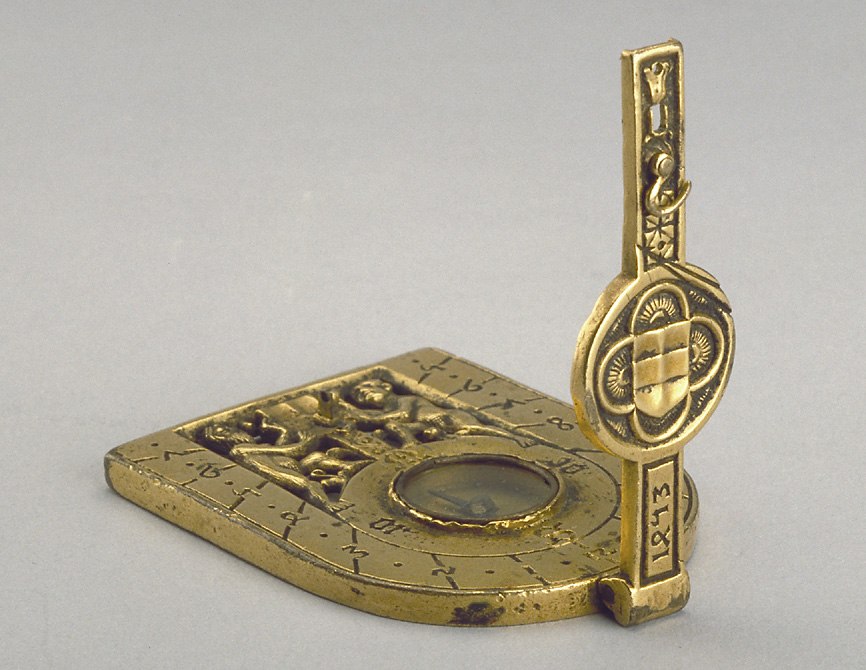
This is a horizontal string gnomon dial crafted from gilt brass, measuring 59 by 80 by 5 millimeters. The dial plate features a shield-like geometry with engraved hour lines ranging from 4:30 to 12 and back to 7:30, with subdivisions marked by dots. It incorporates a central compass with magnetic deviation indicated, surrounded by abbreviated cardinal points on the plate surface. A folding arm, used to support the missing string gnomon, is decorated with a central coat-of-arms and displays the date 1453. Two male figures holding a shield are positioned above the compass assembly. This instrument belongs to a documented group of early portable dials often associated with the work of Georg Peuerbach or Regiomontanus, although the authenticity of these specific pieces remains a subject of academic discussion. It was previously part of the Spitzer Collection and is now held by the British Museum.

Horizontal sundial in gilt brass featuring a shield-shaped plate and folding gnomon arm, dated 1453.
Horizontal sundial in gilt brass featuring a shield-shaped plate and folding gnomon arm, dated 1453. — British Museum, London. Rights pending — permission not yet requested. Original source

Catalogue identity

Source
www.mhs.ox.ac.uk
Category
Tool · Horizontal dial
Maker / attribution
Not established
Reference
Not recorded
Catalogue / lot identifier
MLA 1893, 6-16.9
Source-reported date
1453
Source-reported place
Austria

Source-reported attribution and specifications are not independent authentication. A listing does not establish present ownership, current display, availability or permission to reproduce.

Object description

Dial Plate and Geometry

The instrument features a shield-shaped gilt brass plate. The primary dial surface is engraved with hour lines numbered individually, extending from 4:30 to 12 and down to 7:30. These markers are further divided into half-hour segments indicated by small dots. The central area contains a compass set directly into the plate, with the four cardinal directions denoted by the abbreviations 'S', 'OR', 'M', and 'OC'.

The assembly is supported by a hinged, folding arm used for the string gnomon. This arm is embellished with a coat-of-arms located at its center. A mechanical catch on the reverse side of the arm allows it to remain secured in a folded position when the instrument is not in active use. The underside or reverse of the main plate is plain and unengraved.

Evidence for this section
  • “This dial consists of a gilt brass plate in the shape of a shield.”
  • “The actual dial plate is engraved with hour lines, from [4.30] to 12 to [7.30], numbered by one, divided to the half hour with dots.”
  • “The other side of the arm has a small catch which keeps the arm itself folded when not in use.”

Origins and Scholarly Debate

This object is categorized as one of a group of instruments sharing similar design characteristics, though variations exist between individual examples. Historical research has proposed links to the work of Georg Peuerbach and his pupil Regiomontanus. If authentic, these pieces would represent the earliest known examples of portable dials that integrate both a compass and a polar gnomon mechanism.

However, the provenance and production period are subject to academic scrutiny. Certain scholars have raised doubts regarding the authenticity of this specific family of dials. The instrument is officially recorded in the British Museum as part of the Department of Medieval and Later Antiquities, having been catalogued by F. A. B. Ward in 1981.

Evidence for this section
  • “They have been attributed to Georg Peuerbach and to his pupil Regiomontanus, but some doubts have been expressed on the authenticity of these instruments.”
  • “Some scholars have raised doubts about the authenticity of these dials, which would be the earliest string gnomon dials and the earliest portable dials incorporating a compass and with polar gnomons.”

Features and Figures

A decorative element consisting of two male figures holding a shield is situated directly above the compass housing. This sculptural detail is integrated into the gilt brass plate design. The string gnomon, which historically functioned as the shadow-casting component, is currently missing from the instrument. Despite this absence, the structural remnants of the support arm confirm the original configuration of the device.

The dating of the instrument is established by the '1453' inscription found directly on the folding arm. The magnetic deviation is noted within the compass area, indicating a function designed for navigational or orientation-based timekeeping. The total size of the instrument is consistent with its classification as a portable device, measuring 59 by 80 by 5 millimeters.

Evidence for this section
  • “On top of the compass are two male figures holding a shield.”
  • “The shadow is cast by a string gnomon (now missing), held by a folding arm.”
  • “The arm is decorated at the centre with a coat-of-arms and is engraved with the date 1453.”

Open research questions

  • What physical evidence supports the attribution to the circle of Peuerbach or Regiomontanus?
  • How does the compass design relate to the purported magnetic deviation indicated on the plate?

Source evidence

Recorded claims and source quotations for Horizontal Sundial
FieldSource-reported valueSource quotation
MaterialGilt brass“Gilt brass; 59 x 80 x 5 mm”
Inventory numberMLA 1893, 6-16.9“Registration no. MLA 1893, 6-16.9”
Date1453“Dated 1453; Austrian”
DesignShield-shaped plate“This dial consists of a gilt brass plate in the shape of a shield.”
Cardinal pointsS, OR, M, OC“cardinal points abbreviated 'S', 'OR', 'M', 'OC' on the plate outside the compass.”
ProvenanceSpitzer Collection“The instrument belonged to the Spitzer Collection”
Gnomon typeString gnomon“This string gnomon dial , dated 1453”

Visible details

  • Shield-shaped gilt brass plate
  • Folding gnomon arm with 1453 date
  • Engraved hour lines with half-hour intervals
  • Compass integrated into the dial plate

Research qualifications

  • Missing original string gnomon
  • Authenticity of the instrument questioned by some scholars

Photograph identity and source facts were screened before import; rights clearance remains pending.

Consulted source

Horizontal Dial

Reviewed 2026-10-26 · Record 2b277ccd25

Terms in this record

Glossary explanations for terms named in this object’s record.

Other horizontal dial records