
Skip to content
The Encyclopedia of Horology

Tool · Augsburg horizontal dial

Horizontal Dial in a Powder Flask

Partially verified

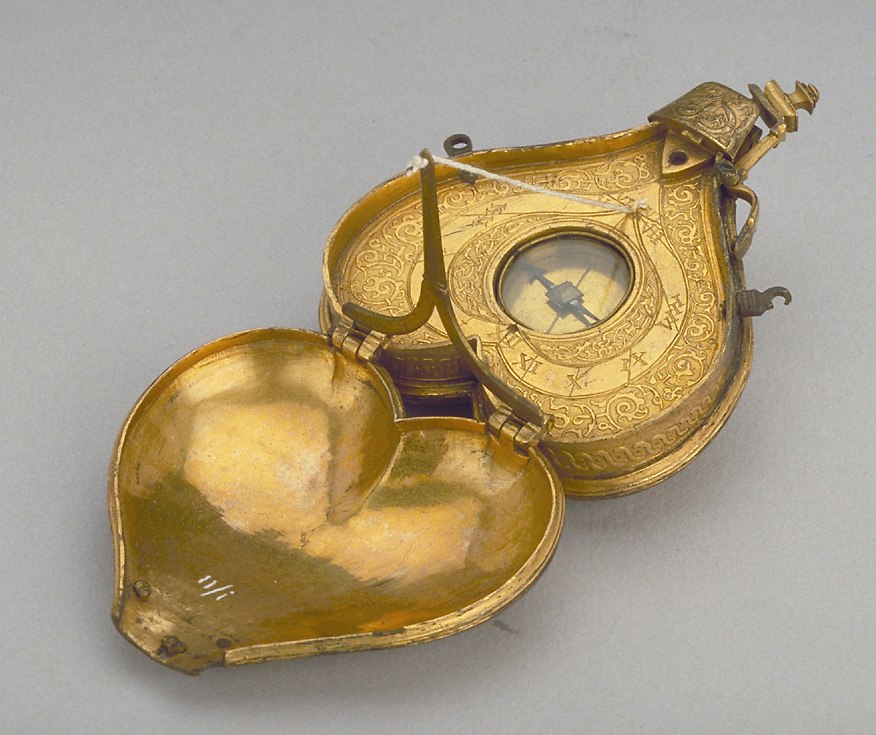
This horizontal dial, attributed to the maker Christoph Schissler, dates to approximately 1560 and originated in Augsburg. Constructed from brass, the device measures 71 x 35 x 90 mm and is fashioned in the form of a three-dimensional heart, simultaneously functioning as a powder flask. The exterior surfaces are adorned with intricate strapwork engraving. When opened, the interior of the box reveals a central compass featuring magnetic deviation markings. A series of concentric hearts serves as the backdrop for the dial's hour lines, which indicate common hours from VI to XII to VI. A string gnomon, mounted on a folding support, facilitates timekeeping. The device includes two suspension rings, one of which is damaged. The hollow interior space beneath the dial-plate serves as a container for gunpowder, representing a dual-purpose tool combining horological function with military or hunting equipment utility.

The horizontal dial and powder flask, shown in the open position with the string gnomon raised and the internal compass visible.
The horizontal dial and powder flask, shown in the open position with the string gnomon raised and the internal compass visible. — British Museum, London. Rights pending — permission not yet requested. Original source

Catalogue identity

Source
www.mhs.ox.ac.uk
Category
Tool · Augsburg horizontal dial
Maker / attribution
Christoph Schissler
Reference
Not recorded
Catalogue / lot identifier
MLA 1855, 12-1.219
Source-reported date
circa 1560
Source-reported place
Germany

Source-reported attribution and specifications are not independent authentication. A listing does not establish present ownership, current display, availability or permission to reproduce.

Object description

Construction and Design

The object is crafted from brass and takes the form of a three-dimensional heart, measuring 71 by 35 by 90 millimetres. The exterior surfaces of this heart-shaped casing are decorated with fine strapwork engraving. The construction serves a dual purpose, acting as a horizontal sun dial while the hollow interior cavity provides a functional powder flask.

The dial layout is located on the interior of the main box. It features concentric heart-shaped lines and strapwork motifs surrounding a central compass. The hour lines, intended for a string gnomon, are engraved for common hours ranging from VI to XII and back to VI.

Evidence for this section
  • “This dial is in the form of a three dimensional heart.”
  • “Both external sides are finely decorated with strapwork.”
  • “The hollow space below the dial-plate is a powder flask.”

Instrumentation and Components

The timekeeping mechanism relies on a string gnomon held by a hinged folding support, which allows the instrument to be collapsed when not in use. A compass is inset at the centre of the dial plate, which includes markings for magnetic deviation to aid in the correct orientation of the instrument.

Two small rings are provided for suspension, though the condition of the object includes a break in one of these elements. The internal face of the lid is plain and lacks any decoration or engraving.

Evidence for this section
  • “The inner part of the box has at the centre a compass with magnetic deviation marked.”
  • “The string gnomon is held by a hinged folding support.”
  • “There are also two small rings for suspension, one of which is broken.”

Provenance and Historical Context

The instrument was previously part of the Bernal Collection before entering the holdings of the British Museum. It is formally referenced in F. A. B. Ward’s catalogue of European scientific instruments held by the museum, where it is listed as item number 11.

Historical comparisons have been drawn to similar examples in scholarly literature, specifically referencing work by A. Rohde. It is noted that while such combination tools were not common, other instances of time-telling devices being integrated into tobacco and powder cases are recorded.

Evidence for this section
  • “The dial is was formerly in the Bernal Collection and is described in F. A. B. Ward, A Catalogue of European Scientific Instruments in the Department of Medieval and Later Antiquities of the British Museum”
  • “It is similar to an example illustrated by A. Rohde, Die Geschichte der Wissenschaftlichen Instrumente”
  • “Even though it was not common, there are other instances of time-telling devices such as dials and quadrants being engraved on powder and tobacco cases.”

Open research questions

  • Are the compass and gnomon support considered original to the Schissler workshop?
  • Does the magnetic deviation marking provide evidence for the specific geographic region of its intended use?

Source evidence

Recorded claims and source quotations for Horizontal Dial in a Powder Flask
FieldSource-reported valueSource quotation
MakerChristoph Schissler“Attributed to Christoph Schissler”
Datecirca 1560“circa 1560”
Dimensions71 x 35 x 90 mm“71 x 35 x 90 mm”
Inventory NumberMLA 1855, 12-1.219“Registration no. MLA 1855, 12-1.219”
CollectionBernal Collection“The dial is was formerly in the Bernal Collection”
FunctionHorizontal dial and powder flask“The hollow space below the dial-plate is a powder flask.”

Visible details

  • Heart-shaped brass housing with strapwork decoration
  • Folding string gnomon assembly with hinged support
  • Central inset compass with visible needle
  • Two suspension rings attached to the exterior

Research qualifications

  • Possible later restoration of the compass assembly
  • Potential later replacement of the string gnomon support

Photograph identity and source facts were screened before import; rights clearance remains pending.

Consulted source

Horizontal Dial

Reviewed 2026-10-26 · Record 88c0d1d48e

Terms in this record

Glossary explanations for terms named in this object’s record.