
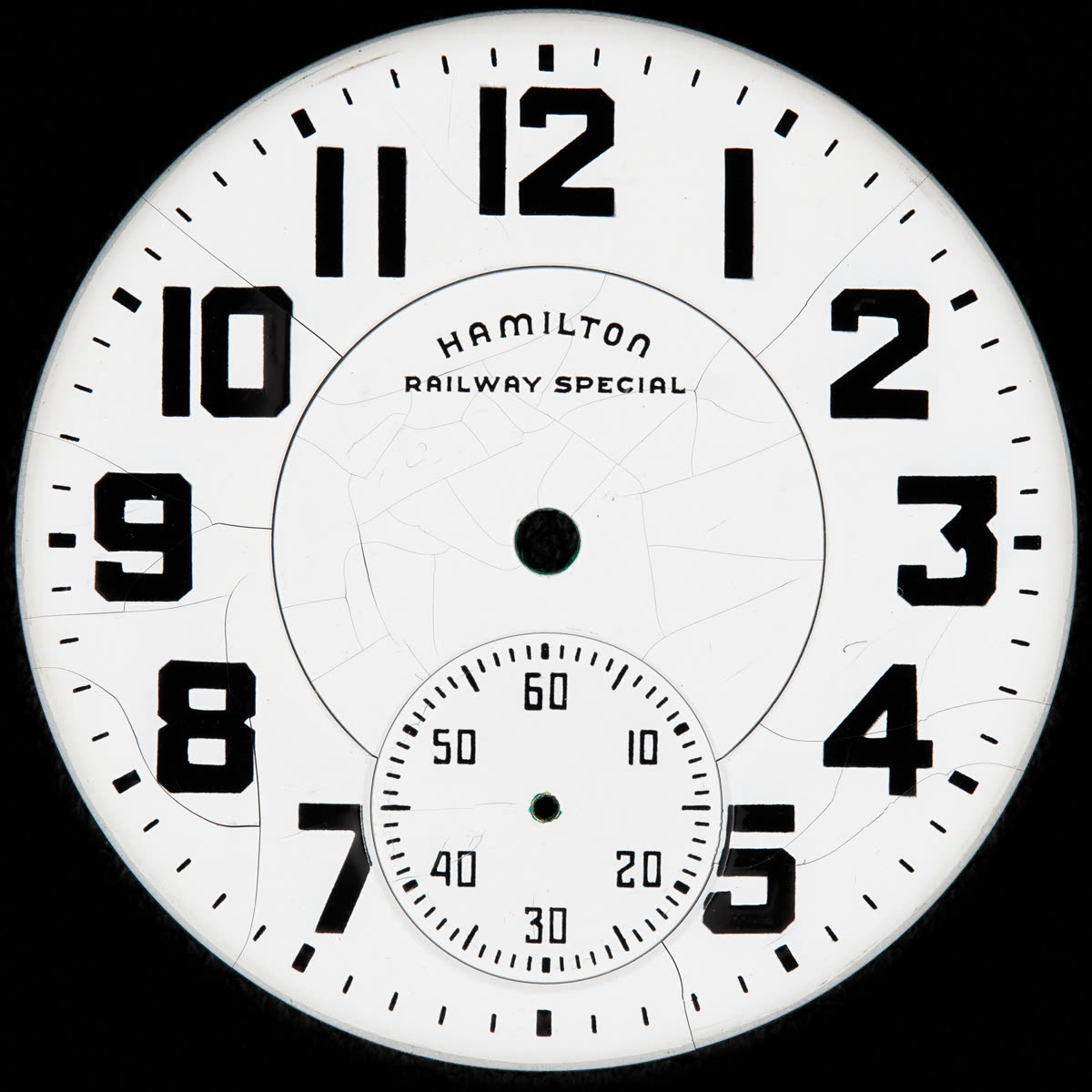
Dial Construction and Material Background
In October 1946, the Hamilton Watch Company began manufacturing watch dials using melamine, a recently commercialized thermoplastic evaluated as a substitute for conventional enamel. Hamilton concluded the material was stainless, resistant to discoloration, and offered a brilliant white finish along with superior surface durability compared to fragile glass enamel.
Adoption of melamine was also supported by thermal and economic efficiencies. The material could resist heat up to 300 degrees Fahrenheit, was baked at a lower temperature, and cooled more rapidly than vitreous enamel; company records cited by the source calculated a manufacturing savings of $1.16 per dial relative to comparable enamel dials.
Evidence for this section
- “In October 1946, the Hamilton Watch Company began manufacturing watch dials using melamine, a thermoplastic material that had recently been commercialized.”
- “The new material was stainless and resistant to discoloration, allowing the watch dials to retain a brilliant white appearance.”
- “Since melamine can resist heat up to 300 degrees Fahrenheit, the material was even being used to replace the enamel on gas stoves when Hamilton adopted it for watch dials.”
- “Melamine can be baked at a lower temperature and cools much quicker than vitreous enamel, making the dials more efficient to manufacture.”
- “According to documents exploring the development of melamine dials, the company estimated that each dial would be $1.16 less expensive to manufacture when compared to similar enamel dials.”