
Skip to content
The Encyclopedia of Horology

Tool · Polyhedral sundial / scaphe dial

Gilt and silvered brass polyhedral scaphe dial

Partially verified

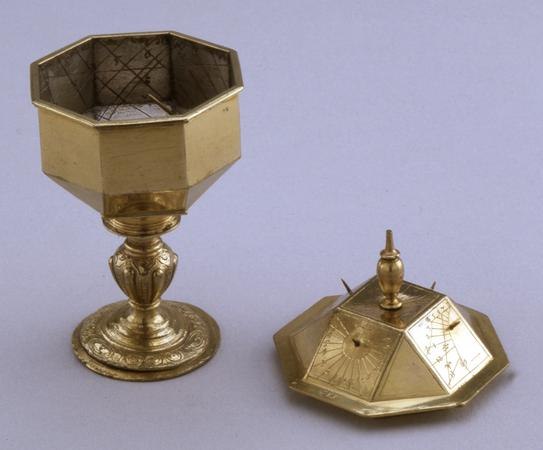
This late 16th-century scientific instrument comprises a plain octagonal gilt and silvered brass cup mounted on an urn-shaped pedestal stand, alongside a removable polyhedral lid with a baluster finial. The interior of the cup is configured as a scaphe dial engraved with astrological house divisions in the Regiomontanus system, declination curves, and hour lines calibrated for approximately 47° N latitude. The polyhedral lid features four distinct pin-gnomon sundials across its facets, including equinoctial and reclining horizontal dials. The source reports that the instrument originally oriented using an integrated compass well in the base set for magnetic deviation, allowing solar time measurement.

Overall view showing the octagonal cup on stem alongside the detached polyhedral sundial lid
Overall view showing the octagonal cup on stem alongside the detached polyhedral sundial lid — British Museum. Rights pending — permission not yet requested. Original source

Catalogue identity

Source
www.britishmuseum.org
Category
Tool · Polyhedral sundial / scaphe dial
Maker / attribution
Not established
Reference
1922,0705.6
Catalogue / lot identifier
Source URL identifies the listing
Source-reported date
late 16thC
Country
Germany

Source-reported attribution and specifications are not independent authentication. A listing does not establish present ownership, current display, availability or permission to reproduce.

Object description

Physical Description and Assembly

This scientific instrument is composed of gilt and silvered brass. It features a plain octagonal cup mounted on a stand and a detachable polyhedral lid topped by a baluster finial. The base assembly includes a domed circular foot engraved with roundels, supporting an urn-shaped stem with alternating raised flutes and straps.

The current stand is described by the source as very poorly executed and potentially a later replacement. The overall dimensions are recorded as 130 mm in height and 63 mm in diameter.

Evidence for this section
  • “This gilt and silvered brass instrument consists of a plain octagonal cup screwed to a stand and a loose polyhedral lid with a baluster finial screwed in.”
  • “The stand, which is very poorly executed and may well be a later replacement”
  • “Diameter: 63 millimetres Height: 130 millimetres”

Dialling and Scaphe Configuration

The exterior of the lid features four facets configured as pin-gnomon sundials, marked for northern and southern orientation. These include an equinoctial dial and various reclining horizontal dials. Each face includes a vertical line to indicate the required gnomon length.

The interior scaphe serves as an azimuth dial with a sloping gnomon and house divisions according to the Regiomontanus system. The current internal pin gnomon is reported as a later replacement that is not of sufficient length to serve its intended function.

Evidence for this section
  • “four sides of the polyhedron are marked as sundials”
  • “The division of the houses is done in the manner of Regiomontanus.”
  • “The pin gnomon is not long enough to serve its purpose and is certainly a later replacement.”

Orientation and Operational Context

The instrument includes an integrated compass well in the base, intended for setting to a magnetic deviation of approximately 9° E. This well is currently empty, with the glass and needle missing.

The instrument is calibrated for approximately 47° N latitude, which the source notes suggests a South German origin dating to the late 16th century.

Evidence for this section
  • “A COMPASS WELL set for a magnetic deviation of circa 9° E in the base is now empty.”
  • “The underlying latitude of circa 47° N suggests a South German origin.”
  • “Production date 16thC(late)”

Open research questions

  • What is the physical extent of the discrepancy between the lid's engraving and the scaphe's internal dialling markings?
  • Does the 'poorly executed' stand exhibit evidence of tools or manufacturing techniques inconsistent with the 16th-century production of the cup and lid?

Source evidence

Recorded claims and source quotations for Gilt and silvered brass polyhedral scaphe dial
FieldSource-reported valueSource quotation
MaterialsGilt and silvered copper alloy (brass)“This gilt and silvered brass instrument consists of a plain octagonal cup screwed to a stand and a loose polyhedral lid with a baluster finial screwed in.”
LatitudeCirca 47° N“The north slope is marked with an equinoctial pin gnomon dial for the latitude 47° N with hour lines labelled 4 to 12 to 8.”
House DivisionRegiomontanus system“The division of the houses is done in the manner of Regiomontanus.”
Dimensions130 mm height, 63 mm diameter“Diameter: 63 millimetres Height: 130 millimetres”
Attributed OriginGermany (Southern?)“Made in: Germany (Southern?)”
MaterialsGilt and silvered copper alloy“Materials copper alloy (brass?) gold (gilt) silver (partial silvering)”

Visible details

  • Plain octagonal cup mounted on a turned, fluted urn-shaped pedestal foot
  • Detached polyhedral lid featuring engraved dial lines, hour markings, and a central baluster finial
  • Gnomon pins projecting from the facets of the lid and within the interior lining of the cup

Research qualifications

  • Source notes the stand is poorly executed and may be a later replacement
  • Source identifies the internal pin gnomon as a later replacement
  • Source records the compass well as empty, with glass and needle missing

Photograph identity and source facts were screened before import; rights clearance remains pending.

Consulted source

polyhedral dial; scaphe-dial; sundial; compass-dial | British Museum

Reviewed 2026-10-25 · Record 065f1f017a

Terms in this record

Glossary explanations for terms named in this object’s record.