
Skip to content
The Encyclopedia of Horology

Tool · Nuremberg crucifix dial

Georg Hartmann Crucifix Dial

Partially verified

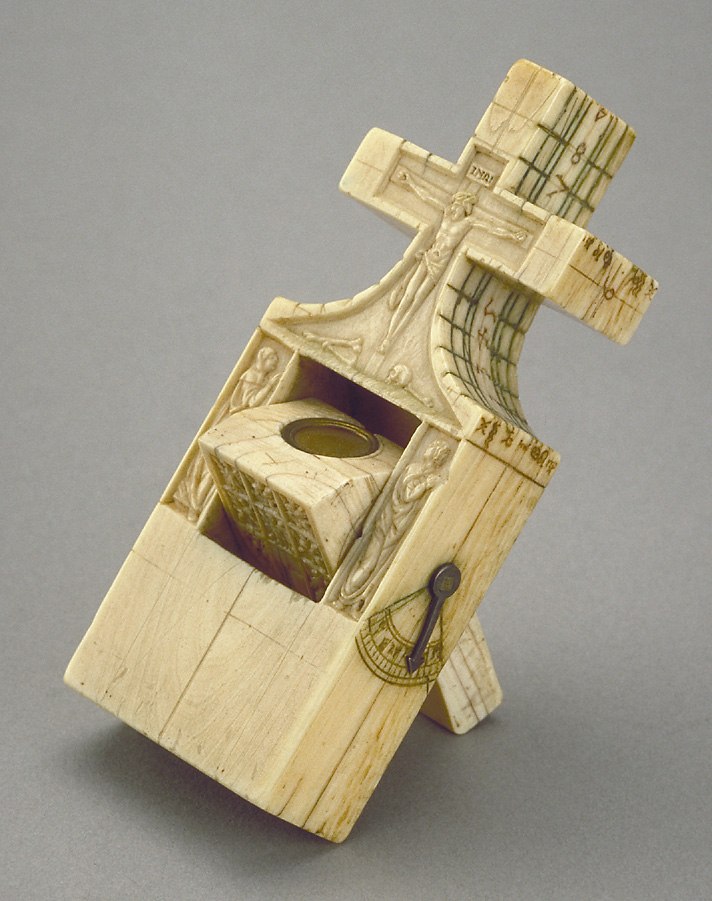
This crucifix dial, dated 1541 and signed by Georg Hartmann of Nuremberg, is a portable ivory sundial combining devotional imagery with timekeeping functionality. The object measures 39 x 96 x 17 mm. Hour lines are engraved onto the upper faces of the cross and the curved sides of the base, complemented by zodiacal symbols at the base of the cross. The instrument incorporates a pivoted section serving as an adjustable support leg, which is set to a specific angle via a side-mounted pointer moving across an unnumbered scale. A small compass is inset into the top of this movable section. The base is inscribed with the signature of the maker and the date of manufacture.

The ivory crucifix dial by Georg Hartmann (1541), featuring the adjustable support leg and compass.
The ivory crucifix dial by Georg Hartmann (1541), featuring the adjustable support leg and compass. — British Museum, London. Rights pending — permission not yet requested. Original source

Catalogue identity

Source
www.mhs.ox.ac.uk
Category
Tool · Nuremberg crucifix dial
Maker / attribution
Georg Hartmann
Reference
Not recorded
Catalogue / lot identifier
MLA 1894, 7-22.1
Source-reported date
1541
Source-reported place
Germany

Source-reported attribution and specifications are not independent authentication. A listing does not establish present ownership, current display, availability or permission to reproduce.

Object description

Construction and Design

The instrument is fashioned from ivory and sculpted into the form of a crucifix. The primary cross structure functions as the dial plate, with hour lines distributed across five upper faces of the cross and the two curved sides of the base. These inscriptions indicate specific hours, specifically 9 to 11, 7 to 9, 12, 3 to 5, and 1 to 3 on the upper faces, with additional lines on the base.

A unique element of this dial is its adjustable support mechanism. A section of the base can be pivoted to serve as a stand, allowing the cross to be positioned at a specific angle. This adjustment is controlled by a pointer that moves across a scale on the side of the base. This section is also decorated with the Deposition and the coat-of-arms of Brandenburg.

Evidence for this section
  • “Ivory; 39 x 96 x 17 mm”
  • “On the arms of the cross are carved the hour lines, numbered 9 to 11, 7 to 9, 12, 3 to 5, 1 to 3 on the five upper faces of the cross.”
  • “A pivoted section of the base can be turned to serve as an adjustable leg to support the cross at an appropriate angle, which is set by means of a pointer on the side.”

Iconography and Features

The dial features significant religious imagery integrated into its functional design. Symbols representing the zodiac are engraved at the base of the cross.

In addition to the timekeeping and religious carvings, the instrument houses a small compass at the top of the movable base section. This feature was necessary for the proper orientation of the sundial during use.

Evidence for this section
  • “The dial is carved with a Crucifixion on one side and a scene from the Old testament where the people of Israel, dying from snakebites, were healed by looking at the Cross made by Moses on God's instructions”
  • “The symbols of the zodiacal signs are engraved on the base of the cross.”
  • “On the top of this part is a small compass.”

Provenance and Documentation

The object is held in the collection of the British Museum, London, with the registration number MLA 1894, 7-22.1. It was acquired by the museum in 1894.

The object is cited in the literature pertaining to European scientific instruments, specifically documented in a catalogue produced by F. A. B. Ward regarding the collections of the Department of Medieval and Later Antiquities.

Evidence for this section
  • “Registration no. MLA 1894, 7-22.1”
  • “The instrument was purchased in 1894 and is described in F. A. B. Ward, A Catalogue of European Scientific Instruments in the Department of Medieval and Later Antiquities of the British Museum”

Open research questions

  • What is the specific significance of the Brandenburg coat-of-arms on this dial?
  • Is there evidence of the original purpose or ownership beyond the maker's mark?

Source evidence

Recorded claims and source quotations for Georg Hartmann Crucifix Dial
FieldSource-reported valueSource quotation
MakerGeorg Hartmann“Signed by Georg Hartmann”
Date1541“Dated 1541”
Dimensions39 x 96 x 17 mm“39 x 96 x 17 mm”
SignatureGEORGIVS HARTMAN NO::RENBERGE: F: ANNO 1541“At the bottom of the cross is the signature 'GEORGIVS HARTMAN NO::RENBERGE: F: ANNO 1541'.”
Inventory NumberMLA 1894, 7-22.1“Registration no. MLA 1894, 7-22.1”
Place of OriginNuremberg“Nuremberg”

Visible details

  • Crucifixion scene carved in relief on the central cross
  • Pivoted support leg with an adjustable side pointer
  • Inset compass located on the top of the pivoted base section
  • Zodiacal symbols engraved near the base of the cross

Research qualifications

  • The unnumbered scale is only suggested to indicate latitudes
  • The exact function of the coat-of-arms of Brandenburg depicted on the dial is not fully explained

Photograph identity and source facts were screened before import; rights clearance remains pending.

Consulted source

Crucifix Dial

Reviewed 2026-10-26 · Record 35075f34b5

Terms in this record

Glossary explanations for terms named in this object’s record.