
Skip to content
The Encyclopedia of Horology

Clock · Mantel clock

French White Alabaster Mantel Clock

Partially verified

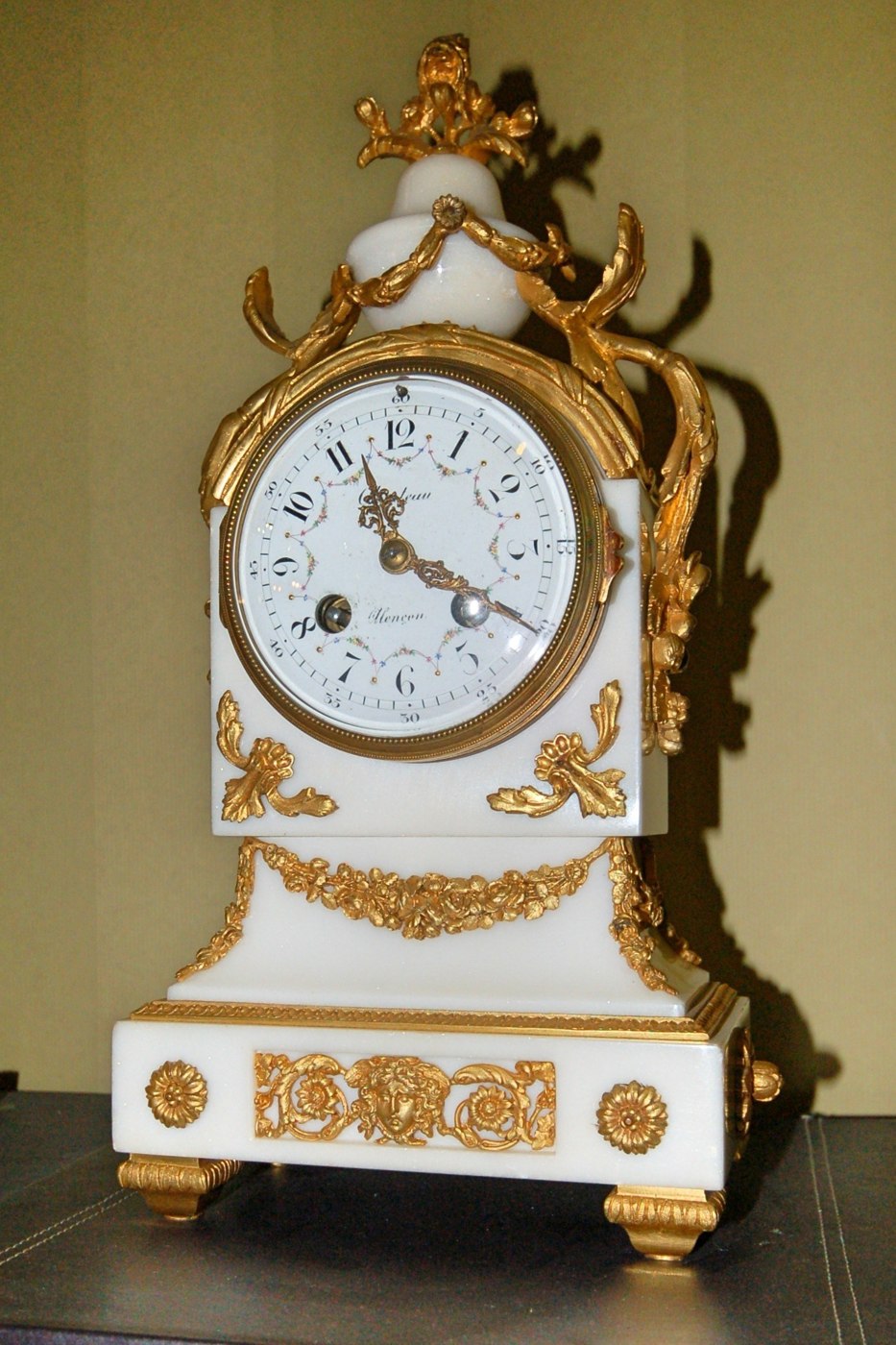
This French mantel clock, dated to circa 1900, features a construction of white alabaster accented with gilt brass mounts. The architectural body is surmounted by a decorative finial and incorporates cast foliage and floral brass ornamentation on the base and case. The clock face is crafted from white glazed porcelain, featuring Arabic numerals for the hours and an outer track for minute intervals. The dial is decorated with hand-painted floral swags and garlands between the numerals. It is signed on the dial with the name 'Alencon Chateau', accompanied by two pierced brass hands. Winding arbors are positioned at the 4 and 8 o'clock locations. No images of the movement or the rear of the clock are provided in the source documentation.

Front view of the French white alabaster mantel clock showing the porcelain dial with painted floral garlands.
Front view of the French white alabaster mantel clock showing the porcelain dial with painted floral garlands. — Pendulum of Mayfair. Rights pending — permission not yet requested. Original source

Catalogue identity

Source
zamanito.com
Category
Clock · Mantel clock
Maker / attribution
Unknown (Alencon Chateau is a dial inscription, not a verified maker)
Reference
Not recorded
Catalogue / lot identifier
Source URL identifies the listing
Source-reported date
circa 1900
Source-reported place
France

Source-reported attribution and specifications are not independent authentication. A listing does not establish present ownership, current display, availability or permission to reproduce.

Object description

Case and Dial Design

The clock features an architectural case composed of white alabaster. The aesthetic is defined by applied gilt brass ornaments that include floral and foliage motifs, appearing on both the base and the primary housing. A decorative finial is situated atop the case, echoing the ornate metalwork found throughout the structure.

The dial is composed of white glazed porcelain. It presents Arabic numerals to indicate the hours and an outer graduated track for the minutes. The area between the numerals is embellished with hand-painted floral swags. Two pierced brass hands are centrally mounted, and the dial includes winding apertures at the 4 and 8 o'clock positions.

Evidence for this section
  • “فرم بدنه دارای معماری کلاسیک فرانسوی به همراه گلدان تزیینی در بالاترین بخش و نقوش شاخ‌وبرگی و گل‌های ریخته‌گری‌شده از جنس برنج بر روی پایه‌ها و قاب است”
  • “صفحه ساعت از جنس پرسلین (چینی) سفید لعاب‌دار است که با ارقام عربی برای ساعت‌شماری و یک نوار بیرونی برای تقسیمات دقیقه تزیین شده است”

Movement and Mechanism

The timepiece is equipped with a French-made mechanical movement. It is configured as a two-train system, where one train governs timekeeping and the second train operates the striking mechanism. The movement is rated for an 8-day duration between windings.

Internal components of the movement, such as the escapement or back plate, are not visible in the provided photographic evidence. As such, the specific technical condition of the internal mechanics remains unverified.

Evidence for this section
  • “این ساعت به یک موتور مکانیکی فرانسوی ۸ روزه و دو قطاره با سازوکار زنگ‌زن مجهز است”
  • “با این حال، تصویری از پشت ساعت یا داخل موتور در مستندات ارائه نشده است”

Signatures and Attribution

The dial of the clock bears an inscription which is identified in the source as 'Alencon Chateau'. This signature is located on the porcelain surface between the numerals.

The auction description characterizes the signature as potentially difficult to read, noting it as 'unreadable'. No further markings or serial numbers on the case or movement are reported in the provided source.

Evidence for this section
  • “روی صفحه امضایی ناخوانا شامل نام Alencon Chateau وجود دارد”

Open research questions

  • Does the 'Alencon Chateau' signature refer to a specific retailer or a location associated with the manufacture of the dial?
  • Can the internal components of the movement be verified through examination to confirm the 8-day dual-train striking system?
  • Are there any maker's marks stamped on the back plate of the brass movement?

Source evidence

Recorded claims and source quotations for French White Alabaster Mantel Clock
FieldSource-reported valueSource quotation
Datecirca 1900“حدود ۱۹۰۰”
MakerAlencon Chateau“امضایی ناخوانا شامل نام Alencon Chateau وجود دارد”
CountryFrance“ساعت رومیزی فرانسوی”
Case materialWhite Alabaster“سنگ مرمر سفید (آلاباستر)”
Movement typeFrench 8-day two-train“موتور مکانیکی فرانسوی ۸ روزه و دو قطاره”
Dial materialPorcelain“صفحه ساعت از جنس پرسلین (چینی) سفید لعاب‌دار است”

Visible details

  • White alabaster case with gilt brass foliage and floral appliques
  • Porcelain dial with Arabic numerals and hand-painted floral decoration
  • Pierced brass clock hands
  • Two winding holes located at the 4 and 8 o'clock positions

Research qualifications

  • The functional status of the movement and the presence of the pendulum and key are unverified
  • The signature 'Alencon Chateau' on the dial is reported as 'unreadable' in the source text
  • The presence of hair-line cracks on the porcelain dial is not confirmed

Photograph identity and source facts were screened before import; rights clearance remains pending.

Consulted source

Antique French White Alabaster Clock C1900

Reviewed 2026-11-02 · Record 701b31dc44

Terms in this record

Glossary explanations for terms named in this object’s record.