
Skip to content
The Encyclopedia of Horology

Clock · Cartel clock

French Louis XV style cartel clock

Partially verified

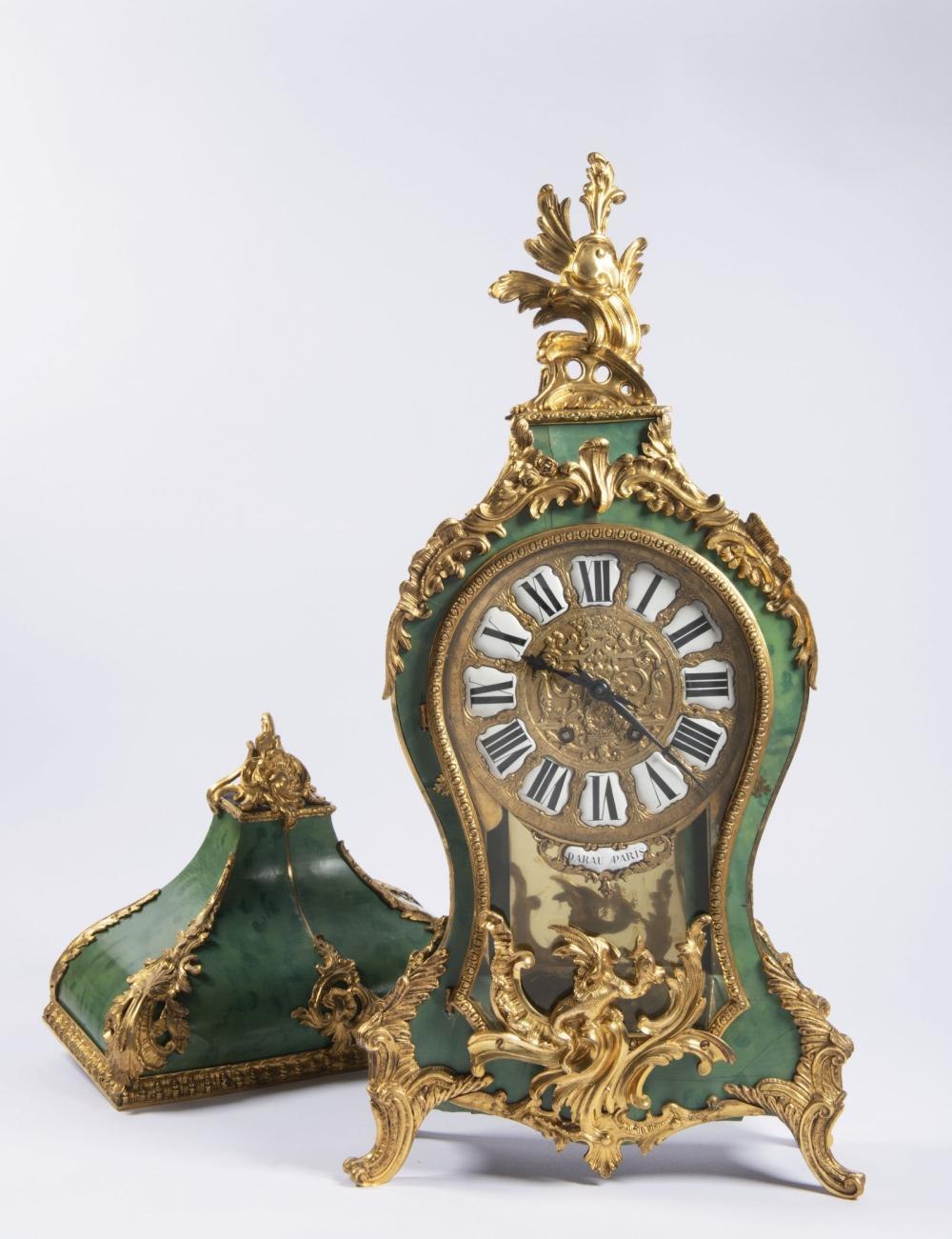
This cartel clock is constructed primarily from green horn veneer, referred to as green horn, accented with fire-gilded bronze, polished brass, blackened wood, and enamel. Standing 86 cm tall, the clock features a case characterized by floral stylized decoration and gilt-bronze mounts. The front is fitted with glass partially obscured by a rococo dragon motif. The dial is inset with enamel components, displaying Roman numerals for the hours and Arabic numerals along the outer rim. It is signed "DARAU A PARIS" at the base of the dial. The piece incorporates a half-beaten clock movement identified by the source as dating from the second half of the 19th century. The object has undergone restoration. The combination of green horn veneer and gilded bronze is identified by the source as reflecting an 18th-century French technique for this type of wall-hanging timepiece.

Full view of the cartel clock with the case cover removed, showcasing the dial and gilt-bronze dragon detail.
Full view of the cartel clock with the case cover removed, showcasing the dial and gilt-bronze dragon detail. — Arthouse Hejtmánek (via Invaluable). Rights pending — permission not yet requested. Original source

Catalogue identity

Source
www.invaluable.com
Category
Clock · Cartel clock
Maker / attribution
Darau
Reference
Not recorded
Catalogue / lot identifier
22
Source-reported date
Around 1740
Source-reported place
France

Source-reported attribution and specifications are not independent authentication. A listing does not establish present ownership, current display, availability or permission to reproduce.

Object description

Case Construction and Ornamentation

The case of this cartel clock is composed of green horn veneer, a material noted in the source for its rarity and technical difficulty. The green surfaces are framed by fire-gilded bronze mounts executed in a floral, stylized aesthetic. The case structure incorporates brass, steel, bell metal, and blackened wood, consistent with mid-18th-century French production.

The front glass, which protects the dial and movement, is accented with a fire-gilded bronze rococo dragon motif. This ornamentation is integrated into the structural shell of the timepiece, which retains the overall dimensions of 86 cm.

Evidence for this section
  • “combination of green horn (known in English as "green horn veneer"), fire-gilded bronze and polished brass”
  • “The green horn inlay technique itself is unique for its difficulty”
  • “The front glass is partially covered by a rococo dragon motif.”

Dial and Signature

The dial is characterized by an intricate, richly decorated background onto which individual enamel segments are inset. These segments feature Roman numerals for the primary timekeeping indicators, while smaller Arabic numerals are positioned along the outer edge of the dial rim.

The signature "DARAU A PARIS" is inscribed directly at the bottom of the dial. This signature identifies the clock with the Parisian maker Darau, consistent with the source attribution of the piece to the French tradition of the early 18th century.

Evidence for this section
  • “The richly decorated dial is inset with enamel parts with Roman numerals and Arabic numerals around the rim.”
  • “Signed at the bottom of the dial: DARAU A PARIS.”

Movement and Restoration

The source indicates that the current movement housed within the cartel case dates to the second half of the 19th century. The movement is described as a half-beaten type. This suggests a replacement or modification occurred long after the initial creation of the case, which is dated to around 1740.

The auction description reports that the clock has been restored. This restoration includes the general condition of the timepiece, though the extent of work on the movement or the green horn veneer is not specified.

Evidence for this section
  • “A clock movement from the second half of the 19th century, half beaten.”
  • “Restored.”

Open research questions

  • What is the specific history of the movement replacement relative to the original case?
  • Can the maker 'Darau' be identified in Parisian guild records of the 1740s?

Source evidence

Recorded claims and source quotations for French Louis XV style cartel clock
FieldSource-reported valueSource quotation
MakerDarau“Signed at the bottom of the dial: DARAU A PARIS.”
Case materialsGreen horn veneer, gilded bronze, brass, steel, bell metal, blackened wood“combination of green horn (known in English as "green horn veneer"), fire-gilded bronze and polished brass on the sides and inside the clock case.”
MovementHalf beaten“A clock movement from the second half of the 19th century, half beaten.”
Date of caseAround 1740“Date Around 1740”
Signature locationBottom of the dial“Signed at the bottom of the dial: DARAU A PARIS.”
Dimensions86 cm“Dimensions 86 cm”
Dial detailInset enamel parts“The richly decorated dial is inset with enamel parts”

Visible details

  • Green horn veneer panels
  • Gilt-bronze dragon motif
  • Dial signed DARAU A PARIS
  • Enamel numeral plaques

Research qualifications

  • Movement date discrepancy with case date
  • Nature of the restoration work performed

Photograph identity and source facts were screened before import; rights clearance remains pending.

Consulted source

FRENCH LOUIS XV. CARTEL CLOCK

Reviewed 2026-10-26 · Record b70c949e30

Terms in this record

Glossary explanations for terms named in this object’s record.