
Skip to content
The Encyclopedia of Horology

Clock · Mantel clock garniture

French Green Sèvres-Style Clock Garniture

Partially verified

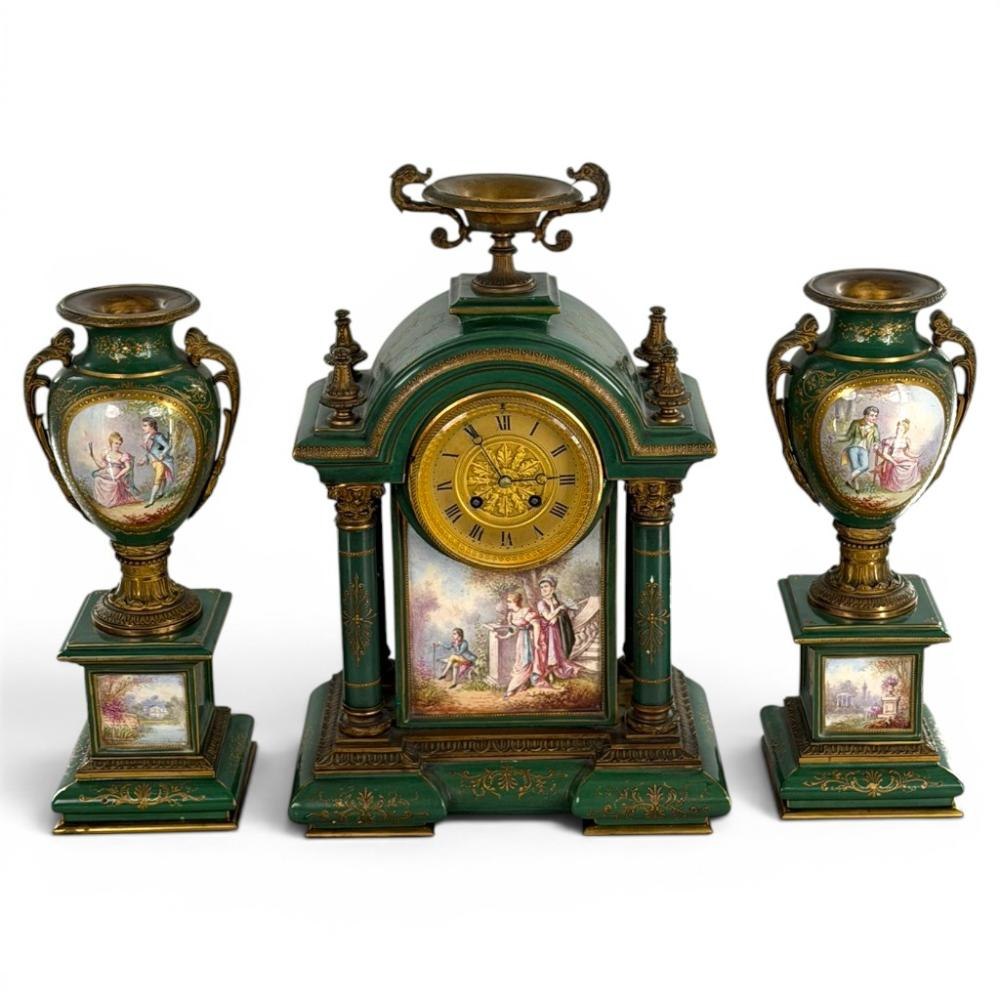
According to the auction catalog, this French three-piece mantel clock garniture dates from the late 19th to early 20th century in the Louis XVI Revival style in the Sèvres taste. The garniture is constructed of green-ground porcelain with polychrome and gilt decoration, gilt metal, brass, glass, and steel. The architectural clock case has a domed cornice flanked by four finials and surmounted by a twin-handled tazza, resting on Corinthian columns. The gilded dial displays Roman numerals, an embossed foliate center, and two winding apertures, positioned above a painted pastoral scene. The clock is accompanied by two matching urns set on square pedestals with landscape reserves.

Front view of the French green Sèvres-style mantel clock flanked by its matching urns
Front view of the French green Sèvres-style mantel clock flanked by its matching urns — Stevens Auction Company. Rights pending — permission not yet requested. Original source

Catalogue identity

Source
www.invaluable.com
Category
Clock · Mantel clock garniture
Maker / attribution
Not established
Reference
Not recorded
Catalogue / lot identifier
58A
Source-reported date
Late 19th to early 20th century
Country
France

Source-reported attribution and specifications are not independent authentication. A listing does not establish present ownership, current display, availability or permission to reproduce.

Object description

Construction and Design

The item is a three-piece mantel clock garniture created in the Louis XVI Revival style, described by the source as being in the Sèvres taste. The clock features an architectural case with a domed cornice, four corner finials, and a twin-handled tazza, all elevated by Corinthian columns.

The set is composed of green-ground porcelain with polychrome and gilt ornamentation. A pair of matching urns, which mirror the green porcelain and classical handle design, are mounted on square pedestals featuring landscape reserves.

Evidence for this section
  • “The architectural clock case has a domed cornice surmounted by a twin-handled tazza and four finials, above Corinthian columns”
  • “Matching twin-handled urns stand on square pedestals decorated with landscape reserves”

Dial and Mechanism

The clock face consists of a gold-toned dial displaying Roman numerals, an embossed foliate center, and two winding apertures. The piece is a twin-train movement that strikes on a coiled gong and is accompanied by two winding keys.

The operational state of the movement is not guaranteed according to the provided report, and internal mechanisms are not described.

Evidence for this section
  • “The dial has an embossed foliate center and two winding apertures. The twin-train movement strikes on a coiled gong.”
  • “Timekeeping and striking are not guaranteed.”

Condition

The source notes evidence of rubbing and localized losses to both the gilding and the green ground. There are reports of small edge chips and abrasions, specifically at the clock base and the projecting corners of the architectural case.

The gilt-metal mounts exhibit tarnish and oxidation. Additionally, a repair label found on the rear of the clock is noted as being heavily worn and in a fragmentary state.

Evidence for this section
  • “Rubbing and localized losses to the gilding and green ground, with small edge chips and abrasions, particularly at the clock base and projecting corners.”
  • “The rear repair label is heavily worn and fragmentary.”

Open research questions

  • What is the identity of the movement manufacturer?
  • Does the fragmented rear repair label contain legible information regarding original manufacture or previous service history?
  • What is the specific technique used to apply the landscape and pastoral decorative reserves?

Source evidence

Recorded claims and source quotations for French Green Sèvres-Style Clock Garniture
FieldSource-reported valueSource quotation
OriginFrance“Origin: France”
DateLate 19th to early 20th century“Date: Late 19th to early 20th century”
Period/StyleLouis XVI Revival, in the Sèvres taste“Period/Style: Louis XVI Revival, in the Sevres taste”
FormThree-piece mantel clock garniture“Form: Three-piece mantel clock garniture”
Clock Dimensions17 in. H, 11.5 in. W, 6.5 in. D“Clock: 17 in. H, 11.5 in. W, 6.5 in. D”
Movement StrikingStrikes on a coiled gong“The twin-train movement strikes on a coiled gong.”
Dimensions17 in. H, 11.5 in. W, 6.5 in. D“Clock: 17 in. H, 11.5 in. W, 6.5 in. D”

Visible details

  • Green porcelain architectural clock case surmounted by a twin-handled metal tazza and four corner finials.
  • Clock case fronted by two Corinthian columns flanking the circular dial and lower painted scene.
  • Gold-toned dial featuring black Roman numerals and two key-winding apertures.
  • Polychrome painted pastoral scene showing figures beneath the dial.
  • Pair of matching green urns with classical handles and figural reserves mounted on square pedestal bases.

Research qualifications

  • The maker of the clock movement and porcelain garniture is not stated in the source.
  • Movement mechanics and internal components are not visible in the photograph; condition and operation are unverified.

Photograph identity and source facts were screened before import; rights clearance remains pending.

Consulted source

At Auction: French Green Sevres-Style Clock Garniture

Reviewed 2026-10-25 · Record 7d625ac76c

Terms in this record

Glossary explanations for terms named in this object’s record.

Other mantel clock garniture records