
Skip to content
The Encyclopedia of Horology

Clock · Mantel clock

Franz Hermle and Sons Bronze Mantel Clock

Partially verified

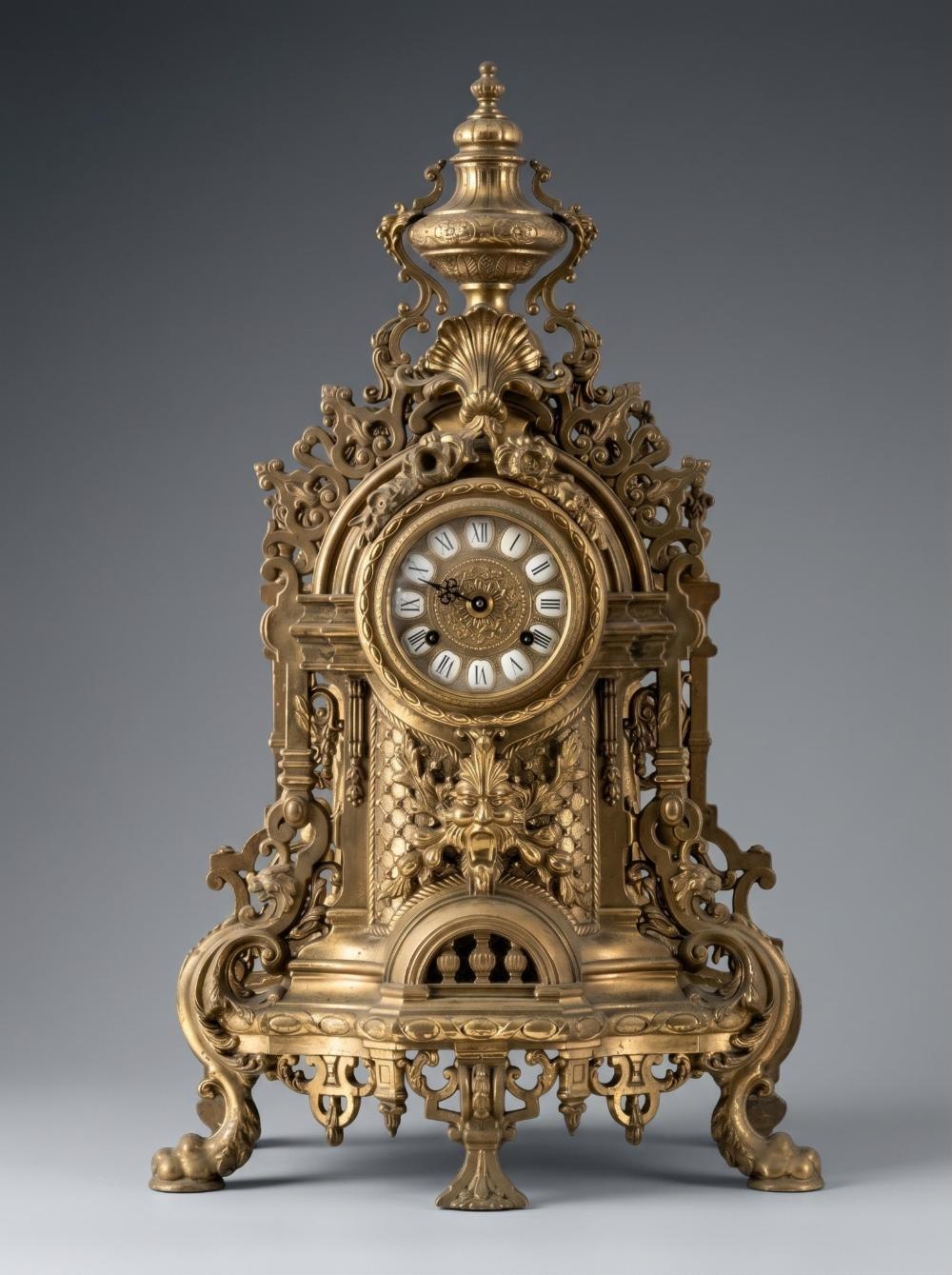
This mantle clock is a decorative, architectural timekeeping piece constructed from cast bronze. The case displays an ornate, sculptural aesthetic defined by complex relief ornamentation including scrollwork, floral motifs, shell patterns, griffins, and wind demon masks, which are also referred to as mascarons. The object is supported by shaped feet with a central stabilizer. The dial is integrated into the clock's architectural framework and consists of twelve separate enameled Roman numeral sections surrounding a bronze center featuring an engine-turned-style pattern. The timepiece contains a German movement that the source attributes to the maker Franz Hermle and Sons.

Auction-listing photograph of the example described as “Franz Hermle and Sons Signed Rococo Style Bronze Mantel Clock - No Reserve”.
Auction-listing photograph of the example described as “Franz Hermle and Sons Signed Rococo Style Bronze Mantel Clock - No Reserve”. — Auction house “Collective Hudson, LLC”, via Invaluable. Rights pending — permission not yet requested. Original source

Catalogue identity

Source
orbiscollectibles.com
Category
Clock · Mantel clock
Maker / attribution
Franz Hermle and Sons
Reference
Not recorded
Catalogue / lot identifier
Source URL identifies the listing
Source-reported date
late 19th century
Source-reported place
Not established

Source-reported attribution and specifications are not independent authentication. A listing does not establish present ownership, current display, availability or permission to reproduce.

Object description

Case and Design

The mantel clock is an elaborate, architectural piece constructed of cast bronze. It features extensive relief ornamentation, including detailed scrollwork, floral motifs, shell patterns, and griffins. A prominent decorative feature is the wind demon mask, also referred to as a mascaron, situated on the lower portion of the case.

The overall design is categorized as a revivalist approach, incorporating various decorative elements to create a complex silhouette. The case is finished with a highly textured and sculptural aesthetic achieved through traditional casting techniques.

Evidence for this section
  • “Constructed primarily of cast bronze, the case features extensive relief ornamentation”
  • “including detailed scrollwork, floral motifs, shell patterns, griffins, and wind demon masks, also referred to as mascarons.”
  • “The design reflects a revivalist approach, incorporating various decorative elements that create a balanced yet complex silhouette”

Dial and Timekeeping

The circular dial is integrated directly into the architectural frame of the clock. It consists of twelve individual enameled Roman numeral sections arranged in a circle. The center of the dial features a decorative bronze surface with an engine-turned-style pattern.

The internal mechanism is a German movement. The documentation attributes this movement to the clockmaker Franz Hermle and Sons. No specific calibre or serial identification is provided for the mechanism in the source record.

Evidence for this section
  • “The circular dial is integrated into the architectural frame and contains twelve individual enameled Roman numeral sections”
  • “contains twelve individual enameled Roman numeral sections arranged around a decorative, engine-turned-style bronze center.”
  • “The internal mechanism is a German movement, attributed to the maker Franz Hermle and Sons.”

Attribution and Record

The record identifies the clock as an item constructed in the late 19th century. The attribution of the movement to Franz Hermle and Sons is presented by the source as a probable classification rather than a definitive statement. The record status is noted as partial, with the evidence being derived from a single auction-house listing.

The provided information pertains specifically to the single example shown in the auction-house photograph. As noted in the source, other examples of this type may differ, and the listing is considered supplementary evidence rather than formal authentication of the object.

Evidence for this section
  • “Probable Credible evidence exists but classification is not fully established.”
  • “The internal mechanism is a German movement, attributed to the maker Franz Hermle and Sons.”
  • “Details apply to that one example; other examples of the type may differ”

Open research questions

  • What specific markings, if any, are present on the movement plates to support the attribution to Franz Hermle and Sons?
  • Does the bronze case bear any foundry marks or artisan signatures beneath the casting?

Source evidence

Recorded claims and source quotations for Franz Hermle and Sons Bronze Mantel Clock
FieldSource-reported valueSource quotation
Materialbronze, enamel“Constructed primarily of cast bronze, the case features extensive relief ornamentation”
MakerFranz Hermle and Sons“The internal mechanism is a German movement, attributed to the maker Franz Hermle and Sons.”
Datelate 19th century“Period late 19th century”
Motifsshell, floral, scroll, griffins, wind demon mask (mascaron)“including detailed scrollwork, floral motifs, shell patterns, griffins, and wind demon masks, also referred to as mascarons.”
Dialenameled Roman numeral sections“contains twelve individual enameled Roman numeral sections arranged around a decorative, engine-turned-style bronze center.”

Visible details

  • Twelve separate enameled Roman numeral dial sections
  • Central wind demon mask or mascaron motif
  • Bronze case featuring scrollwork and shell patterns
  • Engine-turned-style bronze center on the dial

Research qualifications

  • The source attributes the movement to Franz Hermle and Sons as a probability rather than a certainty
  • The late 19th-century date is a general attribution provided by the source

Photograph identity and source facts were screened before import; rights clearance remains pending.

Consulted source

Franz Hermle and Sons Rococo style bronze mantel clock

Reviewed 2026-11-02 · Record e9c984f889

Terms in this record

Glossary explanations for terms named in this object’s record.