
Skip to content
The Encyclopedia of Horology

Tool · Augsburg equinoctial dial

Equinoctial Dial

Partially verified

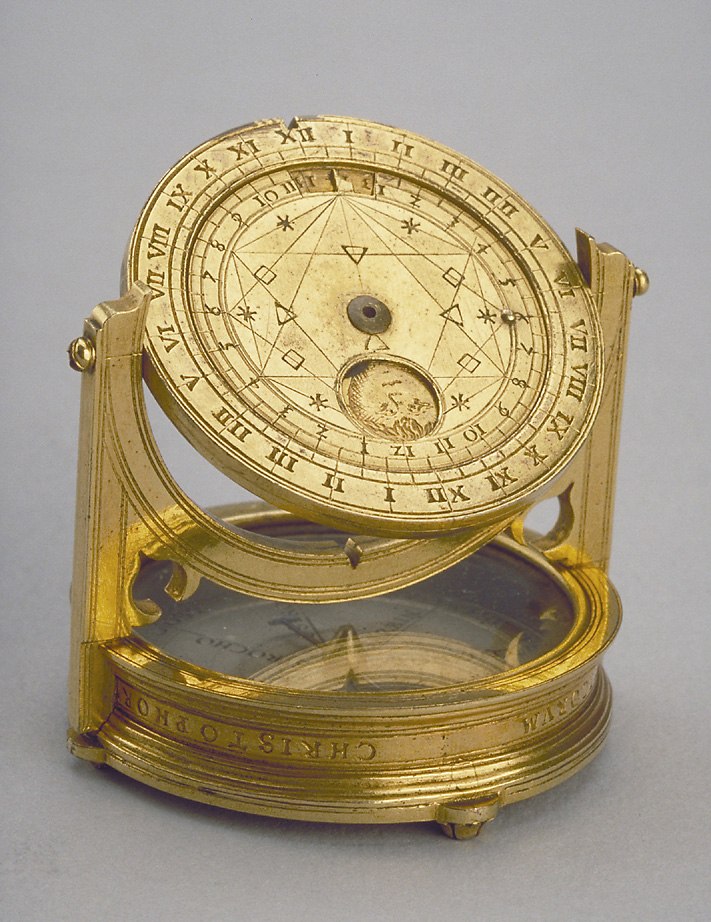
This universal equinoctial dial, signed by Christoph Schissler, dates to approximately 1570 and originates from Augsburg. The instrument is constructed from gilt brass and measures 44 mm in diameter. It comprises two detachable sections: a base containing a compass and a circular disc pivoted on a supporting semicircle. The base is engraved with the names and latitudes of 20 towns, cardinal points in German, and winds in Latin. A central eight-leaf flower decorates the brass plate. The disc features an equinoctial pin gnomon dial with hour divisions for summer and winter use, alongside a pierced rotating volvelle indicating the phases and age of the moon, as well as an aspectarium. The assembly is housed in a round leather case, and the instrument, which lacks a latitude-setting quadrant arm, was bequeathed by Maurice Rosenheim in 1922.

Gilt brass equinoctial dial by Christoph Schissler, circa 1570, showing the rotating moon phase volvelle.
Gilt brass equinoctial dial by Christoph Schissler, circa 1570, showing the rotating moon phase volvelle. — © British Museum, London. Rights pending — permission not yet requested. Original source

Catalogue identity

Source
www.mhs.ox.ac.uk
Category
Tool · Augsburg equinoctial dial
Maker / attribution
Christoph Schissler
Reference
Not recorded
Catalogue / lot identifier
MLA 1922, 7-5.3
Source-reported date
circa 1570
Source-reported place
Germany

Source-reported attribution and specifications are not independent authentication. A listing does not establish present ownership, current display, availability or permission to reproduce.

Object description

Construction and Design

The equinoctial dial is composed of two primary sections of gilt brass, measuring 44 mm in diameter. The lower base functions as a compass, featuring an eight-leaf flower at the center and bun feet shaped as flowers on the outer edges. The compass includes a needle with perpendicular brass spikes and is inscribed with the names and latitudes of 20 cities, including Cartagena, Cordova, and Constantinople.

The second section consists of a circular disc mounted on a supporting semicircle designed to fit into the base. This disc displays hours on both sides, with the top half designated for summer and the bottom for winter. The instrument includes a rotating volvelle for moon phases and an aspectarium, though the quadrant arm intended for latitude adjustment is currently absent.

Evidence for this section
  • “This universal equinoctial dial consists of two separate parts”
  • “The base of the dial is a compass, engraved on the bottom with the names of 20 towns”
  • “A quadrant arm for setting the latitude is missing.”

Signature and Identification

The instrument bears an engraved signature along the rim of the compass base identifying the maker as Christoph Schissler and the location as Augsburg. The inscription is written in Latin as 'CHRISTOPHORVS SCHISSLER FACIEBAT AVGVSTE VINDELICORVM'. This attribution aligns with the general dating of the instrument to approximately 1570.

Additional identifying marks include the museum inventory number MLA 1922, 7-5.3. The object was formally catalogued in F. A. B. Ward's 1981 publication regarding the European scientific instrument collection at the British Museum.

Evidence for this section
  • “The signature 'CHRISTOPHORVS SCHISSLER FACIEBAT AVGVSTE VINDELICORVM' is engraved on the rim of the compass.”
  • “The instrument was bequeathed by Maurice Rosenheim in 1922 and is described in F. A. B. Ward, A Catalogue of European Scientific Instruments in the Department of Medieval and Later Antiquities of the British Museum (London, 1981), p. 47, no.120.”

Function and Components

The dial is designed as a universal tool requiring manual setup. The user must mount the disc on the supports, place it on the compass base, and adjust it for the specific latitude. The compass needle assists in orientation, while the radial engraving of cardinal points and winds supports navigation and usage.

The dial uses a pin gnomon system with separate hour scales to account for seasonal sun position changes. A rotating volvelle with a central pin knob allows for the tracking of the moon's age and phase, incorporating an aspectarium for astronomical observation. The complete assembly is preserved with a round leather case featuring impressed circles.

Evidence for this section
  • “In use, the disc on supports has to be mounted on the base which contains the compass . It has then to be set for the appropriate latitude , and the hour can be read.”
  • “Two different sets of numbers are provided, one for the summer and one for the winter.”
  • “The central part of the disc has a pierced rotating volvelle, showing the phases of the moon, and has an aperture and arm for the age and phase of the moon.”

Open research questions

  • What is the specific mechanical purpose of the 'aspectarium' engraved on this dial?
  • Was the missing quadrant arm a standard feature for all Schissler dials of this specific size, or was it an optional upgrade?

Source evidence

Recorded claims and source quotations for Equinoctial Dial
FieldSource-reported valueSource quotation
MakerChristoph Schissler“Signed by Christoph Schissler”
Datecirca 1570“circa 1570”
Place of originAugsburg“Augsburg”
Dimensions44 mm in diameter“44 mm in diameter”
MaterialGilt brass“Gilt brass”
Inventory NumberMLA 1922, 7-5.3“MLA 1922, 7-5.3”
ProvenanceMaurice Rosenheim“The instrument was bequeathed by Maurice Rosenheim in 1922”
SignatureCHRISTOPHORVS SCHISSLER FACIEBAT AVGVSTE VINDELICORVM“The signature 'CHRISTOPHORVS SCHISSLER FACIEBAT AVGVSTE VINDELICORVM' is engraved on the rim of the compass.”

Visible details

  • The compass base features engraved town names and latitudes
  • A rotating volvelle with a moon phase aperture is located at the center of the disc
  • The dial is mounted on a supporting semicircle
  • The rim of the compass base displays the maker's signature

Research qualifications

  • A quadrant arm for setting the latitude is missing from the instrument
  • The pin for the equinoctial gnomon dial is detached

Photograph identity and source facts were screened before import; rights clearance remains pending.

Consulted source

Equinoctial Dial

Reviewed 2026-10-26 · Record 5fdfb36fff

Terms in this record

Glossary explanations for terms named in this object’s record.