
Skip to content
The Encyclopedia of Horology

Tool · German equinoctial dial

Equinoctial Dial, 1584

Partially verified

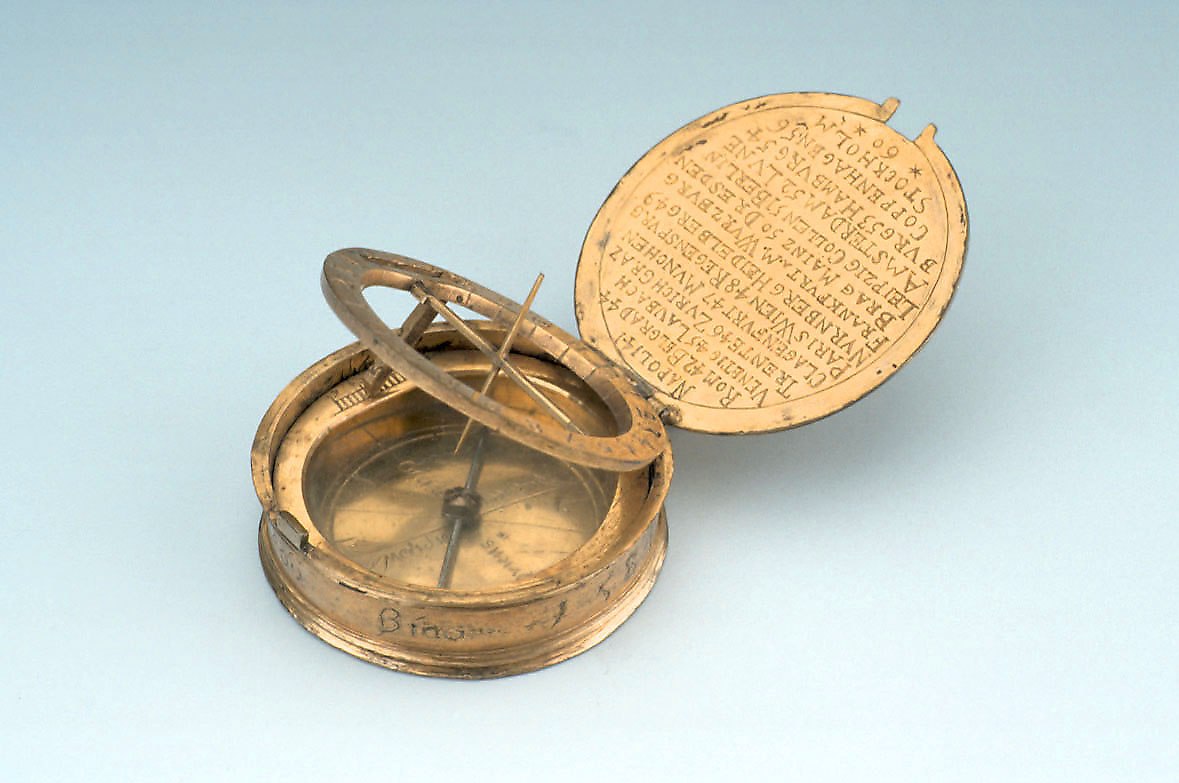
This round equinoctial dial, crafted from gilt brass, measures 50 mm in diameter and dates to 1584. It is unsigned and represents an instrument of German manufacture. The dial features a folding gnomon and a brass arm for adjusting latitude, with an hour circle numbered twice from 1 to 12. The internal compartment houses a compass marked with 32 directions and an equal scale for latitudes ranging from 30 to 60. The lid's interior contains a list of various cities alongside their respective latitudes. The exterior of the lid displays an engraved coat-of-arms framed in foliage, while the edge of the instrument bears the production date and a Greek inscription. The bottom of the box is decorated with a shield-enclosed face and a German verse concerning the compass. The instrument is held by the Museum of the History of Science, Oxford.

Equinoctial dial in gilt brass, dated 1584, showing the open lid with latitude table, the hour ring, and the compass.
Equinoctial dial in gilt brass, dated 1584, showing the open lid with latitude table, the hour ring, and the compass. — Museum of the History of Science, Oxford. Rights pending — permission not yet requested. Original source

Catalogue identity

Source
www.mhs.ox.ac.uk
Category
Tool · German equinoctial dial
Maker / attribution
Not established
Reference
Not recorded
Catalogue / lot identifier
53948
Source-reported date
1584
Source-reported place
Germany

Source-reported attribution and specifications are not independent authentication. A listing does not establish present ownership, current display, availability or permission to reproduce.

Object description

Construction and Function

The equinoctial dial is constructed from gilt brass and is circular, measuring 50 mm in diameter. It is designed with a hinged lid that, when open, reveals a horizontal base containing an integrated compass. The compass features 32 directions, with the primary points labeled in Latin as 'Septen', 'Oriens', 'Meridie', and 'Occidens'. An internal latitude scale, marked from 30 to 60, allows for positional adjustment.

The time-telling mechanism includes an hour ring calibrated from 1 to 12, repeated twice, which works in conjunction with a central folding gnomon. A brass arm is included to facilitate the adjustment of the instrument to the specific latitude of the user's location. The inner surface of the lid serves a practical function as a gazetteer, presenting a tabular list of cities paired with their specific geographic latitudes for easy reference during travel.

Evidence for this section
  • “Gilt brass; 50 mm in diameter”
  • “The inner side has a table of cities and their latitudes.”
  • “The hour circle is numbered 1 to 12 twice and has a folding gnomon and a brass arm for adjusting the latitude.”
  • “The box contains a compass with 32 directions”

Engraving and Inscriptions

The exterior of the instrument is decorated with various engravings. The lid displays a coat-of-arms set within a foliage motif. On the outer edge of the dial, the year 1584 is inscribed alongside a Greek phrase, which is a wish for a long life. The source notes that the engraving style of this Greek text differs from the other inscriptions found on the instrument.

The base of the casing is also decorated, featuring an engraved face enclosed within a shield design.

Evidence for this section
  • “engraved on the top of the lid with a coat-of-arms and, on the edge, a Greek inscription wishing long life.”
  • “The engraving style of the Greek inscription differs from that on the rest of the instrument.”
  • “The bottom of the box is engraved with a face enclosed in a shield and with an inscription on the border, reading 'WEN ICH COMPAST DIR RECHT SOL WEISEN SO HALT MIR VON STAHL VND EISEN'”

Provenance and Identification

This instrument is currently held in the collection of the Museum of the History of Science, Oxford, identified by the inventory number 53948. The piece is classified as unsigned, as no maker's name or mark is present on the instrument. The date and origin of the dial are attributed to 1584 and Germany, respectively, based on the historical documentation provided by the museum.

While the museum maintains the instrument as a single unit, the variation in the engraving of the Greek inscription compared to the rest of the device suggests the possibility that the text might have been added or modified subsequent to the original production of the dial. No further information regarding previous ownership or specific provenance is stated in the record.

Evidence for this section
  • “Unsigned”
  • “Dated 1584; German”
  • “Inventory number 53948”
  • “The engraving style of the Greek inscription differs from that on the rest of the instrument.”

Open research questions

  • Was the Greek inscription added at a different time than the primary dial markings?
  • Can the coat-of-arms on the lid be identified to a specific family or geographic region in Germany?

Source evidence

Recorded claims and source quotations for Equinoctial Dial, 1584
FieldSource-reported valueSource quotation
Inventory Number53948“Inventory number 53948”
Date1584“Dated 1584”
OriginGerman“German”
MaterialGilt brass“Gilt brass”
Diameter50 mm“50 mm in diameter”
InscriptionGerman verse on the bottom of the box“WEN ICH COMPAST DIR RECHT SOL WEISEN SO HALT MIR VON STAHL VND EISEN”
Compass directions32 directions“compass with 32 directions”

Visible details

  • Internal lid features a table of cities with their corresponding latitudes
  • Folding gnomon with an adjustable latitude arm
  • Compass dial marked with 32 directions
  • Exterior base engraved with a face inside a shield

Research qualifications

  • The Greek inscription's engraving style appears distinct from the rest of the instrument
  • The provenance of the instrument is not detailed in the source provided

Photograph identity and source facts were screened before import; rights clearance remains pending.

Consulted source

Equinoctial Dial

Reviewed 2026-10-26 · Record ee3da7db33

Terms in this record

Glossary explanations for terms named in this object’s record.