
Skip to content
The Encyclopedia of Horology

Clock · Skeleton clock

English Lichfield Cathedral Skeleton Clock by Evans of Handsworth

Partially verified

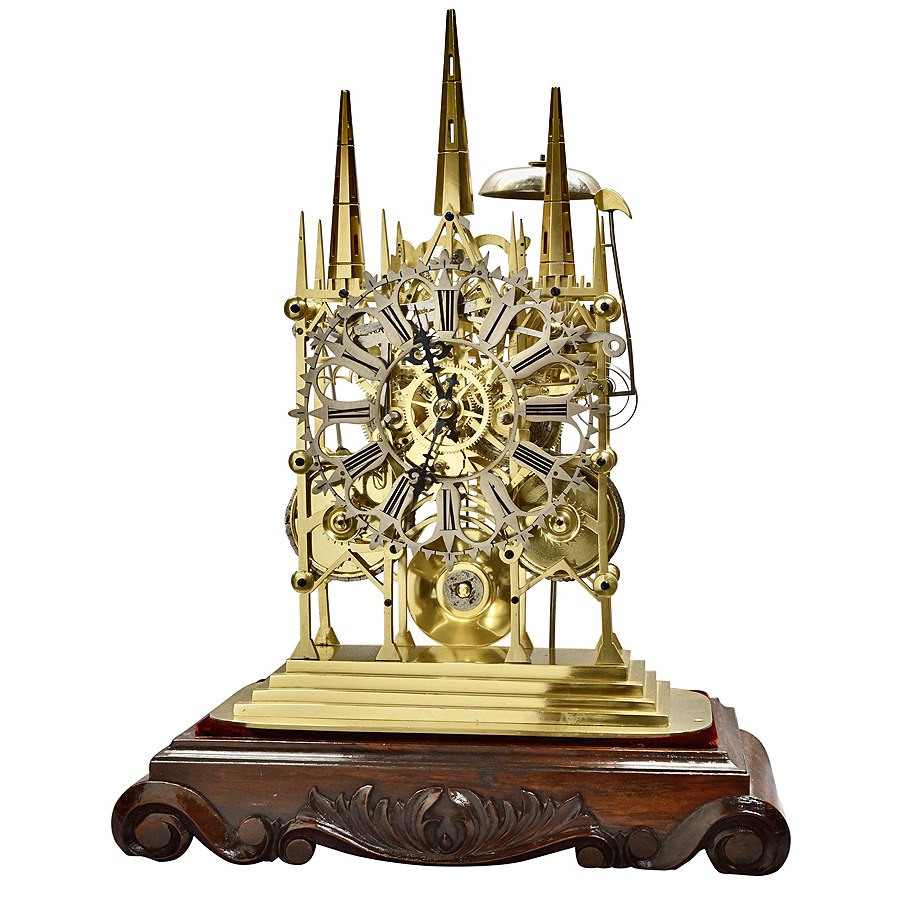
This English brass skeleton clock features an architectural frame designed after Lichfield Cathedral, crowned with three spires. The source attributes the timepiece to Evans of Handsworth and dates it to circa 1870. The eight-day striking movement is reported to strike the half hour on a bell and the hour on a tuned gong. It displays time via a pierced and engraved silvered dial with black Roman numerals and ornate hands, exposing the underlying gear train. The mechanism rests on a stepped brass plinth set onto a carved wooden base with scroll and leaf motifs.

Front view of the brass Lichfield Cathedral skeleton clock on a carved wooden base
Front view of the brass Lichfield Cathedral skeleton clock on a carved wooden base — Renaissance Antiques. Rights pending — permission not yet requested. Original source

Catalogue identity

Source
www.renaissanceantiques.com
Category
Clock · Skeleton clock
Maker / attribution
Evans of Handsworth
Reference
Not recorded
Catalogue / lot identifier
BSCH 48
Source-reported date
Circa 1870
Country
United Kingdom

Source-reported attribution and specifications are not independent authentication. A listing does not establish present ownership, current display, availability or permission to reproduce.

Object description

Architectural Framing and Base

The brass skeleton clock is constructed in an open architectural frame modeled after Lichfield Cathedral, crowned with three prominent spires. The pierced structure displays gothic architecture and leaves the underlying gear train visible.

Visually, the movement rests upon a tiered, stepped brass plinth set onto a carved dark wooden base with scroll feet and foliate relief. The retailer description reports that the clock resides inside a custom-made, glazed mahogany case with carved scroll and leaf detail adorning the base.

Evidence for this section
  • “Known for its iconic three spire top and exemplary gothic architecture, this skeleton clock takes on dramatic shape.”
  • “The impressive clock resides inside a custom-made, glazed mahogany case with carved scroll and leaf detail adorning the base.”
  • “Pierced brass gothic cathedral frame with three prominent central spires”
  • “Movement supported on a tiered stepped brass plinth”
  • “Carved dark wooden plinth with scroll feet and foliate relief carving”

Dial and Striking Movement

Time is displayed on an openwork silvered dial ring engraved with black Roman numerals, swept by decorative dark hands. The openwork dial allows a view directly into the motion work and wheelwork behind it.

The retailer states that an eight-day movement powers the clock, striking the half hour on a bell and the hour on a tuned gong. A striking bell is visibly mounted beside the upper right spire structure, while the tuned gong and internal strike mechanism components are not verified by visible marks in the image.

Evidence for this section
  • “The elaborate pieced and engraved silver dial displays the time on prominent Roman numerals.”
  • “The eight-day  movement strikes the half hour on a bell and hour on a tuned gong.”
  • “Openwork silvered dial ring with black Roman numerals and decorative dark hands”
  • “Visible striking bell mounted beside the upper right spire structure”

Attribution and Source Limitations

The clock is attributed by the seller to Evans of Handsworth (also listed as Evans of Hansworth in the source details) and dated to circa 1870. No maker's name, signature, or serial mark is visibly recorded on the front of the dial or frame in the photograph, leaving the attribution dependent on the seller's cataloging.

Additionally, while the source describes a glazed mahogany case housing the timepiece, only the carved base is shown in the catalog photograph; the glazed hood or upper case is not pictured.

Evidence for this section
  • “English Lichfield Cathedral Skeleton Clock by Evans of Handsworth”
  • “English Lichfield Cathedral Skeleton Clock By Evans of Hansworth”
  • “Circa 1870”
  • “The impressive clock resides inside a custom-made, glazed mahogany case with carved scroll and leaf detail adorning the base.”

Open research questions

  • Is there an engraved signature or maker's stamp identifying Evans of Handsworth on the movement plates, plinth, or back of the dial?
  • Does the glazed mahogany case survive in its entirety, including a glazed hood or vitrine, and what are its separate dimensions?
  • Where is the reported tuned hour gong mounted within or behind the cathedral frame?

Source evidence

Recorded claims and source quotations for English Lichfield Cathedral Skeleton Clock by Evans of Handsworth
FieldSource-reported valueSource quotation
MakerEvans of Handsworth“Evans of Handsworth”
Striking mechanismStrikes half hour on bell and hour on tuned gong“strikes the half hour on a bell and hour on a tuned gong”
Dimensions18 1/2″ High x 13″ Wide x 7″ Deep“18 1/2″ High x 13″ Wide x 7″ Deep”
DateCirca 1870“Circa 1870”
SKUBSCH 48“SKU: BSCH 48”
CaseCustom-made glazed mahogany case“The impressive clock resides inside a custom-made, glazed mahogany case with carved scroll and leaf detail adorning the base.”

Visible details

  • Pierced brass gothic cathedral frame with three prominent central spires
  • Openwork silvered dial ring with black Roman numerals and decorative dark hands
  • Visible striking bell mounted beside the upper right spire structure
  • Movement supported on a tiered stepped brass plinth
  • Carved dark wooden plinth with scroll feet and foliate relief carving

Research qualifications

  • The source notes a custom glazed mahogany case, which is not pictured in the photograph
  • Attribution to Evans of Handsworth is based on seller description; no signature is clearly discernible in the image

Photograph identity and source facts were screened before import; rights clearance remains pending.

Terms in this record

Glossary explanations for terms named in this object’s record.