
Skip to content
The Encyclopedia of Horology

Clock · Mantel clock

Empire Erato Mantel Clock by Thomire & Cie

Partially verified

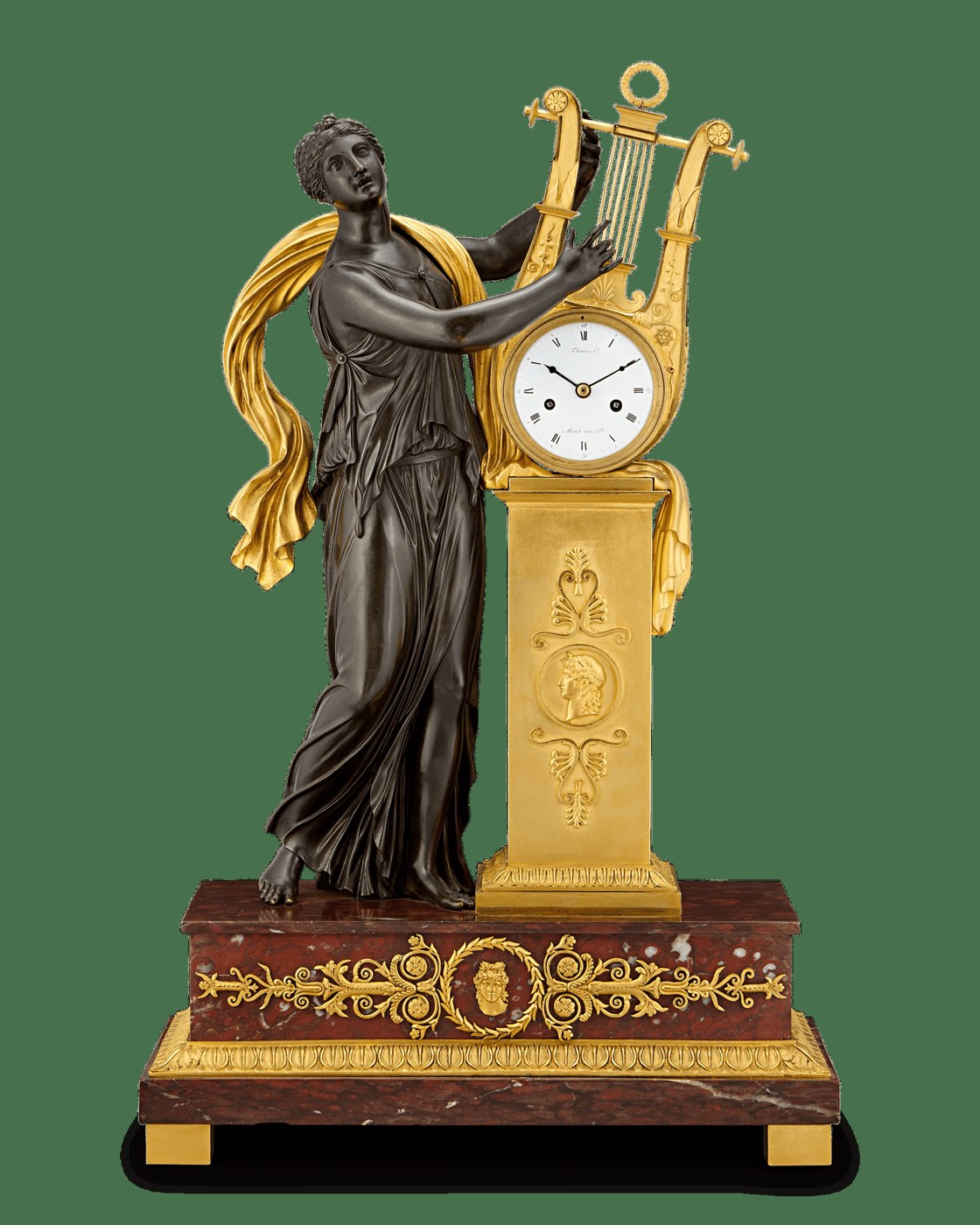
This mantel clock is an Empire-period timepiece constructed from gilt bronze, mercury-gilded bronze, and marble. The design features a figural sculpture of Erato, the Muse of lyric and romantic poetry, positioned beside a rectangular plinth that supports the clock movement. The clock dial is inscribed with the signatures of the bronzier Pierre-Philippe Thomire and the watchmaker Louis Moinet. The base is constructed of red marble ornamented with gilt-bronze foliage and a central medallion. Measuring 25 inches in height, 15 1/2 inches in width, and 8 1/2 inches in depth, the object reflects the collaborative output of Thomire and Moinet, who operated in Paris. The figure is shown holding a mercury-gilded lyre. Moinet, a noted horologist and author, was associated with the Société de Chronométrie, while Thomire was recognized for his work in the Neoclassical aesthetic.

Empire Erato Mantel Clock, depicting the Muse holding a lyre next to the clock dial and plinth.
Empire Erato Mantel Clock, depicting the Muse holding a lyre next to the clock dial and plinth. — M.S. Rau. Rights pending — permission not yet requested. Original source

Catalogue identity

Source
rauantiques.com
Category
Clock · Mantel clock
Maker / attribution
Pierre-Philippe Thomire and Louis Moinet
Reference
Not recorded
Catalogue / lot identifier
Source URL identifies the listing
Source-reported date
circa 1810
Source-reported place
France

Source-reported attribution and specifications are not independent authentication. A listing does not establish present ownership, current display, availability or permission to reproduce.

Object description

Design and Iconography

The clock displays a central figural sculpture representing Erato, identified in Greek mythology as the Muse of lyric and romantic poetry. The figure is positioned beside a vertical rectangular plinth that houses the dial and movement. She is depicted holding a lyre, which is rendered in mercury-gilt bronze, providing a tonal contrast to the dark-toned sculpture.

The supporting plinth is decorated with a relief-molded portrait medallion at its center. The entire assembly rests on a rectangular marble base. This base features further ornamentation in the form of gilt-bronze mounts, which include acanthus leaves and a central motif featuring a profile head.

Evidence for this section
  • “presents an exquisitely detailed figure of Erato.”
  • “She is depicted holding her finely mercury-gilded lyre”

Horological Components

The timekeeping mechanism is housed within a circular container integrated into the side of the plinth. The white dial is marked with Roman numerals for the hours.

The signatures on the dial, "Thomire & Cie" and "Moinet Ainé Hger," identify the collaboration between the bronzier Pierre-Philippe Thomire and the watchmaker Louis Moinet. Moinet was an established manufacturer of precision instruments and a member of the Société de Chronométrie in Paris.

Evidence for this section
  • “Signed “Thomire & Cie” and “Moinet Ainé Hger” on dial”
  • “Louis Moinet, a highly esteemed watchmaker, inventor, scholar and manufacturer of precision instruments”

Historical Context

The piece is attributed to the French Empire period, specifically around 1810. The bronzier Pierre-Philippe Thomire, who trained under Pierre Gouthière, established his Paris workshop in 1776. His work is identified by the source as conforming to the Neoclassical aesthetic.

The collaboration between Thomire and Moinet is documented as producing various high-status commissions for contemporary leaders, including Napoleon Bonaparte and various European royalty. The source notes that Louis Moinet was a scholar of horology, having authored a book on the subject in 1843.

Evidence for this section
  • “The leading bronzier of the Empire period, Pierre-Philippe Thomire”
  • “Moinet and Thomire also collaborated on clocks for the King of Naples, George IV of England and Tsar Alexander of Russia.”

Open research questions

  • What specific type of movement (e.g., silk suspension) is contained within the clock housing?
  • Is there a movement serial number present on the backplate to confirm the dating of the mechanism?

Source evidence

Recorded claims and source quotations for Empire Erato Mantel Clock by Thomire & Cie
FieldSource-reported valueSource quotation
MakerPierre-Philippe Thomire and Louis Moinet“signed on the dial by bronzier Pierre-Philippe Thomire and watchmaker Louis Moinet”
DateCirca 1810“Circa 1810”
Dimensions25" high x 15 1/2" wide x 8 1/2" deep“25" high x 15 1/2" wide x 8 1/2" deep”
SignatureThomire & Cie and Moinet Ainé Hger“Signed “Thomire & Cie” and “Moinet Ainé Hger” on dial”
MaterialsMercury-gilt bronze, bronze, marble“Empire gilt-bronze French mantel clock”
SubjectErato“presents an exquisitely detailed figure of Erato.”

Visible details

  • The clock dial features Roman numeral hour markers.
  • The sculpture of Erato stands upon a marble base with gilt-bronze mounts.
  • A portrait medallion is centered on the front of the gilt-bronze plinth.
  • The clock hands are dark-toned, contrasting with the white dial.

Research qualifications

  • The source mentions historical associations with figures like Napoleon Bonaparte and Thomas Jefferson, but does not state that this specific clock belonged to them.
  • The date of circa 1810 is an attribution provided by the source.

Photograph identity and source facts were screened before import; rights clearance remains pending.

Consulted source

ساعت شومینه‌ای اراتو؛ تومیر

Reviewed 2026-11-02 · Record b23039a7d1

Terms in this record

Glossary explanations for terms named in this object’s record.