
Skip to content
The Encyclopedia of Horology

Tool · Augsburg diptych dial

Diptych Dial

Partially verified

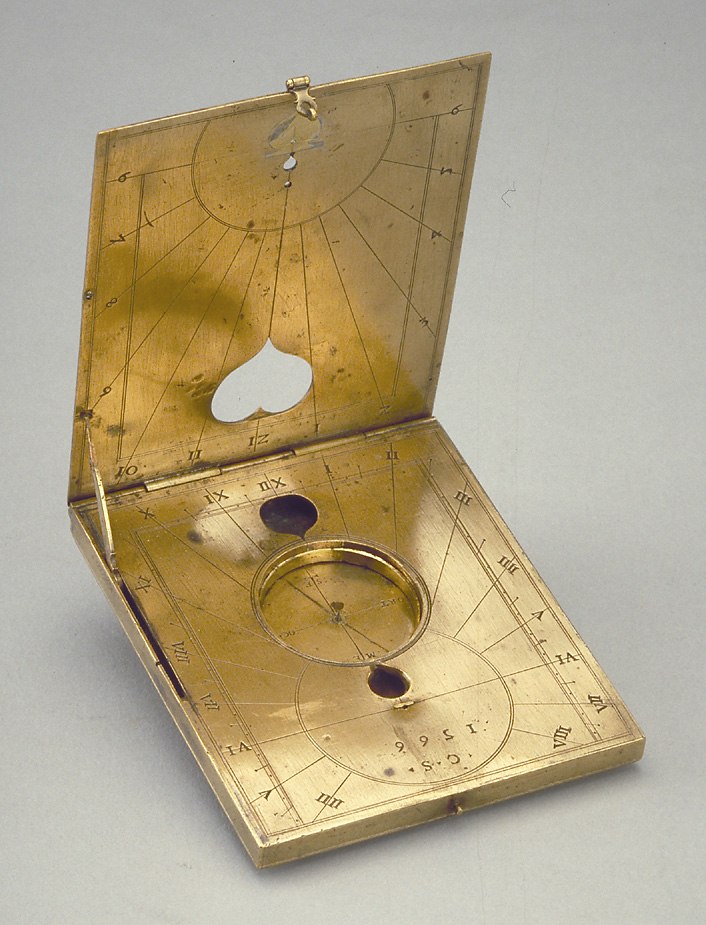
This gilt brass diptych dial, measuring 88 x 104 x 8 mm, is attributed to Christoph Schissler and dated 1566. The object comprises two leaves joined by a hinge, with a brass hook and ring latch on the side to secure the instrument in an open position. The outer upper leaf features strapwork, two coats-of-arms, and the date 1566 engraved twice. Internally, the upper leaf contains a vertical string gnomon dial. The lower leaf houses a compass, although the ring, needle, and glass are currently detached. It also features a horizontal string gnomon dial, though the string is missing. The lower leaf includes a sun effigy and a signature, '?C ? S ? 1566', positioned centrally among hour lines marked IIII to XII to VIII. The exterior of the lower leaf includes three bun feet and a clasp mechanism for closure when not in use.

Gilt brass diptych dial by Christoph Schissler, 1566, showing the open leaves, internal string gnomon dials, and the compass compartment.
Gilt brass diptych dial by Christoph Schissler, 1566, showing the open leaves, internal string gnomon dials, and the compass compartment. — © British Museum, London. Rights pending — permission not yet requested. Original source

Catalogue identity

Source
www.mhs.ox.ac.uk
Category
Tool · Augsburg diptych dial
Maker / attribution
Christoph Schissler
Reference
Not recorded
Catalogue / lot identifier
MLA 1855, 12-1.229
Source-reported date
1566
Source-reported place
Germany

Source-reported attribution and specifications are not independent authentication. A listing does not establish present ownership, current display, availability or permission to reproduce.

Object description

Construction and Decoration

The diptych dial is constructed from gilt brass, measuring 88 by 104 by 8 mm. The outer face of the upper leaf shows decorative engravings including strapwork and two coats-of-arms. The date 1566 is engraved twice on this section. A heart-shaped viewing hole for the compass is present, and the lower leaf also features a heart-shaped hole of uncertain utility.

The lower leaf exterior is plain, featuring a blank rectangle and four lines extending to the corners, supported by three bun feet. A clasp is used to keep the instrument closed. On the left side of the dial, a brass hook and ring latch is provided to maintain the open position during use.

Evidence for this section
  • “On the left side is a brass hook and ring latch for keeping the dial open when in use.”
  • “The outer side of the lower leaf is engraved with a blank rectangle with four lines to the corners, and three bun feet.”

Dials and Compass

The inner upper leaf contains a vertical string gnomon dial calibrated for common hours from 6 to 12 to 6. A spade-shaped aperture in the centre was later filled with a matching brass plate. The lower leaf contains the internal horizontal string gnomon dial, though the string is currently missing. Hour lines are marked from IIII to XII to VIII and further divided into half-hour segments using lines and quarter-hour segments using dots.

The lower leaf also contains a compass cavity. While the ring, needle, and glass are described as detached, the cardinal points are engraved with abbreviations: SE, ORT, ME, and OCC, along with a line indicating magnetic deviation. The hour lines on the horizontal dial radiate from a sun effigy located at the centre.

Evidence for this section
  • “The inner part of the upper leaf has a vertical string gnomon dial indicating common hours from 6 to 12 to 6.”
  • “The inner part of the lower leaf has a compass (ring, needle and glass are detached) with the cardinal points abbreviated”
  • “The horizontal string gnomon dial (string missing) indicates common hours from IIII to XII to VIII, divided to half hours with lines and to quarter hours with dots.”

Provenance and Documentation

The instrument was formerly part of the Bernal collection, recorded as number 3959. It was acquired by the British Museum in 1855. It is catalogued under the registration number MLA 1855, 12-1.229.

The object is documented in F. A. B. Ward's 1981 publication, 'A Catalogue of European Scientific Instruments in the Department of Medieval and Later Antiquities of the British Museum', where it is listed as item 103 on page 43.

Evidence for this section
  • “The instrument was formerly in the Bernal collection (no. 3959) and was purchased in 1855.”
  • “It is described in F. A. B. Ward, A Catalogue of European Scientific Instruments in the Department of Medieval and Later Antiquities of the British Museum (London, 1981), p. 43, no.103.”

Open research questions

  • What is the specific intended function of the heart-shaped aperture in the lower leaf?
  • To what extent is the signature ' ?C ? S ? 1566' consistent with other known works of Christoph Schissler?

Source evidence

Recorded claims and source quotations for Diptych Dial
FieldSource-reported valueSource quotation
MakerChristoph Schissler“Attributed to Christoph Schissler”
MaterialGilt brass“Gilt brass”
Dimensions88 x 104 x 8 mm“88 x 104 x 8 mm”
Date1566“Dated 1566”
LocationBritish Museum, London“British Museum, London”
Signature?C ? S ? 1566“At the centre of the figure is the signature and date ' ?C ? S ? 1566'.”

Visible details

  • Heart-shaped aperture on the upper leaf
  • Compass ring present on lower leaf with missing needle
  • Signature '?C ? S ? 1566' engraved on the horizontal dial
  • Brass hook and ring latch assembly on the left edge

Research qualifications

  • Use of the heart-shaped hole in the lower leaf is described as not quite clear
  • Signature is marked with question marks in the source description, indicating uncertainty

Photograph identity and source facts were screened before import; rights clearance remains pending.

Consulted source

Diptych Dial

Reviewed 2026-10-26 · Record 4ea525256d

Terms in this record

Glossary explanations for terms named in this object’s record.