
Skip to content
The Encyclopedia of Horology

Tool · Italian diptych dial

Diptych Dial

Partially verified

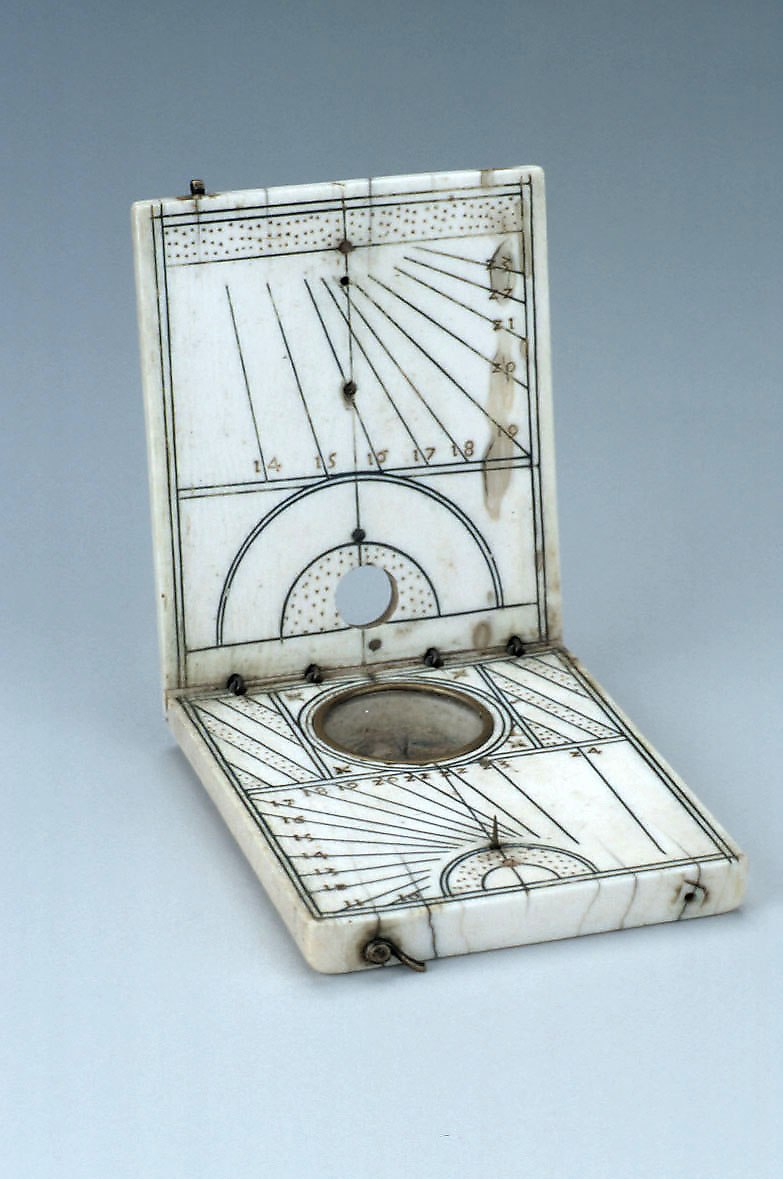
This diptych dial is a portable scientific instrument constructed from ivory and brass, measuring 56 x 69 x 12 mm. It is unsigned and undated, though attributed to Italian origins based on the latitude for which its folding brass gnomon is calibrated. The instrument consists of two hinged leaves featuring multiple horological components. The outer side of the upper leaf houses a horizontal sundial calibrated for approximately 45 degrees latitude, equipped with a folding gnomon and a compass viewing hole. Decoration on this face includes stars and foliage. The inner side of the upper leaf features a pin gnomon dial for Italian hours. The lower leaf contains an inset compass with a decorative card painted in gold, red, and blue, although the magnetic needle is missing. A second pin gnomon dial for Italian hours is provided on the inner side of the lower leaf.

Detailed view of the interior faces and the compass recess of the diptych dial.
Detailed view of the interior faces and the compass recess of the diptych dial. — Museum of the History of Science, Oxford. Rights pending — permission not yet requested. Original source

Catalogue identity

Source
www.mhs.ox.ac.uk
Category
Tool · Italian diptych dial
Maker / attribution
Not established
Reference
Not recorded
Catalogue / lot identifier
82248
Source-reported date
circa 1600
Source-reported place
Italy

Source-reported attribution and specifications are not independent authentication. A listing does not establish present ownership, current display, availability or permission to reproduce.

Object description

Structural Design and Exterior

The diptych dial is fashioned as a two-leaf folding instrument composed primarily of ivory, providing a compact surface for integrated timekeeping components. The overall dimensions are 56 by 69 by 12 mm, facilitating portability. While the outer side of the lower leaf remains entirely blank, the upper leaf exterior provides a horizontal sundial for latitude calibrated to approximately 45 degrees.

This exterior dial incorporates a folding brass gnomon to facilitate observation, accompanied by a dedicated viewing hole for the underlying compass. The face is embellished with engraved motifs depicting stars and foliage, contrasted against the plain ivory body. Common hours are marked numerically from IIII to XII to VIII, including half-hour divisions.

Evidence for this section
  • “Ivory and brass; 56 x 69 x 12 mm”
  • “The outer side of the upper leaf has a horizontal dial for latitude circa 45? with folding brass gnomon and compass viewing hole.”
  • “The dial has common hours numbered from IIII to XII to VIII to the half-hour and decoration of stars and foliage.”

Interior Horological Components

The interior faces of the diptych are dedicated to multiple timekeeping systems, primarily utilizing pin gnomons. On the inner side of the upper leaf, a pin gnomon dial is arranged for reading Italian hours, with markings ranging from 14 to 23. This section is decorated with a multiple half-circle motif at the base.

The inner side of the lower leaf serves as the central operational area for directional orientation and timekeeping. It houses a recessed compass, though the original magnetic needle is currently missing. The compass card is finished in gold, red, and blue. Below this, a second pin gnomon dial is positioned for Italian hours, marked 10 to 24, and features a circular motif mirroring the upper leaf's design.

Evidence for this section
  • “The inner side of the upper leaf has a pin gnomon dial for Italian hours, numbered from 14 to 23.”
  • “The inner side of the lower leaf has a compass (needle missing) with card painted in gold, red and blue”
  • “Below is a pin gnomon dial for Italian hours numbered from 10 to 24 with a circular motif similar to the one on the upper leaf.”

Attribution and Provenance

The instrument is unsigned and contains no specific date mark, leading to its identification as a product of the circa 1600 period based on technical and stylistic features. The attribution to Italy is derived from the specific calibration of the folding brass gnomon for a latitude of 45 degrees.

The piece is currently held within the collection of the Museum of the History of Science, Oxford, identified by inventory number 82248.

Evidence for this section
  • “Unsigned”
  • “circa 1600; Italian”
  • “since its folding brass gnomon is for a latitude of about 45?, it has been identified as Italian”

Open research questions

  • What is the specific historical context of the 45-degree latitude calibration in Italian-made dials of the 17th century?
  • Can the missing compass needle be reconstructed or replaced while maintaining the integrity of the original ivory card?

Source evidence

Recorded claims and source quotations for Diptych Dial
FieldSource-reported valueSource quotation
MaterialIvory and brass“Ivory and brass”
Dimensions56 x 69 x 12 mm“56 x 69 x 12 mm”
LatitudeApproximately 45 degrees“latitude of about 45?”
Compass Card DecorationPainted in gold, red and blue“compass card is richly painted and gilt”
Inventory Number82248“Inventory number: 82248”

Visible details

  • Hinged ivory construction with brass components
  • Compass needle is missing from the lower leaf
  • Upper leaf features stars and foliage ornamentation
  • Pin gnomon dials are present on both interior faces

Research qualifications

  • The exact origin remains unconfirmed, relying on latitude identification for Italian attribution
  • The magnetic compass needle is absent, limiting the functionality of the instrument

Photograph identity and source facts were screened before import; rights clearance remains pending.

Consulted source

Diptych Dial

Reviewed 2026-10-26 · Record 19102bee3d

Terms in this record

Glossary explanations for terms named in this object’s record.

Other italian diptych dial records