
Skip to content
The Encyclopedia of Horology

Tool · Central European dialling quadrant

Dialling Quadrant by Erasmus Habermel

Partially verified

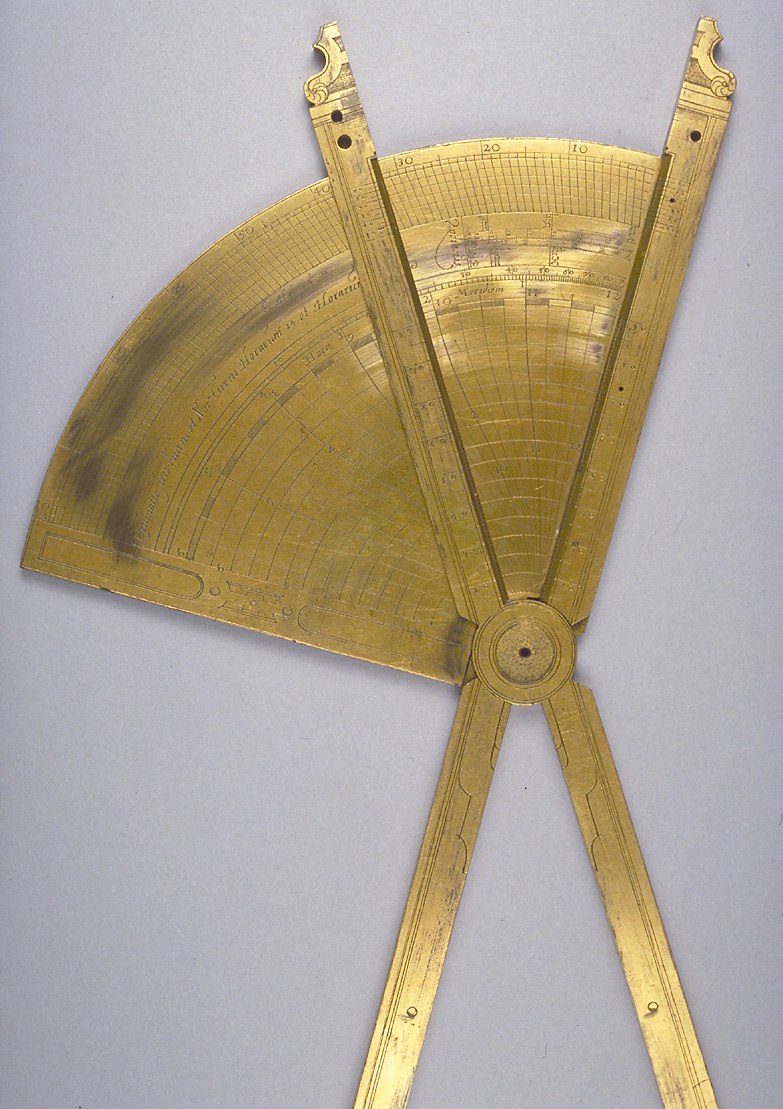
This 1592 dialling quadrant was manufactured in Prague by Erasmus Habermel and is composed of gilt brass with a diameter of 138 mm. It functions as a complex mathematical tool for calculating sundial construction and daylight duration. The instrument features two pivoted arms—one fixed and one movable—mounted to a quadrant plate. The obverse side contains scales for horary lines, solar declination, and transversal degree markings to facilitate the calculation of horizontal sundials for varying latitudes. The reverse displays horary scales alongside a Rojas projection, which assists in determining maximum daylight duration throughout the year. The surface is decorated with a geometrical pattern. The piece is currently held in the British Museum collection, having been presented by A.W. Franks in 1867, and is documented in scholarly catalogues regarding European scientific instruments.

The obverse of the brass dialling quadrant, featuring the signed maker's name, zodiacal scales, and pivoted arms for calculation.
The obverse of the brass dialling quadrant, featuring the signed maker's name, zodiacal scales, and pivoted arms for calculation. — British Museum, London. Rights pending — permission not yet requested. Original source

Catalogue identity

Source
www.mhs.ox.ac.uk
Category
Tool · Central European dialling quadrant
Maker / attribution
Erasmus Habermel
Reference
Not recorded
Catalogue / lot identifier
MLA 1867,7-5.25
Source-reported date
1592
Source-reported place
Prague

Source-reported attribution and specifications are not independent authentication. A listing does not establish present ownership, current display, availability or permission to reproduce.

Object description

Design and Obverse Functionality

The obverse of the quadrant is engineered to aid in the creation of horizontal sundials for any given latitude without the need for manual calculation. The surface is engraved with a series of scales including an horary quadrant marked with hour lines ranging from 6 to 12 to 6, subdivided into quarter-hour increments. A declination arc and a zodiacal scale are integrated into the design, the latter extending over 23.5 degrees and marked with zodiacal symbols.

The two pivoted arms attached to the quadrant plate play a critical role in its operation. By moving the arm over the horary quadrant and aligning the appropriate latitude with a specific hour line, the user can determine angles using the transversal scale. The 0 to 60 scale on the arms corresponds directly to the transversal scale on the instrument plate.

Evidence for this section
  • “The obverse of this unusual and very sophisticated instrument by one of the most renowned makers of the late 16th century bears markings which allow the construction of a horizontal sundial for any latitude without calculation.”
  • “The obverse is laid out as an horary quadrant labelled 'Horae Ante' / 'Post Meridiem' with hour lines 6 to 12 to 6, numbered by 1 and divided to 1/4 hours.”

Reverse Functionality

The reverse of the instrument is designed to determine the maximum daylight duration for any location and time of year. It features a similar horary quadrant layout but includes one quarter of a Rojas projection. This projection contains hour lines numbered 12 to 24, which are marked twice across the quadrant and once along the horizontal edge, with alternating shading for half-hour and quarter-hour divisions.

Operational use involves setting the movable arm against the zodiacal scale to account for the time of year. By identifying the intersection of the correct latitude on the arm with the hour curves, the duration of daylight is indicated. The arms on this side also possess identical non-linear degree scales for precision adjustments.

Evidence for this section
  • “The reverse can be used to determine the maximum length of daylight for any latitude”
  • “The reverse of the quadrant is laid out as an horary quadrant with markings for morning and afternoon hours 6 to 12 to 6, numbered by 1 and divided to 20 minutes, and labelled 'Horae Post' / 'Ante Meridiem'.”

Provenance and Identification

The instrument is signed by Erasmus Habermel and dated 1592. The piece is part of the collection at the British Museum, identified by the registration number MLA 1867,7-5.25. It entered the collection as a gift from A.W. Franks in 1867.

The quadrant has been formally catalogued in scholarly research regarding the history of scientific instruments. Specifically, it appears in the 1981 catalogue compiled by F. A. B. Ward, which documents the collection of European scientific instruments held within the Department of Medieval and Later Antiquities.

Evidence for this section
  • “Signed by Erasmus Habermel”
  • “The instrument was presented by A.W. Franks in 1867 and is described in F. A. B. Ward, A Catalogue of European Scientific Instruments in the Department of Medieval and Later Antiquities of the British Museum (London, 1981), p. 94, no. 273.”

Open research questions

  • What specific mechanisms or attachments were originally intended for the holes found on the arm tips?
  • Can the specific historical owner prior to A.W. Franks be identified through institutional records?

Source evidence

Recorded claims and source quotations for Dialling Quadrant by Erasmus Habermel
FieldSource-reported valueSource quotation
MakerErasmus Habermel“Signed by Erasmus Habermel”
Date1592“Dated 1592”
LocationPrague“Prague”
MaterialGilt brass“Gilt brass”
Diameter138 mm“138 mm in diameter (quadrant)”
Inventory numberMLA 1867,7-5.25“Registration no. MLA 1867,7-5.25”
LiteratureF. A. B. Ward, A Catalogue of European Scientific Instruments in the Department of Medieval and Later Antiquities of the British Museum (London, 1981), p. 94, no. 273“described in F. A. B. Ward, A Catalogue of European Scientific Instruments in the Department of Medieval and Later Antiquities of the British Museum (London, 1981), p. 94, no. 273.”

Visible details

  • Quadrant plate features a transversal degree scale 0 to 90
  • Surface displays engraved zodiacal scales and hour line markings
  • Overall construction is of gilt brass with a diameter of 138 mm

Research qualifications

  • The exact function of the holes on the arms remains speculative, possibly for sights or an arc fixing mechanism
  • The specific purpose of the geometrical surface decoration is not detailed in the source

Photograph identity and source facts were screened before import; rights clearance remains pending.

Consulted source

Dialling Quadrant

Reviewed 2026-10-26 · Record 3ca5b490d3

Terms in this record

Glossary explanations for terms named in this object’s record.