
Skip to content
The Encyclopedia of Horology

Tool · French crucifix dial

Crucifix Dial

Partially verified

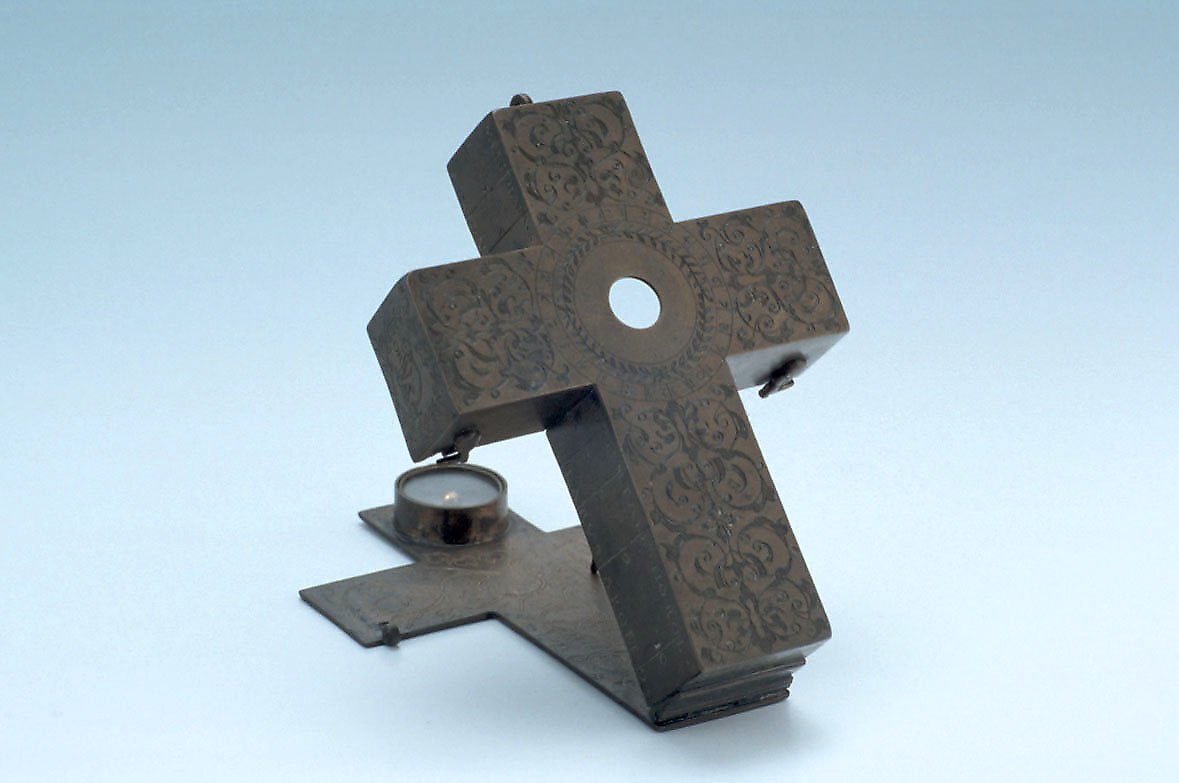
This brass crucifix dial, dated 1592 and of French origin, is a polyhedral instrument measuring 112 x 24 x 82 mm. Held by the Museum of the History of Science, Oxford, the instrument is unsigned. Its construction features a central cross form with elaborate engraved decorations, including arabesques and foliate patterns. The dial incorporates multiple timekeeping functions, including an integrated compass and a central equinoctial dial, though the latter currently lacks its gnomon. The surface is heavily inscribed with Latin phrases, cardinal directions, and specific geographical references, such as the latitude for Senlis. The object is hinged, allowing it to be closed when not in use. This piece serves as a complex example of sixteenth-century portable timekeeping, demonstrating a combination of devotional form and functional scientific design through its various specialized markings, ranging from hour lines to latitude scales.

The crucifix dial shown with its compass visible on the base plate.
The crucifix dial shown with its compass visible on the base plate. — Museum of the History of Science, Oxford. Rights pending — permission not yet requested. Original source

Catalogue identity

Source
www.mhs.ox.ac.uk
Category
Tool · French crucifix dial
Maker / attribution
Not established
Reference
Not recorded
Catalogue / lot identifier
53446
Source-reported date
1592
Source-reported place
France

Source-reported attribution and specifications are not independent authentication. A listing does not establish present ownership, current display, availability or permission to reproduce.

Object description

Construction and Decoration

The crucifix dial is crafted from brass and maintains a structural form derived from a cross. The faces of the object are decorated with detailed engraved motifs, including arabesques and foliate designs. These decorative elements frame the various timekeeping inscriptions and indicators located across the surfaces of the cross arms and the main plate.

The instrument incorporates a series of functional marks that facilitate its use as a sundial. Cardinal directions are engraved with symbolic figures, including a cock for the occident, a dog for the orient, and a combination of solar, lunar, and stellar imagery for the meridian. The construction includes closure hooks on the edges, enabling the object to be secured when inactive.

Evidence for this section
  • “On one side of the cross there is foliate decoration”
  • “The other face of the cross is decorated with arabesques”
  • “On the edges of the instrument are hooks for closing the dial when not in use”

Timekeeping Functions

The dial serves as a multifunctional scientific instrument. It contains a compass to orient the device correctly relative to magnetic north, and an unequal latitude scale marked from 0 to 90 degrees. The specific mention of 'LAT SILVAN 49' aligns the latitude setting with Senlis, France. The hour lines provided include designations for western, meridian, polar, and eastern orientations.

An equinoctial dial is located at the center of the cross face. While the markings and the central mounting hole remain visible, the original gnomon is absent, rendering this specific component non-functional in its current state. The inscriptions on the arms of the cross emphasize its solar timekeeping purpose through verses such as 'here the bright Apollo gives the hours'.

Evidence for this section
  • “On the inner side of this plate is a compass, an unequal scale of latitudes”
  • “equinoctial dial, whose gnomon is missing”
  • “The hour lines are engraved with the indications 'HOROL OCCIDENTALE', 'HOROL MERIDIANVM', 'MERIDIANVM POLARE' and 'ORIENTALE HOROL'”

Inscriptions and Markings

The surface is heavily annotated with Latin inscriptions that contribute to both the devotional appearance and the functional identity of the object. The Latin text 'LAVREA CHRISTO' appears alongside the foliage decoration on one side of the cross. Further textual engravings on the arms include 'HIC DABIT HORAM CLARVS APOLLO' and 'NVBE FVGATA SPLENDEAT AETHER', which translate to observations regarding the sun's role in timekeeping.

The date 1592 is engraved prominently below the northern cardinal point indicator. These markings are part of a systematic layout of the instrument's components, which also include specific abbreviations for the cardinal points. The inclusion of these dates and Latin phrases provides the primary historical markers for the object.

Evidence for this section
  • “on one side of the cross is a foliage decoration with the inscription 'LAVREA CHRISTO'”
  • “On the arms of the cross are engraved the inscriptions 'HIC DABIT HORAM CLARVS APOLLO'”
  • “Below the indication of the north is the date '15 92'”

Open research questions

  • What material was likely used for the missing gnomon?
  • Was the dial calibrated for other latitudes in addition to Senlis?

Source evidence

Recorded claims and source quotations for Crucifix Dial
FieldSource-reported valueSource quotation
Date1592“Dated 1592”
Inventory Number53446“Inventory number: 53446”
Dimensions112 x 24 x 82 mm“112 x 24 x 82 mm”
OriginFrance“French”
InscriptionLAVREA CHRISTO“'LAVREA CHRISTO'”
Latitude referenceSenlis“LAT SILVAN 49' referring to the latitude of Senlis (France)”

Visible details

  • Features engraved Latin inscriptions on cross arms
  • Contains a small integrated compass
  • Equinoctial dial central hole is present but gnomon is missing
  • Cardinal points decorated with celestial and animal figures

Research qualifications

  • The gnomon for the equinoctial dial is missing
  • Latitude scale is partially obscured or potentially marked [0?]

Photograph identity and source facts were screened before import; rights clearance remains pending.

Consulted source

Crucifix Dial

Reviewed 2026-10-26 · Record 6c61005e7d

Terms in this record

Glossary explanations for terms named in this object’s record.