
Skip to content
The Encyclopedia of Horology

Tool · Scientific instrument diptych sundial

Conrad Karner Ivory Diptych Sundial

Partially verified

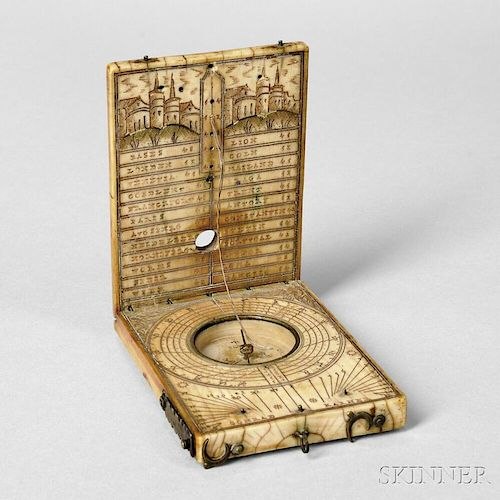
This ivory diptych sundial is catalogued by Bonhams Skinner as originating from seventeenth-century Nuremberg and is inscribed with the signature of maker Conrad Karner. The upper leaf interior displays an engraved and inked architectural town skyline positioned above a latitude table listing twenty-four European towns, pierced by a central viewing aperture. The lower leaf holds a sunk glazed compass encircled by multiple time scales graduated 4-12 and 1-8 alongside Italian and Babylonian hour divisions. The leaves are joined by a string gnomon and fitted with decorative brass hinges and hooks.

Interior view of the ivory diptych sundial by Conrad Karner showing town latitude table, string gnomon, and inset compass
Interior view of the ivory diptych sundial by Conrad Karner showing town latitude table, string gnomon, and inset compass — Bonhams Skinner. Rights pending — permission not yet requested. Original source

Catalogue identity

Source
www.bidsquare.com
Category
Tool · Scientific instrument diptych sundial
Maker / attribution
Conrad Karner
Reference
Not recorded
Catalogue / lot identifier
392
Source-reported date
17th century
Country
Germany

Source-reported attribution and specifications are not independent authentication. A listing does not establish present ownership, current display, availability or permission to reproduce.

Object description

Physical Construction and Design

The instrument is a rectangular ivory diptych sundial measuring 2 1/2 by 3 5/8 by 9/16 inches. The two leaves are joined by brass hinges and include decorative brass clasps. The exterior case features foliate decoration, a wind rose numbered 1-32, and a hinged brass cover for a wind vane on the side. The base of the instrument is fitted with four brass nail-head feet.

The interior vertical leaf displays a carved village scene above a latitude table for twenty-four towns, along with a string gnomon. The horizontal leaf houses a glazed, recessed compass and features time scales graduated 4-12 and 1-8, with additional Italian and Babylonian hour divisions.

Evidence for this section
  • “wd. 2 1/2, dp. 3 5/8, ht. 9/16 in.”
  • “foliate decorated outer case with wind rose numbered 1-32”
  • “four brass nail-head feet”
  • “inner face with a carved village scene above the twenty-four towns with their latitudes, and string gnomon”
  • “glazed sunk compass”
  • “Babylonian and Italian hours”

Maker Attribution and Dating

The dial bears the signature 'Conrad Karner'. Cataloguing attributes the object to Nuremberg in the 17th century. The instrument includes 'horn maker's marks' near the compass and 'double horn maker's marks' on the reverse side.

Dating information is present on the reverse side of the instrument, where the text 'Epacta Iviani Anno 1619' is engraved in conjunction with circular scales.

Evidence for this section
  • “marked Conrad Karner”
  • “Nuremberg, 17th century”
  • “horn maker's mark”
  • “double horn maker's marks”
  • “Epacta Iviani Anno 1619”

Reverse Face and Condition

The reverse side is described in the catalogue as containing multiple circular scales, including dual 1-12 hour tracks and lunar days 1-29, alongside an engraved brass pointer and an inner scale labeled 'Epacta Creori Anno'.

The catalogue notes a loss of structural detail, stating the object is 'lacking index finger'. Condition is subject to appraisal and wear, and the absence of a formal condition statement in the provided source does not confirm the object's state of repair.

Evidence for this section
  • “back side with multiple circular scales, dual 1-12 hours, lunar days 1-29”
  • “engraved brass pointer”
  • “inner scale Epacta Creori Anno”
  • “lacking index finger”

Open research questions

  • What is the specific physical function and placement of the 'index finger' noted as missing in the catalogue?
  • Does the 'horn maker's mark' correspond to a documented workshop in 17th-century Nuremberg?
  • Is the 'Epacta Creori Anno' engraving incomplete on this specific specimen, given the absence of a year following 'Anno'?

Source evidence

Recorded claims and source quotations for Conrad Karner Ivory Diptych Sundial
FieldSource-reported valueSource quotation
OriginNuremberg, 17th century“Nuremberg, 17th century”
Town listTwenty-four towns with their latitudes“twenty-four towns with their latitudes”
Maker markingConrad Karner“marked Conrad Karner”
Inscribed dateAnno 1619“Epacta Iviani Anno 1619”
DimensionsWd. 2 1/2, dp. 3 5/8, ht. 9/16 in.“wd. 2 1/2, dp. 3 5/8, ht. 9/16 in.”
Town listTwenty-four towns with their latitudes“twenty-four towns with their latitudes”
Secondary internal scaleEpacta Creori Anno“inner scale Epacta Creori Anno”

Visible details

  • Rectangular hinged ivory diptych open at approximately a right angle, joined by a taut string gnomon
  • Inked and carved town skyline scene on the interior face of the vertical leaf above a two-column latitude table
  • Circular recessed glazed compass inset into the horizontal leaf, surrounded by circular hour tracks and radiating lines
  • Maker name visible along the lower border inscribed 'CONRAD KARNER'
  • Decorative brass clasps, hinges, and attachment eyes fitted to the ivory edges

Research qualifications

  • Exterior case features, wind rose, lunar calendar, and reverse face scales noted in the catalogue description are not visible in the interior photograph
  • Catalogue notes 'lacking index finger'

Photograph identity and source facts were screened before import; rights clearance remains pending.

Consulted source

Conrad Karner Ivory Diptych Sundial sold at auction on 31st October | Bidsquare

Reviewed 2026-10-25 · Record bd63961ccb

Terms in this record

Glossary explanations for terms named in this object’s record.