
Skip to content
The Encyclopedia of Horology

Clock · Musical clock

Clock with musical mechanism

Partially verified

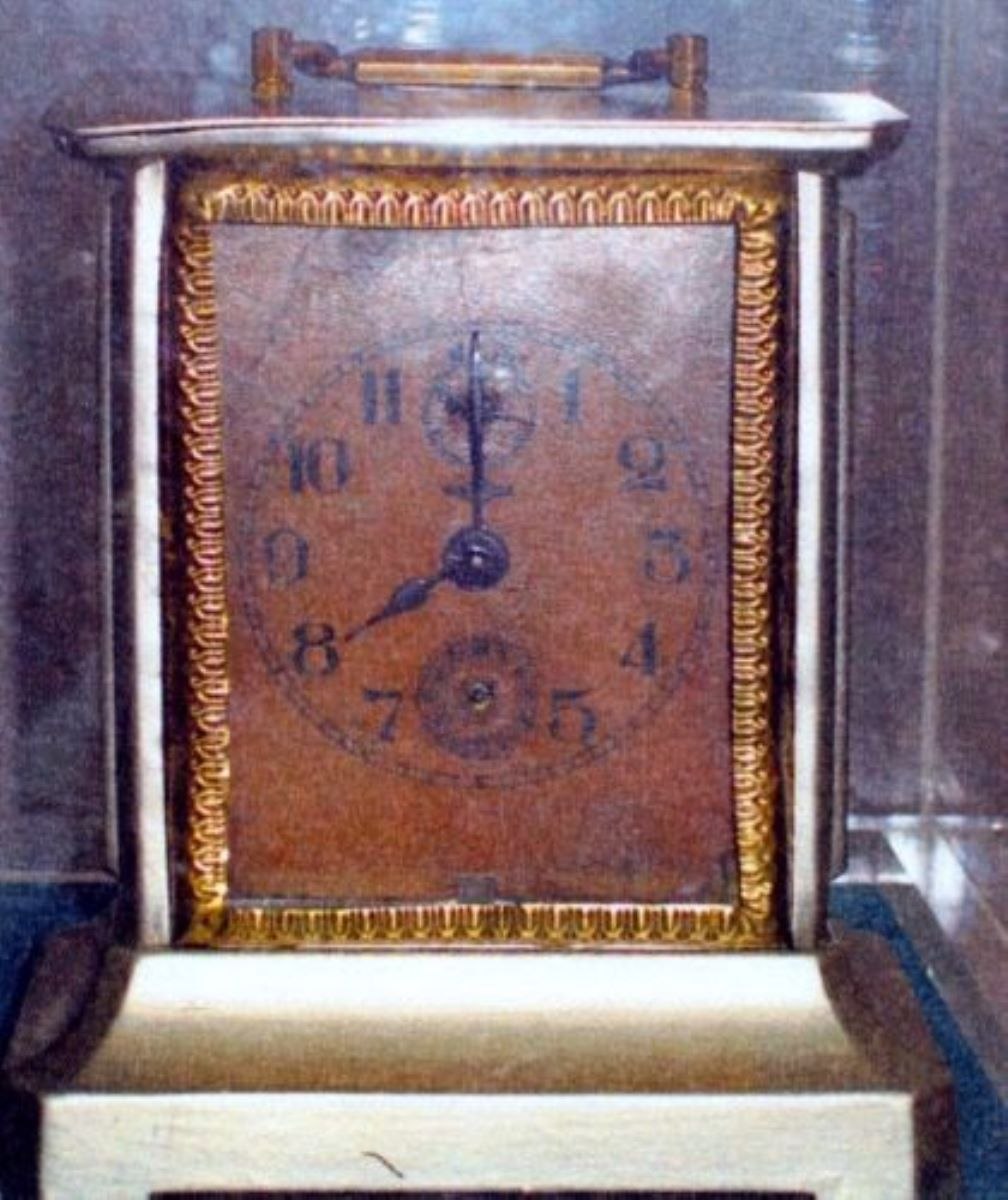
This musical clock, dated to 1900, is held in the collection of the Moldova National Museum Complex. It is constructed as a rectangular cuboid case, defined by chrome-plated metal borders and glass panes, which sits upon a distinct metal base. The primary timekeeping dial is marked with black Arabic numerals. An additional smaller dial is positioned at the 6 o'clock mark, serving as the setting for the clock's alarm function. The base of the clock houses a pinned-cylinder musical mechanism. Winding of the clock is managed via a wheel located behind the movement. The object includes a carrying handle fixed to the upper exterior and a small metal door located at the rear of the case. The total dimensions of the object are recorded as 13.5 cm in length, 10 cm in width, and 16.5 cm in height.

Front view of the rectangular musical clock showing the dial with alarm sub-dial and chrome-plated borders.
Front view of the rectangular musical clock showing the dial with alarm sub-dial and chrome-plated borders. — Moldova National Museum Complex via Europeana. Rights pending — permission not yet requested. Original source

Catalogue identity

Source
orbiscollectibles.com
Category
Clock · Musical clock
Maker / attribution
Not established
Reference
/2048047/Clasate_1d59261fed8542f6a757725e6f670515
Catalogue / lot identifier
Source URL identifies the listing
Source-reported date
1900
Source-reported place
Not established

Source-reported attribution and specifications are not independent authentication. A listing does not establish present ownership, current display, availability or permission to reproduce.

Object description

Case and Dial Design

The clock is designed in a rectangular cuboid format, utilizing glass panels combined with chrome-plated metal borders along the sides. The entire structure is elevated on a metal base, providing a stable foundation for the vertical case. A functional handle is mounted on the top of the clock, indicating intended portability.

The primary dial displays hours using black Arabic numerals. Integrated into the main dial face, at the 6 o'clock position, is a sub-dial specifically designed for setting the alarm time.

Evidence for this section
  • “The rectangular cuboid case features chrome-plated metal borders on the sides and glass panes, all resting on a metal base.”
  • “The dial features black Arabic numerals for indicating the hours, and at the 6 o'clock position is placed the dial for setting the alarm time.”
  • “The clock is fitted with a handle on the upper part and a metal small door at the back.”

Mechanism and Operation

The object functions as a dual-purpose device, incorporating both timekeeping and musical performance. A pinned-cylinder musical mechanism is housed within the metal base, which is distinct from the primary clock movement.

Driving the clock mechanism requires the use of a winding wheel, which is positioned behind the main movement. This indicates a manual winding process for the timekeeping function, though the specific winding mechanism for the musical component is not explicitly detailed beyond its placement within the base.

Evidence for this section
  • “The base contains the pinned-cylinder musical mechanism.”
  • “The clock is driven by means of the winding wheel located behind the movement.”

Provenance and Documentation

This clock is part of the collection of the Moldova National Museum Complex and has been catalogued under a specific identifier. The museum records provide standardized physical measurements of the specimen, listing the length at 13.5 cm, width at 10 cm, and height at 16.5 cm.

Current documentation identifies the object as a clock with a musical mechanism, dated to 1900. While the museum has provided this information, the record acknowledges that the broader classification or type of this object has not undergone independent verification by external horological specialists.

Evidence for this section
  • “clock with musical mechanism, 1900 is held by Moldova National Museum Complex, dated 1900.”
  • “The museum record gives measurements L: 13.5 cm; W: 10 cm; H: 16.5 cm.”
  • “how far this object represents a wider collectible type has not yet been independently verified.”

Open research questions

  • What is the name of the manufacturer of the musical cylinder mechanism?
  • Are there any internal maker marks or serial numbers stamped on the clock movement or the base?

Source evidence

Recorded claims and source quotations for Clock with musical mechanism
FieldSource-reported valueSource quotation
InstitutionMoldova National Museum Complex“held by Moldova National Museum Complex”
Dimensions13.5 cm x 10 cm x 16.5 cm“L: 13.5 cm; W: 10 cm; H: 16.5 cm”
Case constructionRectangular cuboid with chrome-plated metal borders“The rectangular cuboid case features chrome-plated metal borders on the sides and glass panes”
Alarm functionSetting dial at 6 o'clock“at the 6 o'clock position is placed the dial for setting the alarm time”
Movement powerWinding wheel behind movement“The clock is driven by means of the winding wheel located behind the movement”
Musical featurePinned-cylinder mechanism in base“The base contains the pinned-cylinder musical mechanism.”

Visible details

  • Rectangular cuboid case with glass panes and chrome-plated borders
  • Carrying handle mounted to the top
  • Small alarm setting dial at the 6 o'clock position
  • Secondary winding mechanism accessed from the rear

Research qualifications

  • Maker of the clock and the musical movement remain unidentified.
  • Exact metallic composition beyond general description has not been verified.

Photograph identity and source facts were screened before import; rights clearance remains pending.

Consulted source

Clock with musical mechanism, 1900

Reviewed 2026-11-02 · Record 30f0093ad1

Terms in this record

Glossary explanations for terms named in this object’s record.