
Skip to content
The Encyclopedia of Horology

Clock · Plinth clock

Clock in a case of marble and Derby porcelain

Partially verified

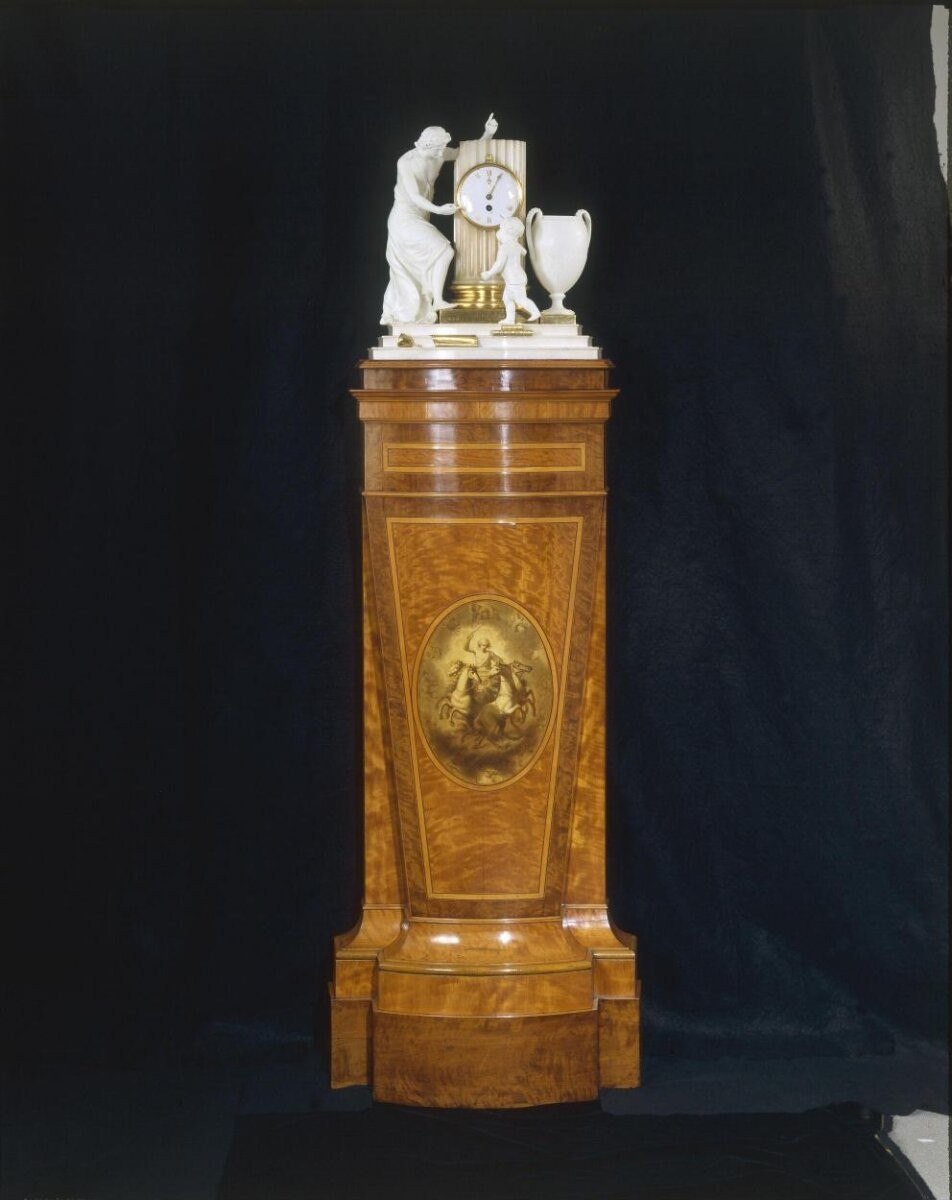
This clock, created in 1787 by Benjamin Vulliamy, features a complex mixed-media construction. The timepiece is housed within a fluted marble column, with the dial assembly mounted on the pillar. The composition includes biscuit porcelain figures identified as Venus and Cupid, accompanied by a porcelain vase, all resting upon a white marble base with gilt-brass accents. The entire assembly is supported by a tall, tapered plinth veneered in satinwood and mahogany, featuring a central oval painted panel depicting Apollo driving the chariot of the sun, surrounded by the signs of the zodiac. The porcelain figures are attributed to models by sculptor John Deare. This clock forms a pair with another object in the collection.

Full view of the clock and its matching plinth base.
Full view of the clock and its matching plinth base. — Victoria and Albert Museum. Rights pending — permission not yet requested. Original source

Catalogue identity

Source
collections.vam.ac.uk
Category
Clock · Plinth clock
Maker / attribution
Benjamin Vulliamy
Reference
Not recorded
Catalogue / lot identifier
W.15:1,2-1958
Source-reported date
1787
Source-reported place
London, England

Source-reported attribution and specifications are not independent authentication. A listing does not establish present ownership, current display, availability or permission to reproduce.

Object description

Construction and Materials

The clock is composed of a diverse array of materials, indicating a collaborative production. The core timekeeping element is mounted into a fluted pillar of marble. The sculptural elements, described as 'biscuit' porcelain, represent the figures of Venus and Cupid, along with a separate vase. These elements are arranged on a white marble base, which features gilt-brass detailing.

The supporting structure is a tall plinth, which is finished with satinwood and mahogany veneers. This plinth is tapered in appearance through the use of a central panel and is decorated with an oval painting of the sun god Apollo.

The overall composition reflects an integration of fine cabinet-making, porcelain manufacture, and horological mechanics.

Evidence for this section
  • “A clock in a case of marble and Derby porcelain, with gilt-brass mounts”
  • “mounted on a tall plinth veneered in satinwood and mahogany, with an oval painted panel showing Apollo driving the chariot of the sun”
  • “This one combines an unglazed white porcelain known as 'biscuit' with gilt bronze, elegant marquetry and a painted scene.”

Signatures and Inscriptions

The clock bears specific markings that identify its maker and date of production. The inscription 'Vulliamy London 1787' is engraved onto the gilt-brass base that supports the marble column.

Additional historical details are provided by an inscription found on an ormolu scroll at the base of the steps, which reads 'Fugit irreperabile tempus. Virgil'. This Latin phrase serves as a thematic element within the object's design.

On the back of the clock regulator, there is also a marking reading 'BREVETE SGDG', which appears to indicate a technical certification or patent reference, although its full significance in the context of this 1787 object is subject to the limitations of the provided source information.

Evidence for this section
  • “Vulliamy London 1787”
  • “Inscribed on ormolu scroll at base of steps 'Fugit irreperabile tempus. Virgil'”
  • “on back of clock regulator BREVETE SGDG”

Provenance and Attribution

The firm of Vulliamy & Son is identified as the primary maker of this clock, with the figures sourced from the Derby porcelain factory. The stand is attributed to the London firm of Thomas Brownley, and the painted panel on the plinth is attributed to John Bromley.

The figures are based on models attributed to the sculptor John Deare.

Evidence for this section
  • “made in London by Vulliamy & Son”
  • “stand probably made in London by Thomas Brownley”
  • “figures are based on models that are likely to have been made by John Deare”

Open research questions

  • What is the specific historical significance of the 'BREVETE SGDG' mark appearing on an object dated 1787?
  • Are there archival records that definitively confirm the attribution of the plinth painting to John Bromley?

Source evidence

Recorded claims and source quotations for Clock in a case of marble and Derby porcelain
FieldSource-reported valueSource quotation
MakerBenjamin Vulliamy“The clock was made by the firm of Benjamin Vulliamy”
Date1787“Vulliamy London 1787”
Place of originLondon“made in London by Vulliamy & Son”
FiguresVenus and Cupid“The figures looking at the clock are Venus and Cupid.”

Visible details

  • Biscuit porcelain figures depicting Venus and Cupid
  • Apollo driving the chariot of the sun painted on plinth panel
  • Gilt-brass mounts on marble and wood components
  • Fluted pillar incorporates the clock dial

Research qualifications

  • Biscuit figures only likely made by John Deare
  • Stand and painting possibly by Thomas and John Bromley
  • Exact division of labour between firm members remains partially speculative

Photograph identity and source facts were screened before import; rights clearance remains pending.

Consulted source

A clock in a case of marble and Derby porcelain, mounted on a tall plinth

Reviewed 2026-11-02 · Record af803827d0

Terms in this record

Glossary explanations for terms named in this object’s record.