
Skip to content
The Encyclopedia of Horology

Tool · Magnetic sundial

Charles Bloud magnetic sundial

Partially verified

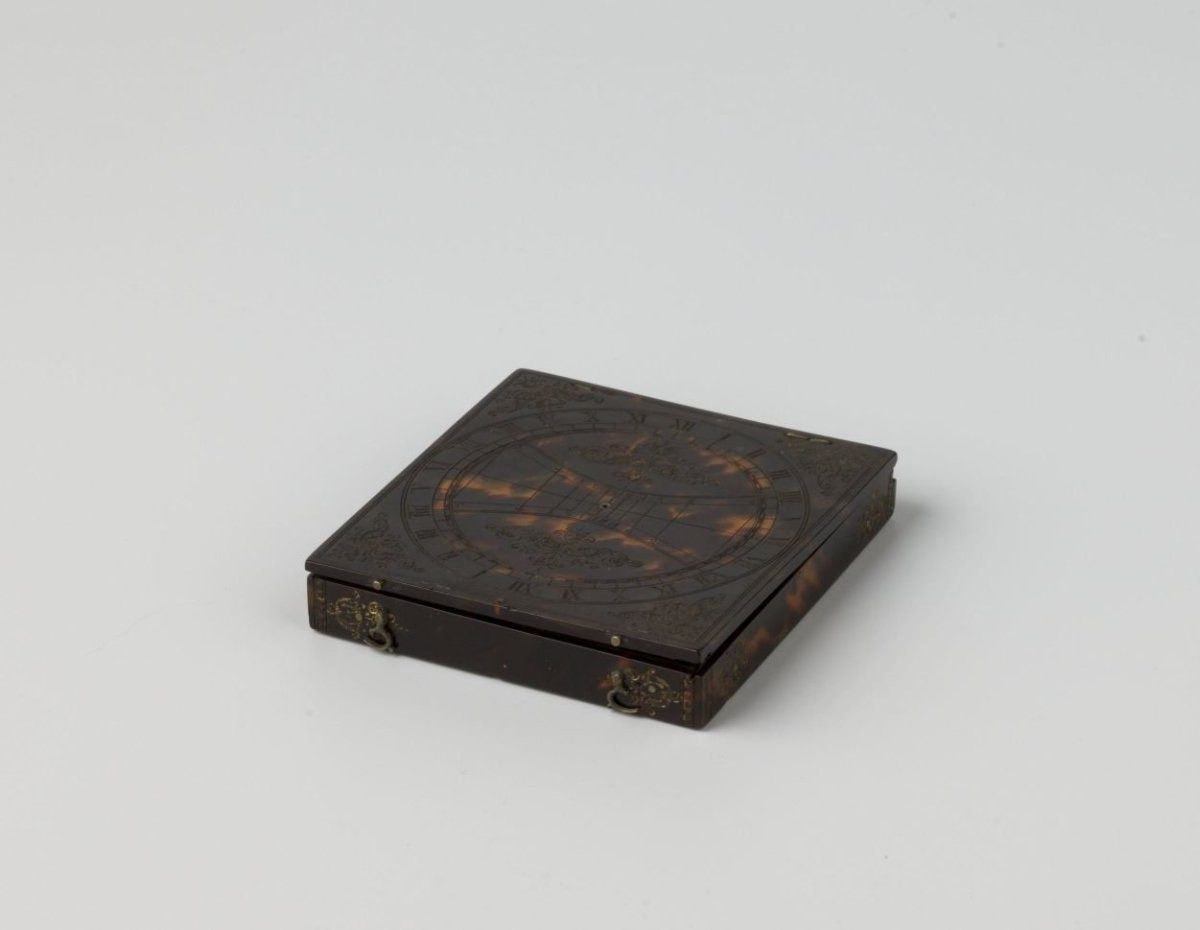
This magnetic sundial, or 'cadran magnetique', is a travelling instrument housed in a tortoiseshell horn box. Attributed to the maker Charles Bloud of Dieppe, the device functions through an internal compass. The base contains an eight-pointed compass rose with an elliptical silver dial featuring hour markers, alongside a rotatable silver disk for date calibration. A folding pin allows the instrument to function as a vertical sundial when angled against the lid. The interior of the lid includes a moon dial with rotating disks to indicate lunar phases and day tracking, along with a vertical scale of polar altitudes from 0 to 80 degrees. The instrument's signature is engraved on the underside. The current state of the instrument lacks the original copper pin described in historical accounts.

The exterior of the tortoiseshell horn box, showing the hour scale and engraved detail on the lid.
The exterior of the tortoiseshell horn box, showing the hour scale and engraved detail on the lid. — Rijksmuseum. Rights pending — permission not yet requested. Original source

Catalogue identity

Source
www.rijksmuseum.nl
Category
Tool · Magnetic sundial
Maker / attribution
Charles Bloud
Reference
Not recorded
Catalogue / lot identifier
NG-KOG-1690
Source-reported date
1600 - 1699
Source-reported place
France

Source-reported attribution and specifications are not independent authentication. A listing does not establish present ownership, current display, availability or permission to reproduce.

Object description

Construction and Layout

The instrument is contained within a square box made of tortoiseshell horn, consisting of two parts. The lower section houses a compass, which is central to the instrument's operation as a magnetic dial. The compass rose is eight-pointed and includes markings for French locations and their associated polar altitudes. An elliptical silver ring provides hour markings in two sets of 1-12 and VII-I, XII-V.

On the reverse side of the bottom section, a silver disc allows for date setting. This disk features a central grid of 49 squares and a surrounding monthly/daily calendar. An engraved hand serves as a reference point for alignment. A folding pin is located beside the compass, designed to be deployed for vertical sundial functionality by propping the lid at an angle.

Evidence for this section
  • “Vrijwel vierkante, uit twee delen bestaande zonnewijzer.”
  • “De onderkant bevat een kompas met een achtvoudige kompasroos”
  • “Rechts naast het kompas een uitklapbaar stiftje”

Lid Functions and Astronomical Indicators

The underside of the lid serves as an additional instrument for tracking lunar information. It features a fixed silver disk marked for months and hour divisions. Two separate rotating disks enable the tracking of days and the lunar phases. This assembly provides the user with data concerning moonrise and moonset, as well as night length.

A vertical scale on the right side of the lid, calibrated from 0 to 80 degrees, facilitates the positioning of the lid for vertical sun observation. When tilted, the lid’s exterior surface functions as a vertical sundial using a pin interface. This integration of solar and lunar data reflects the multifunctional nature of Bloud's design.

Evidence for this section
  • “Op de onderzijde van het deksel is een maanwijzer aangebracht.”
  • “Aan de rechterkant een verticale schaal met poolhoogten van 0 tot 80 graden.”

Condition and Historical Context

The instrument is identified by its signature on the underside. Historical documentation, specifically from the 19th century, suggests that a string might have originally been part of the instrument’s setup, similar to German 'Klappsonnenuhr' models. However, observation of known examples by Bloud does not confirm the presence of such a cord.

The object currently exhibits a loss of the original copper pin, which is noted to have resided in a side opening that remains closable with a small hook. The magnetic dial was a specific development by Bloud, produced only during a narrow span of years in the late 17th century.

Evidence for this section
  • “Wat wel ontbreekt is het koperen pennetje, dat in een opening aan de zijkant moet hebben gezeten.”
  • “Het instrument is een beperkt aantal jaren in produktie geweest.”

Open research questions

  • What is the exact mechanical relationship between the rotation of the date-setting disc and the vertical shifting of the internal silver ring?
  • Does the absence of the copper pin hinder the functionality of the device as a vertical sundial?

Source evidence

Recorded claims and source quotations for Charles Bloud magnetic sundial
FieldSource-reported valueSource quotation
MakerCharles Bloud“vervaardiger: Charles Bloud, Dieppe”
SignatureFAIT & INVENT PAR CHARLES BLOUD“signatuur, onderzijde: ‘FAIT & INVENT PAR CHARLES BLOUD’”
Dimensions9.8 cm x 9.2 cm x 1.5 cm“lengte 9,8 cm x breedte 9,2 cm x hoogte 1,5 cm”
MaterialTortoiseshell horn“Reiszonnewijzer/ kompas-zonnewijzer in schildpadhoornen doos”
OriginDieppe, France“vervaardiger: Charles Bloud, Dieppe”
FunctionMagnetic sundial (cadran magnetique)“De 'magnetische zonnewijzer' (cadran magnetique) is een uitvinding van Bloud uit 1670 of 1686.”

Visible details

  • Housed in a square, two-part tortoiseshell-effect box
  • Signed 'FAIT & INVENT PAR CHARLES BLOUD' on the underside
  • Features an internal magnetic compass rose
  • Includes a folding stilt for vertical alignment

Research qualifications

  • A 19th-century description notes the historical presence of a string, though none is visible on similar Bloud examples
  • The copper pin originally located in the side opening is currently missing

Photograph identity and source facts were screened before import; rights clearance remains pending.

Consulted source

Travelling sundial / compass-sundial in tortoiseshell horn box

Reviewed 2026-11-02 · Record 5adb3267aa

Terms in this record

Glossary explanations for terms named in this object’s record.