
Skip to content
The Encyclopedia of Horology

Tool · German chalice dial

Chalice Dial by Markus Purmann

Partially verified

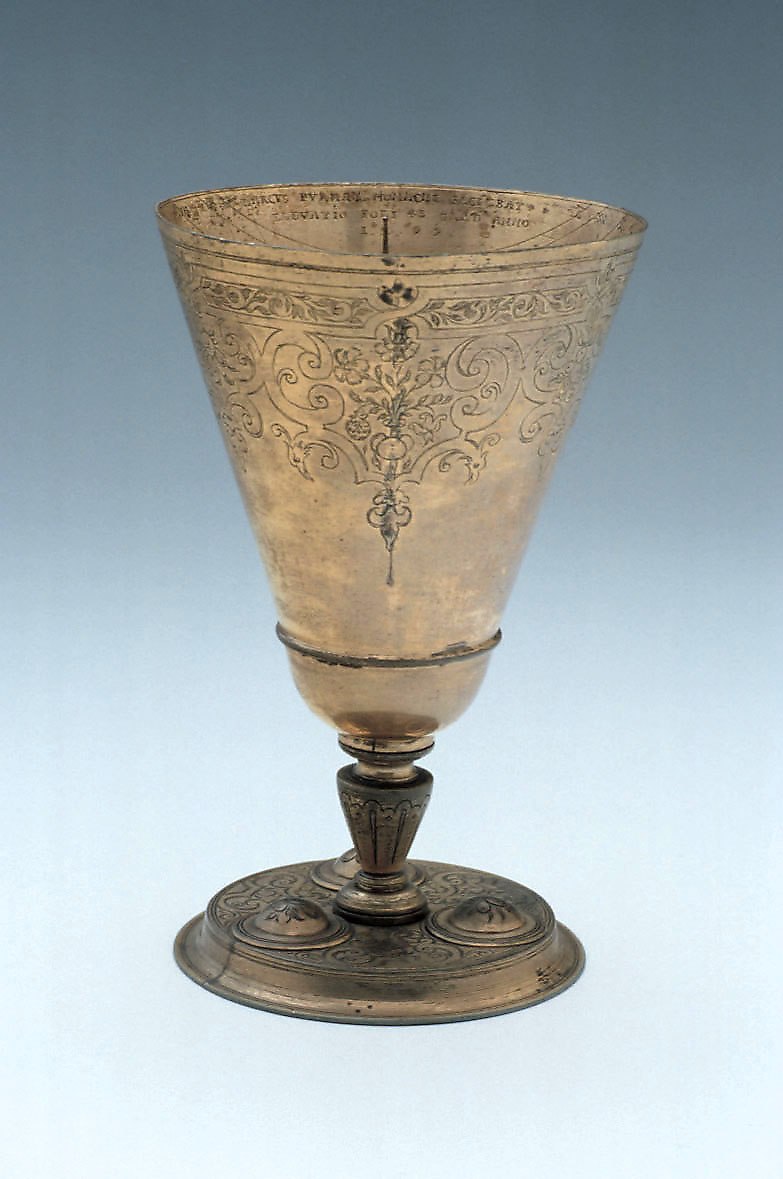
This chalice dial, created in Munich in 1599 by maker Markus Purmann, is constructed of gilt brass and measures 134 mm in height. The instrument functions as a sundial, with a central gnomon positioned within the cup. The external surface is engraved with floral motifs enclosed in cartouches and foliage. The base features three raised bosses, one of which contains a compass compartment. The internal portion of the chalice is engraved with hour lines for both Italian and common hours. The Italian hours, numbered 9 to 24, are designed for use with an empty cup, while the common hours, numbered 4 to 12 and VI to XII, account for the refraction of light when the cup is filled with water. A scale of latitudes is present on the folded brass plate, and zodiacal symbols indicate the solar declination.

A gilt brass chalice dial with floral engravings, a central gnomon, and a base with three bosses.
A gilt brass chalice dial with floral engravings, a central gnomon, and a base with three bosses. — Museum of the History of Science, Oxford. Rights pending — permission not yet requested. Original source

Catalogue identity

Source
www.mhs.ox.ac.uk
Category
Tool · German chalice dial
Maker / attribution
Markus Purmann
Reference
Not recorded
Catalogue / lot identifier
51021
Source-reported date
1599
Source-reported place
Munich

Source-reported attribution and specifications are not independent authentication. A listing does not establish present ownership, current display, availability or permission to reproduce.

Object description

Physical Design and Decoration

The instrument is a chalice-shaped sundial standing 134 mm high, fashioned from gilt brass. The exterior cup surface is finished with finely engraved floral patterns contained within cartouches, alongside foliage designs. The rim features further decorative engraving.

The base of the object is supported by three raised circular bosses. One of these serves as a cover for a small compass, though this component is presently incomplete.

Evidence for this section
  • “The external part of the chalice is finely engraved with flowers enclosed in cartouches, and a decoration on the rim.”
  • “The cup has a base decorated with arabesques and three raised bosses, one of which opens to reveal a small compass”

Timekeeping and Technical Function

The chalice dial utilizes a central gnomon to cast shadows onto lines engraved within the cup. The dial displays two distinct systems of time. The Italian hours, marked 9 to 24, are intended for use while the vessel is empty, denoted by the inscription 'Horarium sine aqua'.

Common hours are also provided, calculated to account for the refractive index of water when the cup is filled. These are labeled with the inscription 'Horarium ex perspectiua radiorum refractorum aquae' and are numbered 4 to 12 to 8 and VI to XII to VI.

Evidence for this section
  • “The gnomon is in the centre of the cup.”
  • “The other lines, indicated 'Horarium ex perspectiua radiorum [star] [star] [star] [star] refractorum aquae [star] [star] [star]' are for common hours”

Signatures and Scientific Markings

The object bears a detailed signature and technical information inscribed by the maker. The text reads 'MARCVS PVRMAN MONACHI FACIEBAT' alongside the specific latitude 'ELEVATIO POLI 48 GRAD' and the year 'ANNO 15 99'.

Additional scientific markings include zodiacal symbols for solar declination and an unequal scale of latitudes ranging from 0 to 66 degrees, identified by the label 'SCALA ALTITVDINIS SOLIS'.

Evidence for this section
  • “the signature reads 'MARCVS PVRMAN MONACHI FACIEBAT [star] [star] ELEVATIO POLI 48 GRAD ANNO 15 99'.”
  • “Where the brass plate is folded to form the cup, there is an unequal scale of latitudes from [0?] to 66? by 2?, numbered by 10?, with the indication 'SCALA ALTITVDINIS SOLIS'.”

Open research questions

  • What is the original configuration of the compass mechanism that was replaced in the 19th century?
  • Are there other known chalice dials by Markus Purmann that utilize the same refraction calculations?

Source evidence

Recorded claims and source quotations for Chalice Dial by Markus Purmann
FieldSource-reported valueSource quotation
MakerMarkus Purmann“Signed by Markus Purmann”
Date1599“Dated 1599”
MaterialGilt brass“Gilt brass”
Height134 mm“134 mm in height”
Location of manufactureMunich“Munich”
Italian hour scaleNumbered 9 to 24“Italian hours, whose lines, numbered from 9 to 24, are to be read with the cup empty”
Latitude scaleUnequal scale 0 to 66 degrees“an unequal scale of latitudes from [0?] to 66? by 2?, numbered by 10?”

Visible details

  • Floral engraving on the exterior surface
  • Raised bosses located on the base
  • Central gnomon visible inside the cup
  • Signature text engraved around the interior rim

Research qualifications

  • Compass needle is missing
  • Compass plate is identified as a 19th-century replacement

Photograph identity and source facts were screened before import; rights clearance remains pending.

Consulted source

Chalice Dial

Reviewed 2026-10-26 · Record 4636cf6e50

Terms in this record

Glossary explanations for terms named in this object’s record.