
Skip to content
The Encyclopedia of Horology

Clock · Cartel clock

Cartel clock

Partially verified

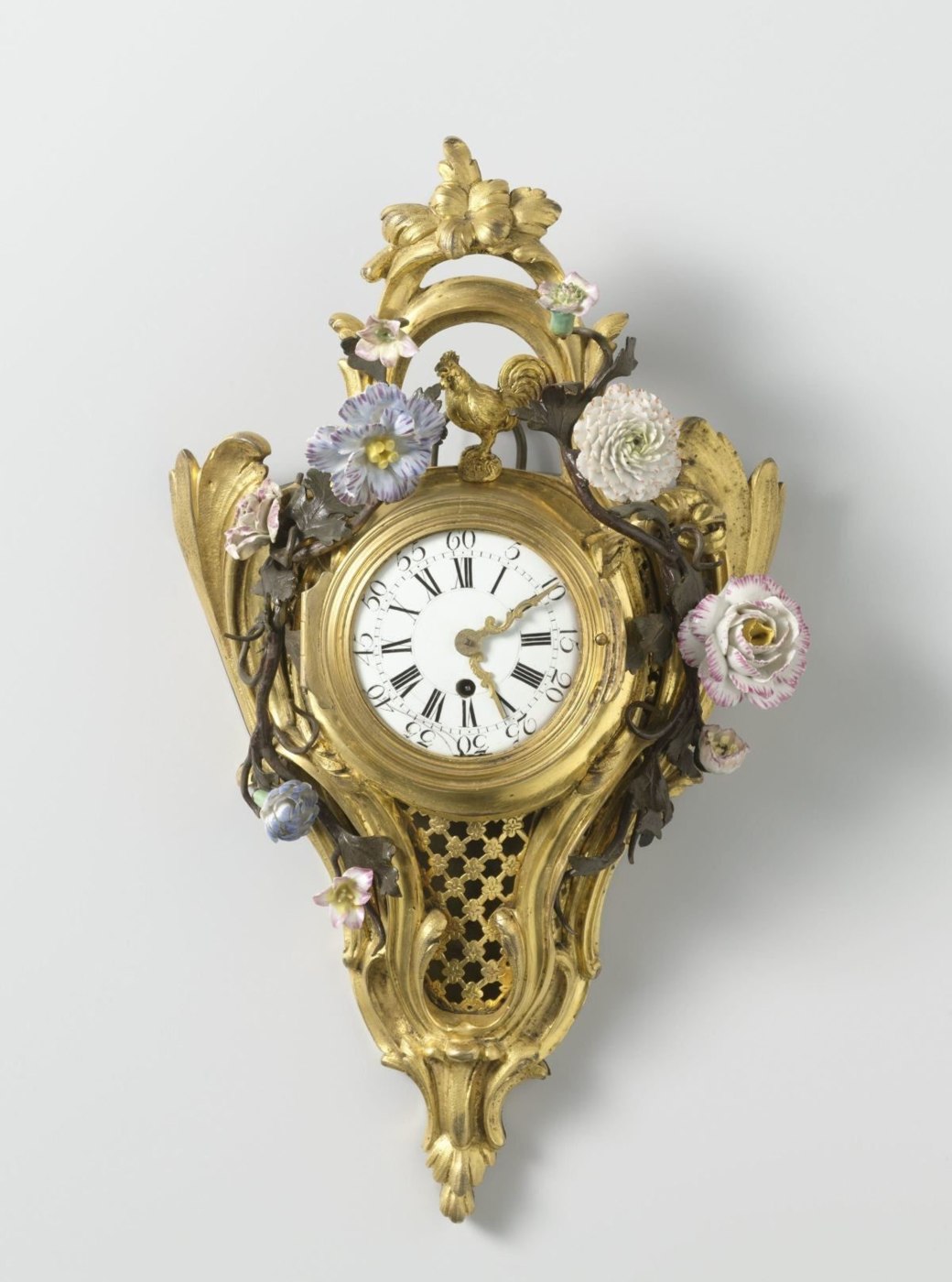
This cartel clock, designated by the museum as BK-16908, dates to approximately 1750 and is attributed to an anonymous maker from France. The clock features a round dial housed within a frame of gilt bronze, which is characterized by rocaille ornamentation. The exterior of the case is decorated with painted metal branches intertwined with porcelain flowers. The object currently resides in the collection of the Rijksmuseum.

Cartel clock, gilt bronze and porcelain, attributed to an anonymous French maker, circa 1750.
Cartel clock, gilt bronze and porcelain, attributed to an anonymous French maker, circa 1750. — Rijksmuseum. Rights pending — permission not yet requested. Original source

Catalogue identity

Source
www.rijksmuseum.nl
Category
Clock · Cartel clock
Maker / attribution
Not established
Reference
Not recorded
Catalogue / lot identifier
BK-16908
Source-reported date
ca. 1750
Source-reported place
France

Source-reported attribution and specifications are not independent authentication. A listing does not establish present ownership, current display, availability or permission to reproduce.

Object description

Case and Decorative Elements

The cartel clock is encased in a gilt bronze frame which features asymmetrical rocaille motifs. These motifs form the structural housing for the round dial of the clock. Integrated into this bronze structure are painted metal branches, which serve as mounts for a series of porcelain flowers.

The decorative arrangement extends across the sides and top of the clock. Perched atop the circular dial housing is a small, cast gilt bronze figure. The lower portion of the frame transitions into a narrow area featuring an openwork lattice design, providing visual contrast to the surrounding dense ornamentation.

Evidence for this section
  • “De ronde wijzerplaat is gevat in een verguld bronzen montuur, versierd met rocaillemotieven en metalen beschilderde bladtakken met bloemen van porselein.”

Provenance and Acquisition

The provenance of the clock includes an entry into the art market record during the Second World War. It was acquired from the estate of Dr. Fritz Mannheimer in Amsterdam and Paris in 1940. This acquisition was facilitated by the Dienststelle Mühlmann for the intended collection of the Führermuseum in Linz.

Following the war, the object was subject to recuperation through the SNK in 1945. It was subsequently placed on loan to the Rijksmuseum by the DRVK in 1952, among a larger group of 1,702 objects. The museum completed the transfer of the object into its permanent collection in 1960.

Evidence for this section
  • “war recuperation, SNK, 1945”
  • “on loan, with 1,702 other objects, from the DRVK to the museum, 1952;{Note RMA.} transferred to the museum, 1960”

Clock Identification and Technical Context

The object is identified as a mechanical clock within the category of cartel clocks. The design combines materials such as gilt bronze and porcelain to create a decorative wall timepiece.

While the object is categorized as a mechanical clock, specific technical details regarding the movement, such as the escapement type, strike train, or maker of the movement, are not preserved in the source text.

Evidence for this section
  • “Soort kunstwerk meubilair, uurwerk, klok, kartelklok, mechanische klok”
  • “vervaardiger: anoniem, Frankrijk”

Open research questions

  • Who was the clockmaker responsible for the mechanical movement housed within the bronze case?
  • What are the specific technical properties of the clock's escapement mechanism?

Source evidence

Recorded claims and source quotations for Cartel clock
FieldSource-reported valueSource quotation
MakerAnonymous, France“vervaardiger: anoniem, Frankrijk”
Dateca. 1750“ca. 1750”
Object TypeCartel clock“kartelklok”
MaterialGilt bronze, metal, porcelain“Kartelklok van verguld brons met ronde wijzerplaat versierd met rocailles met met metalen beschilderde bladtakken met bloemen van porselein.”
Museum Inventory NumberBK-16908“Objectnummer BK-16908”
Provenance (1952-1960)Transferred to Rijksmuseum collection via DRVK loan“on loan, with 1,702 other objects, from the DRVK to the museum, 1952;{Note RMA.} transferred to the museum, 1960”

Visible details

  • The lower section of the gilt-bronze frame includes a perforated, lattice-work decorative panel.
  • The floral decorations are attached to darkened, painted metal stalks that wrap around the bronze frame.

Research qualifications

  • The internal mechanism and its state of functionality are not explicitly described in the source.
  • The exact nature of the clockwork components remains unverified by the provided documentation.

Photograph identity and source facts were screened before import; rights clearance remains pending.

Terms in this record

Glossary explanations for terms named in this object’s record.