
Skip to content
The Encyclopedia of Horology

Component · Clock dial plate

British delftware clock dial plate

Partially verified

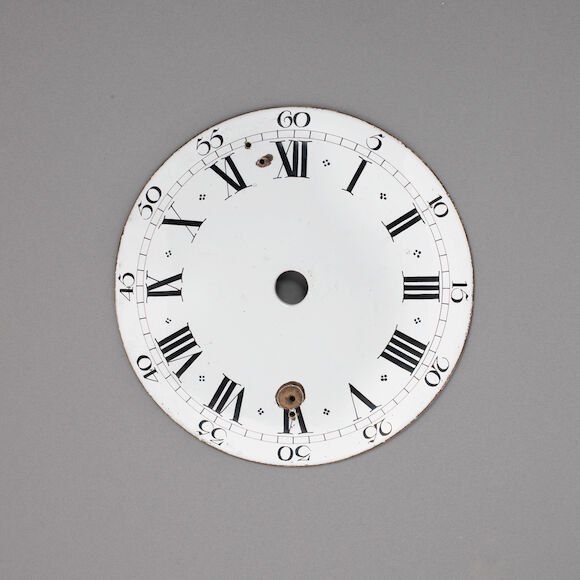
This late 18th-century British delftware clock dial plate features a convex circular ceramic form measuring 24.2 cm in diameter. The dial surface is decorated in manganese pigment, presenting an inner chapter of bold Roman numerals for hours alongside an outer track of five-minute Arabic numerals. It includes a centrally pierced hole with secondary small piercings noted to be later additions. The reverse is inscribed with the marking FN3.

Front view of the convex circular delftware clock dial plate showing manganese numerals and central arbor hole
Front view of the convex circular delftware clock dial plate showing manganese numerals and central arbor hole — Bonhams. Rights pending — permission not yet requested. Original source

Catalogue identity

Source
www.bonhams.com
Category
Component · Clock dial plate
Maker / attribution
Not established
Reference
Not recorded
Catalogue / lot identifier
11
Source-reported date
late 18th century
Country
United Kingdom

Source-reported attribution and specifications are not independent authentication. A listing does not establish present ownership, current display, availability or permission to reproduce.

Object description

Object Type and Physical Form

Catalogued as a British delftware clock dial plate dating to the late 18th century, the item has a circular form measuring 24.2 cm in diameter with a convex surface profile.

Visual observation records a convex circular white tin-glazed ceramic dial with manganese numerals and minute track. Minor rim chipping and edge wear are visible along the border, corresponding with the cataloguer's note of '(some rim chips)'.

Evidence for this section
  • “A British delftware clock dial plate, late 18th century”
  • “The convex circular dial painted in manganese with Roman and Arabic numerals”
  • “24.2cm diam”
  • “(some rim chips)”
  • “Convex circular white tin-glazed ceramic dial with manganese numerals and minute track”
  • “Visible minor rim chipping and edge wear along the ceramic border”

Dial Layout and Apertures

The dial face is painted in manganese pigment featuring Roman numerals for the hour chapter and Arabic numerals for five-minute intervals.

The plate is pierced in the centre, accompanied by secondary small perforations noted by the auction house to have been pierced later. Direct observation notes a central winding or arbor aperture with smaller secondary perforations located near XII and VI.

Evidence for this section
  • “The convex circular dial painted in manganese with Roman and Arabic numerals”
  • “pierced in the centre and with further small holes pierced later”
  • “Central winding/arbor aperture with smaller secondary perforations near XII and VI”

Reverse Inscription and Comparative Literature

The back of the dial plate is reported by the auction catalogue to be 'inscribed FN3 on the back', though this mark is not visible in the provided front-facing photograph.

The auction catalogue lists comparative delftware dials, citing an example published in Leslie Grigsby's The Longridge Collection (2000, fig P431), another exhibited in Sampson and Horne's 2007 exhibition (catalogue fig 07/24), and one from the Sampson and Horne Collection sold at Bonhams London on 28 April 2010 (lot 432).

Evidence for this section
  • “inscribed FN3 on the back”
  • “For a similar example, see Leslie Grigsby, The Longridge Collection (2000), fig P431.”
  • “Another was exhibited in Sampson and Horne's exhibition 2007, catalogue fig 07/24.”
  • “Another from the Sampson and Horne Collection was sold in these rooms on 28 April 2010, lot 432”

Open research questions

  • What specific purpose or attachment method did the later-pierced small holes near XII and VI serve (e.g., dial feet pins or clock-case bracket screws)?
  • Does the inscription 'FN3' represent a potter's mark, factory order code, or subsequent collector/dealer inventory notation?
  • Does the reverse retain remnants of ceramic studs or mounting lugs indicating how the dial originally fastened to a clock movement?

Source evidence

Recorded claims and source quotations for British delftware clock dial plate
FieldSource-reported valueSource quotation
Material and OriginBritish delftware“A British delftware clock dial plate”
DateLate 18th century“late 18th century”
DecorationPainted in manganese with Roman and Arabic numerals“painted in manganese with Roman and Arabic numerals”
Dimensions24.2 cm diameter“24.2cm diam”
Inscribed MarkFN3 on reverse“inscribed FN3 on the back”
Auction ResultSold for £1,750 inc. premium on 2 November 2011“2 November 2011, 10:30 GMT London, New Bond Street Sold for £1,750 inc. premium”
Comparative ReferencesGrigsby (2000) fig P431; Sampson & Horne (2007) fig 07/24; Bonhams 28 April 2010, lot 432“For a similar example, see Leslie Grigsby, The Longridge Collection (2000), fig P431. Another was exhibited in Sampson and Horne's exhibition 2007, catalogue fig 07/24. Another from the Sampson and Horne Collection was sold in these rooms on 28 April 2010, lot 432”

Visible details

  • Convex circular white tin-glazed ceramic dial with manganese numerals and minute track
  • Central winding/arbor aperture with smaller secondary perforations near XII and VI
  • Visible minor rim chipping and edge wear along the ceramic border

Research qualifications

  • Source notes subsequent small holes were pierced later
  • Condition includes some rim chips as reported by the auction house
  • Reverse inscription FN3 is not visible in the provided image

Photograph identity and source facts were screened before import; rights clearance remains pending.

Consulted source

Bonhams : A British delftware clock dial plate, late 18th century

Reviewed 2026-10-21 · Record b0d06aa975

Terms in this record

Glossary explanations for terms named in this object’s record.