
Skip to content
The Encyclopedia of Horology

Clock · Skeleton clock

Brighton Pavilion Skeleton Clock

Partially verified

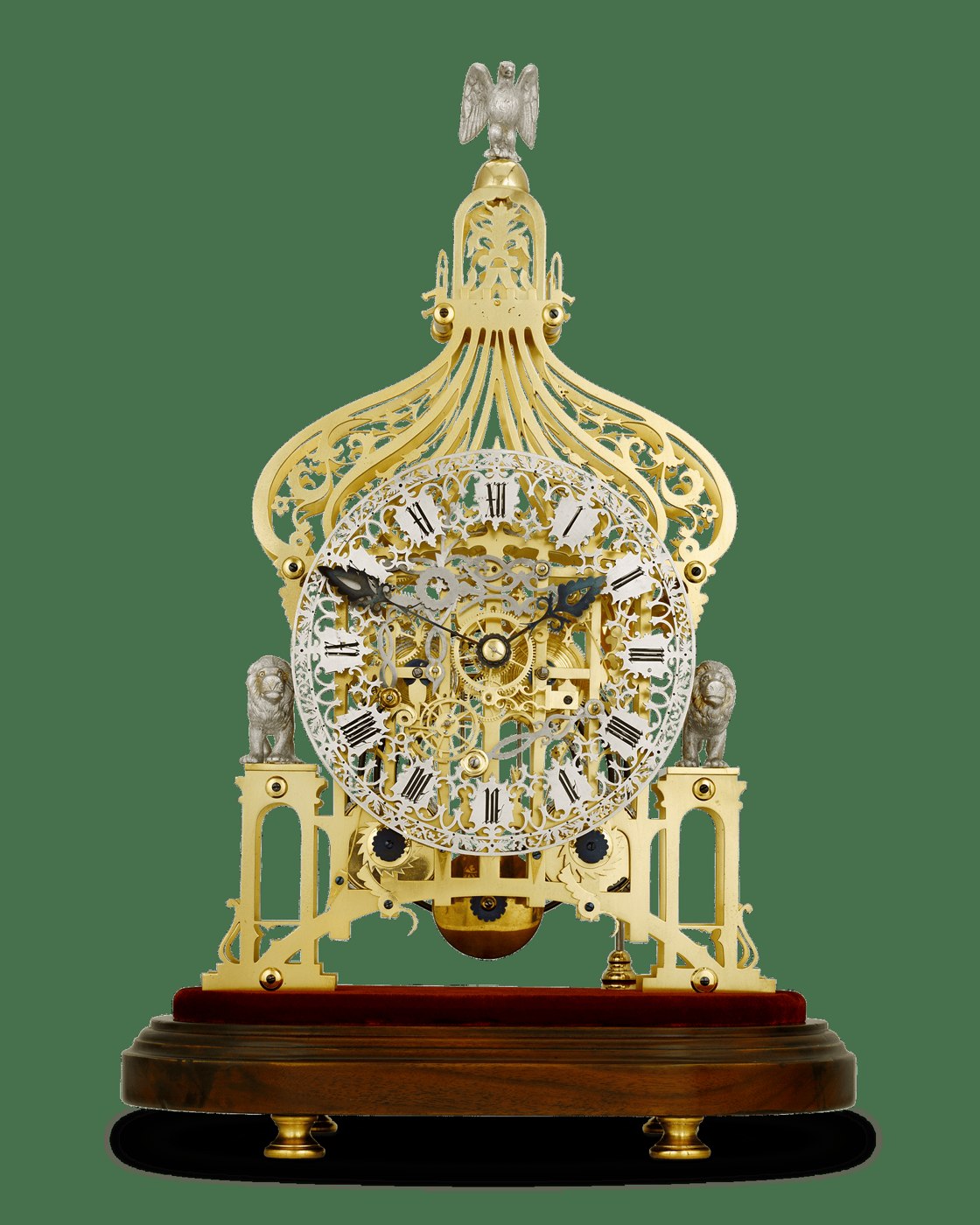
This Victorian brass skeleton clock is attributed to the maker J. Smith & Sons of Clerkenwell, circa 1890. The design of the frame draws visual reference from the dome of the Brighton Pavilion in England. The clock features a complex 8-day, two-train fusée movement, which powers the striking mechanism for the hour and half-hour. The time is displayed on an elaborately pierced dial featuring black Roman numerals. The entire assembly is presented on a red velvet plinth and is intended to be displayed beneath a glass dome. As a skeleton clock, the timepiece is engineered to expose the internal working mechanisms, reflecting a design focus on the clock's technological components. The dimensions of the piece are 23 inches high, 15 1/4 inches wide, and 9 inches deep.

Front view of the J. Smith & Sons skeleton clock displaying the ornate brass frame and Brighton Pavilion-inspired dome structure.
Front view of the J. Smith & Sons skeleton clock displaying the ornate brass frame and Brighton Pavilion-inspired dome structure. — M.S. Rau. Rights pending — permission not yet requested. Original source

Catalogue identity

Source
rauantiques.com
Category
Clock · Skeleton clock
Maker / attribution
J. Smith & Sons
Reference
Not recorded
Catalogue / lot identifier
Source URL identifies the listing
Source-reported date
circa 1890
Source-reported place
England

Source-reported attribution and specifications are not independent authentication. A listing does not establish present ownership, current display, availability or permission to reproduce.

Object description

Design and Construction

The clock is constructed from brass and incorporates architectural elements modeled after the dome of the Brighton Pavilion. The structure is characterized by its skeletonized frame, which exposes the movement to view, and includes decorative cast metal components such as an eagle ornament at the apex and two lions positioned at the base of the dial structure.

The timepiece is mounted on a red velvet plinth and includes a custom glass dome for display. The overall composition balances the intricate, pierced metalwork of the frame with the substantial architectural references, creating a visual focus on the mechanics of the movement.

Evidence for this section
  • “Taking the form of the decadent Brighton Pavilion, this Victorian brass skeleton clock”
  • “The shape itself resembles the dome of the famed Brighton Pavilion”
  • “Set upon a red velvet plinth beneath its custom glass dome”

Movement and Dial

The movement is an 8-day, two-train fusée design, engineered to provide power for both timekeeping and the striking train. This arrangement allows the clock to sound on the hour and the half-hour. The movement is visible through the frame, consistent with the design goals of skeleton clocks produced in the 19th century.

The dial is elaborately pierced and serves as the primary face for the Roman numerals. It is integrated into the center of the brass frame, allowing for visibility of the gear train behind it.

Evidence for this section
  • “operates thanks to its complex 8-day, two-train fusée movement, which allows it to strike on the hour and half hour”
  • “It indicates the time on an elaborately pierced dial with black Roman numerals”

Attribution and History

The clock is identified by the vendor as being the work of J. Smith & Sons of Clerkenwell. The company was active in London during the 19th century, a period when English clockmakers produced significant examples of skeleton timepieces.

The vendor references the publication 'Skeleton Clocks, Britain 1800-1914' by Derek Roberts as containing similar examples, establishing the object within the broader context of British clockmaking of this era.

Evidence for this section
  • “Crafted by the famed J. Smith & Sons of Clerkenwell”
  • “Similar clocks are featured on pages 72-74 of Skeleton Clocks, Britain 1800-1914 by Derek Roberts.”

Open research questions

  • Does the clock carry a signature or maker's mark on the movement plates?
  • Are there records confirming specific commissions of Brighton Pavilion-themed skeleton clocks by J. Smith & Sons?

Source evidence

Recorded claims and source quotations for Brighton Pavilion Skeleton Clock
FieldSource-reported valueSource quotation
MakerJ. Smith & Sons“Crafted by the famed J. Smith & Sons of Clerkenwell”
Datecirca 1890“Circa 1890”
MaterialBrass“Victorian brass skeleton clock”
Dimensions23" high x 15 1/4" wide x 9" deep“23" high x 15 1/4" wide x 9" deep”
Movement Type8-day, two-train fusée“complex 8-day, two-train fusée movement”
FunctionsStrikes on the hour and half hour“allows it to strike on the hour and half hour”

Visible details

  • Features a metallic eagle figure mounted atop the central dome
  • Includes two metallic lion figures standing on rectangular platforms flanking the dial
  • Dial is heavily pierced with a decorative filigree pattern
  • Clock is displayed on a red velvet covered base with brass feet

Research qualifications

  • The exact attribution to J. Smith & Sons is reported by the vendor but not verified by independent marks shown
  • The clock's operational capacity is stated in the listing but not verified here

Photograph identity and source facts were screened before import; rights clearance remains pending.

Consulted source

ساعت اسکلتون پاویلیون برایتون؛ اسمیت

Reviewed 2026-11-02 · Record ca5150a7cb

Terms in this record

Glossary explanations for terms named in this object’s record.