
Skip to content
The Encyclopedia of Horology

Tool · Rounding-up tool

19th-Century Watch and Clock Wheel Rounding Machine

Partially verified

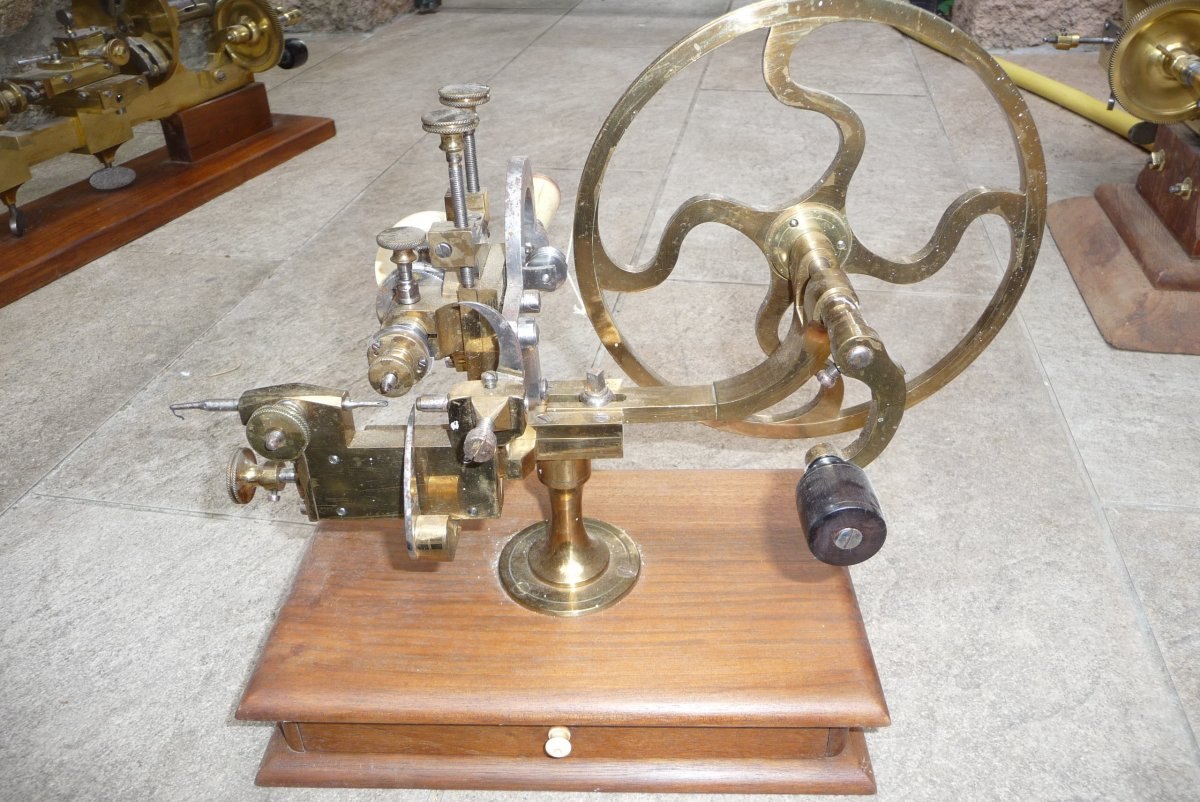
This horological tool is a 19th-century rounding-up machine intended for rounding the teeth of watch and clock wheels after cutting. Constructed of brass and steel components, the apparatus is supported on a turned brass pedestal mounted atop a rectangular wooden base fitted with a lower drawer. It incorporates a large hand-cranked brass drive wheel with curved spokes, an adjustable carriage assembly, vertical knurled adjustment thumbscrews, and handles described by the seller as ivory.

Full view of the brass wheel rounding tool mounted on its wooden base with drawer
Full view of the brass wheel rounding tool mounted on its wooden base with drawer — Luc Baudry / Proantic. Rights pending — permission not yet requested. Original source

Catalogue identity

Source
www.proantic.com
Category
Tool · Rounding-up tool
Maker / attribution
Not established
Reference
645020
Catalogue / lot identifier
Source URL identifies the listing
Source-reported date
19th century
Country
Not established

Source-reported attribution and specifications are not independent authentication. A listing does not establish present ownership, current display, availability or permission to reproduce.

Object description

Identity and Functional Context

The catalogued object is described by the source as a "machine for rounding the wheels of watches and clocks from the 19th century". According to the seller listing, the tool's intended workshop role was post-cutting wheel finishing: "It allowed the teeth of watch or clock wheels to round, after cutting."

The seller also notes that "This beautiful machine was used regularly by the watchmaker who owned it." However, no specific watchmaker name, maker signature, or workshop location is recorded in the source text.

Evidence for this section
  • “Very nice machine for rounding the wheels of watches and clocks from the 19th century.”
  • “It allowed the teeth of watch or clock wheels to round, after cutting.”
  • “This beautiful machine was used regularly by the watchmaker who owned it.”

Visible Physical Construction

Visible observation shows a "Central turned brass pedestal support fixed to a rectangular wooden plinth with an integrated front drawer and small pull knob." This mounting raises the brass mechanism above the bench surface.

Mounted to the standard is a "Large brass hand wheel featuring curved, wave-form spokes and an attached crank with dark turning grip." Adjacent to the drive wheel is a "Complex brass and steel carriage assembly fitted with dual vertical knurled thumbscrews, horizontal arbors, and pale turned adjustment handles."

Evidence for this section
  • “Central turned brass pedestal support fixed to a rectangular wooden plinth with an integrated front drawer and small pull knob.”
  • “Large brass hand wheel featuring curved, wave-form spokes and an attached crank with dark turning grip.”
  • “Complex brass and steel carriage assembly fitted with dual vertical knurled thumbscrews, horizontal arbors, and pale turned adjustment handles.”

Reported Accessories and Source Limitations

The listing documentation states that the machine includes "its ivory handles, and all its strawberries and cleats." The term "strawberries" represents a literal translation of the French horological term "fraises" (circular rounding-up cutters).

The drawer is visible only in its closed position in the primary photograph, meaning the reported cutters and cleats cannot be visually verified from this image. Furthermore, the identification of the handle material as ivory is an unverified dealer assertion.

Evidence for this section
  • “With its drawer, its ivory handles, and all its strawberries and cleats.”

Open research questions

  • Are any maker marks, stamps, or regional numbering present on the brass casting, arbors, or underside of the base?
  • What specific sizes, module numbers, and profiles of rounding-up cutters ('strawberries') and cleats are housed in the drawer?
  • Can the material of the pale turned handles be scientifically tested to verify ivory rather than bone or a composite material?

Source evidence

Recorded claims and source quotations for 19th-Century Watch and Clock Wheel Rounding Machine
FieldSource-reported valueSource quotation
Tool functionRounding watch and clock wheel teeth“machine for rounding the wheels of watches and clocks”
Era19th century“from the 19th century”
Handle materialIvory“its ivory handles”
Base featureBase with drawer“With its drawer”
Reported accessoriesCutters ("strawberries") and cleats“all its strawberries and cleats”
Operational functionRounding teeth of watch or clock wheels after cutting“It allowed the teeth of watch or clock wheels to round, after cutting”

Visible details

  • Large brass hand wheel featuring curved, wave-form spokes and an attached crank with dark turning grip.
  • Central turned brass pedestal support fixed to a rectangular wooden plinth with an integrated front drawer and small pull knob.
  • Complex brass and steel carriage assembly fitted with dual vertical knurled thumbscrews, horizontal arbors, and pale turned adjustment handles.

Research qualifications

  • The drawer contents, mentioned in the listing as milling cutters ('strawberries') and cleats, are not displayed open in the primary image.
  • Maker name, workshop stamps, and precise regional origin are not recorded in the source documentation.

Photograph identity and source facts were screened before import; rights clearance remains pending.

Consulted source

Proantic: Machine Rounding The Wheels Of Watches And Clocks XIXth.

Reviewed 2026-10-21 · Record b806217a88

Terms in this record

Glossary explanations for terms named in this object’s record.

Other rounding-up tool records