
Skip to content
The Encyclopedia of Horology

Clock · Mantel clock

19th century French ormolu and Sevres-style mantel clock

Partially verified

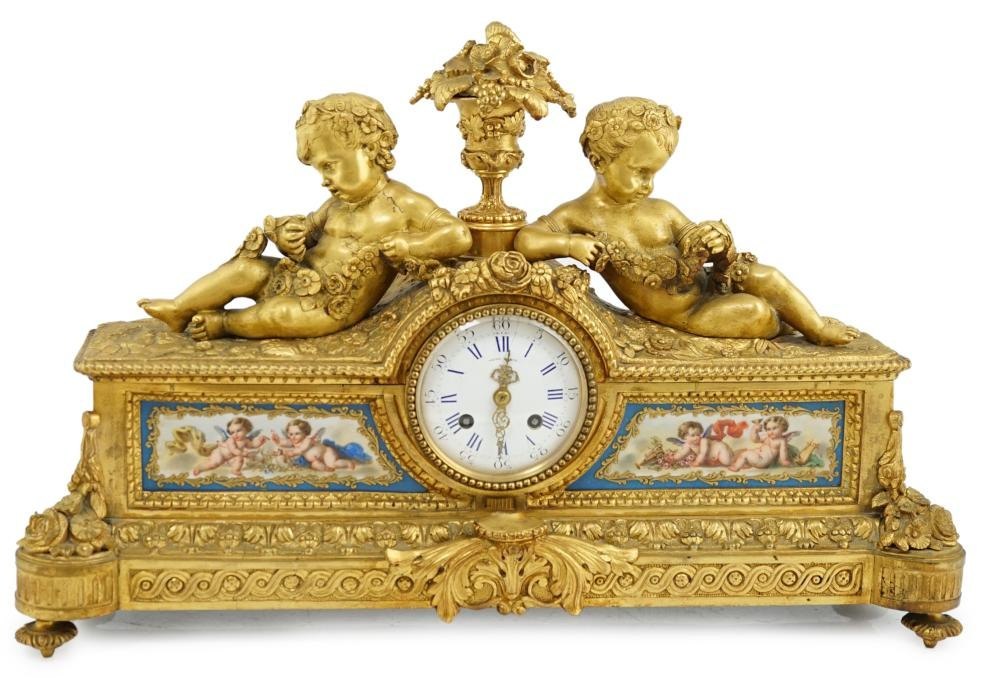
This 19th-century French mantel clock features an ornate ormolu casing complemented by Sevres-style porcelain panels. The sculptural design is centered around two reclining putti figures positioned beside a central flowering urn, which surmounts the clock face. The dial is enamelled with Roman numerals and is signed with the inscription 'Prize Medal 1851'. Below the dial, the clock base incorporates decorative porcelain plaques depicting amorini against a blue ground. The mechanical construction is an eight-day countwheel movement, produced by Japy Freres and additionally stamped by Miroy Freres with the mark 'Etablissement de Paris'. The clock stands on a detailed ormolu base with foliate and scroll motifs. Included are a pendulum and an associated winding key. Dimensions are 52cm in width, 13.5cm in depth, and 33cm in height.

The mantel clock, showing the central urn, two putti figures, enamel dial with Roman numerals, and porcelain panels with amorini on a blue ground.
The mantel clock, showing the central urn, two putti figures, enamel dial with Roman numerals, and porcelain panels with amorini on a blue ground. — Gorringes, via Invaluable. Rights pending — permission not yet requested. Original source

Catalogue identity

Source
orbiscollectibles.com
Category
Clock · Mantel clock
Maker / attribution
Japy Freres and Miroy Freres
Reference
Not recorded
Catalogue / lot identifier
Source URL identifies the listing
Source-reported date
19th century
Source-reported place
France

Source-reported attribution and specifications are not independent authentication. A listing does not establish present ownership, current display, availability or permission to reproduce.

Object description

Casing and Decorative Elements

The clock is constructed with an ormolu casing which features detailed foliate and scroll motifs across its base. The design is characterized by a central flowering urn positioned between two reclining putti figures. These sculptural elements are prominently displayed at the top of the main clock housing.

The lower section of the case incorporates Sevres-style porcelain panels. These plaques are positioned beneath the dial and display decorative depictions of amorini set against a blue ground. The overall structure combines these metalwork and porcelain features to establish the object's ornamental appearance.

Evidence for this section
  • “ornate ormolu casing complemented by Sevres-style porcelain panels”
  • “clock base incorporates decorative porcelain plaques depicting amorini against a blue ground”
  • “stands on a detailed ormolu base with foliate and scroll motifs”

Movement and Dial

The timepiece is driven by an eight-day countwheel movement. This movement was manufactured by Japy Freres and carries a secondary stamp from Miroy Freres, identifying the object with the mark 'Etablissement de Paris'.

The dial is finished with enamelled surfaces and features Roman numerals for the hour markers. The face includes the inscription 'Prize Medal 1851', relating to the manufacturing period of the clock. A pendulum and an associated winding key are provided with the unit.

Evidence for this section
  • “eight-day countwheel movement, produced by Japy Freres”
  • “additionally stamped by Miroy Freres with the mark 'Etablissement de Paris'”
  • “dial is enamelled with Roman numerals and is signed with the inscription 'Prize Medal 1851'”

Technical Dimensions

The physical footprint of the clock is recorded as 52cm in width and 13.5cm in depth. The height of the clock is 33cm, incorporating the full structure from the base to the top of the ornamental urn.

The assembly includes both the primary clock mechanism and the accessory components required for operation, specifically the pendulum and winding key. These dimensions define the space occupied by the object in its entirety.

Evidence for this section
  • “52cm in width, 13.5cm in depth, and 33cm in height”
  • “It includes its pendulum and an associated winding key”

Open research questions

  • What was the specific commercial relationship between the manufacturing firms Japy Freres and Miroy Freres for this clock?
  • To what extent do the 'Prize Medal 1851' marks correlate to the specific date of manufacture for this movement type?

Source evidence

Recorded claims and source quotations for 19th century French ormolu and Sevres-style mantel clock
FieldSource-reported valueSource quotation
MakerJapy Freres, Miroy Freres“produced by Japy Freres and additionally stamped by Miroy Freres”
MovementEight-day countwheel“eight-day countwheel movement”
Dial InscriptionPrize Medal 1851“signed with the inscription 'Prize Medal 1851'”
Dimensions52cm x 13.5cm x 33cm“52cm in width, 13.5cm in depth, and 33cm in height”
MaterialsOrmolu and porcelain“ornate ormolu casing complemented by Sevres-style porcelain panels”
StampsEtablissement de Paris“additionally stamped by Miroy Freres with the mark 'Etablissement de Paris'”

Visible details

  • Two reclining putti figures flank a central urn atop the clock.
  • Enamelled clock face features Roman numerals.
  • Base includes porcelain plaques with amorini imagery.
  • Ormolu casing includes scroll and foliate motifs.

Research qualifications

  • The source categorizes the dating as 'Probable' and implies the evidence status is 'partial'.
  • The specific nature of the association between Japy Freres and Miroy Freres is not explicitly defined in the source text.

Photograph identity and source facts were screened before import; rights clearance remains pending.

Terms in this record

Glossary explanations for terms named in this object’s record.